Face-Turning Octahedron (FTO)
History, Mathematics, Notation, Solution and How It Works
The Face-Turning Octahedron, usually shortened to FTO, is an eight-faced twisty puzzle built on octahedral geometry. It is an old puzzle with a surprisingly modern story: related designs appeared during the first Rubik's Cube boom, but FTO speedsolving only became widely accessible after the arrival of stable magnetic models in 2024. The World Cube Association has selected it to be its new official event starting from 2027. The latest puzzle was Skewb, added in 2014.
This guide explains what an FTO is, how its pieces move, where it came from, why its centers behave in two separate groups, how its enormous number of positions is calculated, and how to read FTO notation. The illustrated beginner solution will be added as a separate section.
What Is a Face-Turning Octahedron?
An octahedron is a solid with eight triangular faces, twelve edges and six vertices. A Face-Turning Octahedron converts that geometry into a mechanical combination puzzle: each of its eight faces can rotate independently around the center of that face.
The familiar Rubik's Cube is based on a cube and uses quarter turns of 90 degrees. An FTO face has threefold rotational symmetry, so a normal face turn is 120 degrees. Three turns of the same face return it to its starting position.
Calling the FTO an “eight-sided Rubik's Cube” gives beginners a useful first impression, but the comparison is incomplete. The FTO has different piece orbits, different parity restrictions and a very different visual recognition problem. Solvers must track triangular centers and unusual three-piece cycles rather than square layers arranged on six faces.
Corners, Edges and Center Triangles
The FTO has 42 visible movable elements. They belong to three piece types. Different guides sometimes call the six three-colored pieces “vertices” and sometimes “corners.” Both terms refer to the same pieces.
The six corners
Each corner occupies one of the six vertices of the octahedron and displays three colors. These pieces provide a useful reference for the puzzle's color scheme because the colors meeting around an edge or center must agree with the neighboring corners.
The twelve edges
Each edge displays two colors. Unlike a 3×3 Rubik's Cube edge, an FTO edge does not have an independently variable flip state in the mathematical position count. Once an edge is moved to a particular location, its visible orientation is determined by that location.
The twenty-four center triangles
The centers are the most visually distinctive FTO pieces. There are three same-colored center triangles on each of the eight faces, giving 24 centers in total. Internally, however, they do not form one interchangeable set. They are divided into two separate orbits of twelve pieces. A center belonging to one orbit can never move into the other orbit through legal face turns.
How the FTO Mechanism Works
The layer belonging to one face has the same thickness as the layer belonging to the opposite face, with a middle region between them. These cutting planes meet at the center of each triangular face. That is why every face contains several triangular center pieces rather than one fixed center like a standard 3×3 cube.
Jaap Scherphuis points out a useful geometric relationship: if the FTO's cuts were made deeper until the middle layers disappeared, the resulting puzzle would have the geometry of a Skewb Diamond.
What moves during one face turn?
A 120-degree face turn cycles several corners, edges and centers around the selected triangular face. Because the same turn repeated three times is the identity, FTO algorithms are built largely from three-cycles and commutators. This is one reason short repeated sequences can move only a small group of pieces while restoring the rest of the puzzle.
History of the Face-Turning Octahedron
The FTO is often perceived as a new puzzle because its mainstream popularity is recent. Its underlying concept, however, reaches back to the beginning of the 1980s, shortly after the Rubik's Cube became an international phenomenon.
Who invented the FTO?
There is no simple single-name answer. Several inventors developed related octahedral face-turning concepts independently or in overlapping periods. Rubik's early proposal was not identical to the modern FTO. Hewlett, Rohrbach, Xie and Pitcher later contributed patents, prototypes or mechanisms, but the available historical record does not establish one uncontested inventor of the first fully functional modern puzzle.
The most accurate description is that the modern FTO emerged through a sequence of related inventions rather than from one commercially successful original model.
Why the FTO Suddenly Became Popular
For many years, the main obstacle was not a lack of solving ideas but a lack of good hardware. Older FTOs could be difficult to turn quickly, unstable or hard to obtain. Dedicated enthusiasts continued to develop methods, but the puzzle remained a specialist event.
Interest grew during the late 2010s and the COVID-19 pandemic as tutorials, online rankings and the FTO Fan Club community gave solvers a place to compare methods and times. The RexTO conversion then offered improved performance, although it required modified hardware rather than a standard competition-ready product.
The decisive shift came in 2024. The magnetic DianSheng FTO M brought modern speedcube features to the puzzle, including magnets, improved stability and better turning. Other manufacturers followed with additional magnetic and ball-core designs. Retailers reported demand far beyond the puzzle's previous niche audience, and Cuboss described FTO as the standout puzzle of 2024.
How Many Positions Does an FTO Have?
The FTO has exactly:
That is approximately 31.4 sextillion states. The calculation begins by pretending that every piece can be arranged independently, then removes arrangements that cannot occur or that look identical.
1. Start with an unrestricted upper bound
The six corners can be permuted in 6! ways and each appears to have two possible orientations. The twelve edges can be permuted in 12! ways. The two center orbits each contain twelve pieces, so they initially contribute two more factors of 12!.
2. Apply the legal-move restrictions
3. The simplified formula
The factor for whole-puzzle orientation is 12 rather than 24. Once one unique corner or edge is fixed, an octahedron has twelve relevant orientations for that piece.
A two-color thought experiment
One of the clearest ways to understand the FTO's constraints is to imagine painting its faces with two alternating colors so that adjacent faces always differ. Legal turns preserve this pattern. It immediately reveals three important facts:
- Corners have only two possible orientations.
- Edges have no independent orientation coordinate.
- The 24 centers belong to two groups that never mix.
This simple coloring argument explains much of the puzzle's deeper group structure without requiring advanced algebra.
Face-Turning Octahedron Notation
FTO notation is based on the same basic idea as cube notation: a letter identifies a face, and an apostrophe reverses the direction. The geometry and holding position must be explained carefully because each turn is 120 degrees and some visible faces meet only at a vertex.
Standard holding position
Hold the puzzle with one triangular face on top. Its three corners point toward the back, left and right. The upper face is U. The visible faces are labeled L, F and R. The F face shares a complete edge with U, while L and R meet the upper face at vertices. The face opposite U is D.
Clockwise is judged from the face being turned
A move such as R means a clockwise 120-degree rotation while looking directly at the right face. R' means a counterclockwise 120-degree turn from the same viewpoint. The viewer's position in a perspective drawing can make an arrow appear reversed, so every illustrated algorithm should identify the active face explicitly.
Why double turns are unusual
On a 3×3 cube, R2 is a distinct half turn. On the FTO, two clockwise turns equal one counterclockwise turn:
For that reason, most FTO tutorials prefer the prime form instead of writing double face turns.
Lowercase and slice notation
Advanced guides may use lowercase letters for internal slices. Jaap's solution, for example, uses r for the inner slice adjacent to the right face. Slice conventions are less universal than the five basic face letters, so any tutorial using them should define the direction with an illustration before the first algorithm.
How FTO Solving Methods Evolved
The puzzle has been solved using several very different strategies. There is no single universally required order for corners, edges and centers.
Classical edges-first approach
Jaap's published solution follows a mathematical three-phase structure: solve all edges, place and orient the six vertices, then solve the centers with controlled cycles. The method is compact and systematic, but it assumes that the solver is comfortable with setup moves and piece cycles.
Corners-first beginner approaches
Other early guides begin with the six corners, then use short clockwise and counterclockwise cycles for edges and centers. Slateblog's notes are an example of this style. Such guides can be easier to memorize, although their informal orientation descriptions require careful reconstruction before the algorithms can be used reliably.
Bencisco and modern speedsolving
Ben Streeter began developing the Bencisco method in 2018 specifically for speed. Its appearance helped move FTO away from occasional puzzle solving and toward systematic timed practice. Later community methods continued to improve efficiency, recognition and lookahead.
The beginner method used in this guide
The illustrated solution that will accompany this article uses a clear layer-by-layer progression:
- Solve the six corners.
- Solve the centers of the first face.
- Complete the first face and bottom layer.
- Solve the middle layer.
- Finish the final layer.
This is not intended to be the fastest competition method. Its purpose is to make every case recognizable, keep the required algorithms short and provide a dependable first solution.
How to Solve a Face-Turning Octahedron
This beginner method solves the FTO in five stages: corners, white centers, the white face, the middle layer and the final layer. It is reconstructed from the QY Toys leaflet and rewritten to make the recognition and holding instructions clearer.
Before You Start
- Use white as the first face and yellow as the opposite face.
- A face turn is 120 degrees. A prime mark means counterclockwise while looking directly at the face being turned.
- Keep the puzzle in the orientation shown in each diagram. The short algorithms will not work as intended from a different angle.
- The diagrams use U, R and L turns.

Three Algorithms Used Throughout the Guide
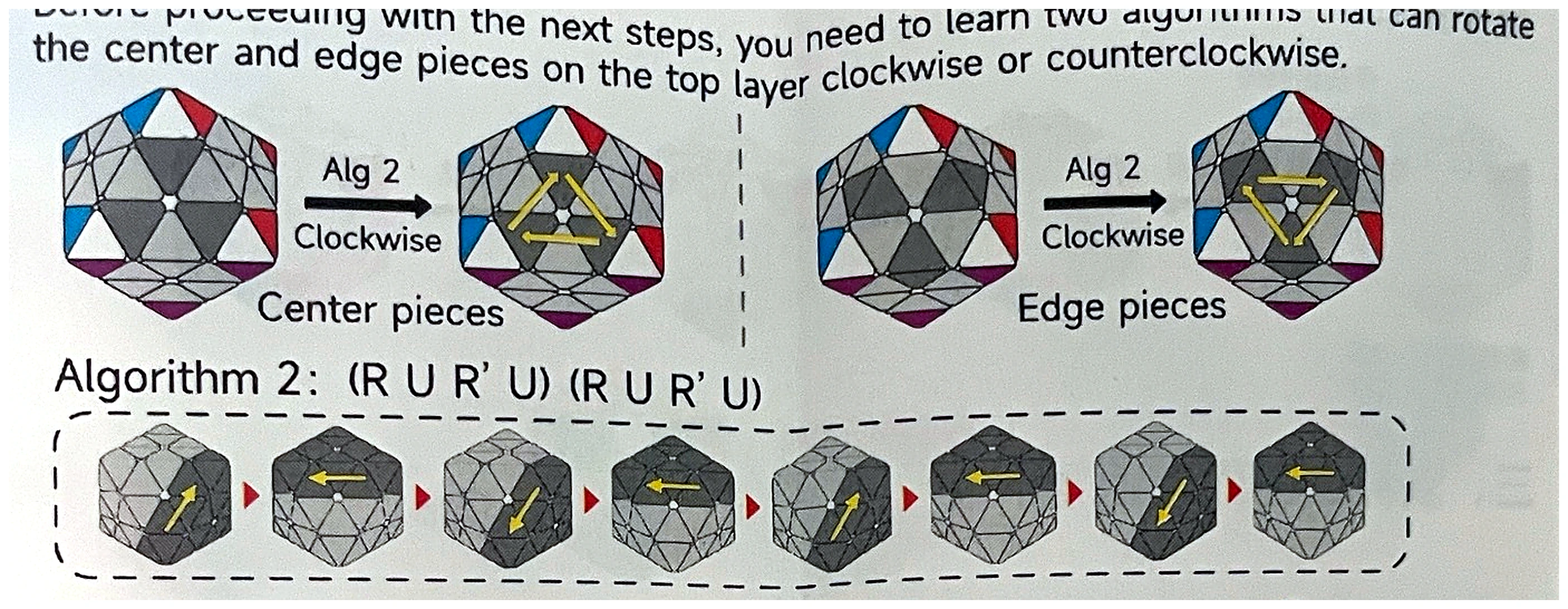
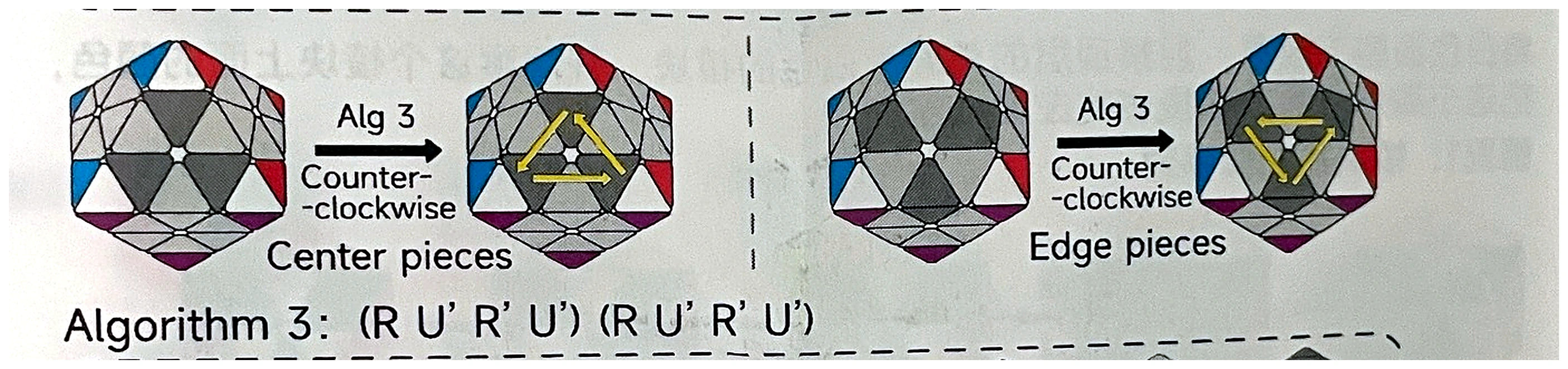
Learn these sequences before solving the centers and edges. Algorithms 2 and 3 cycle pieces around the upper layer in opposite directions.
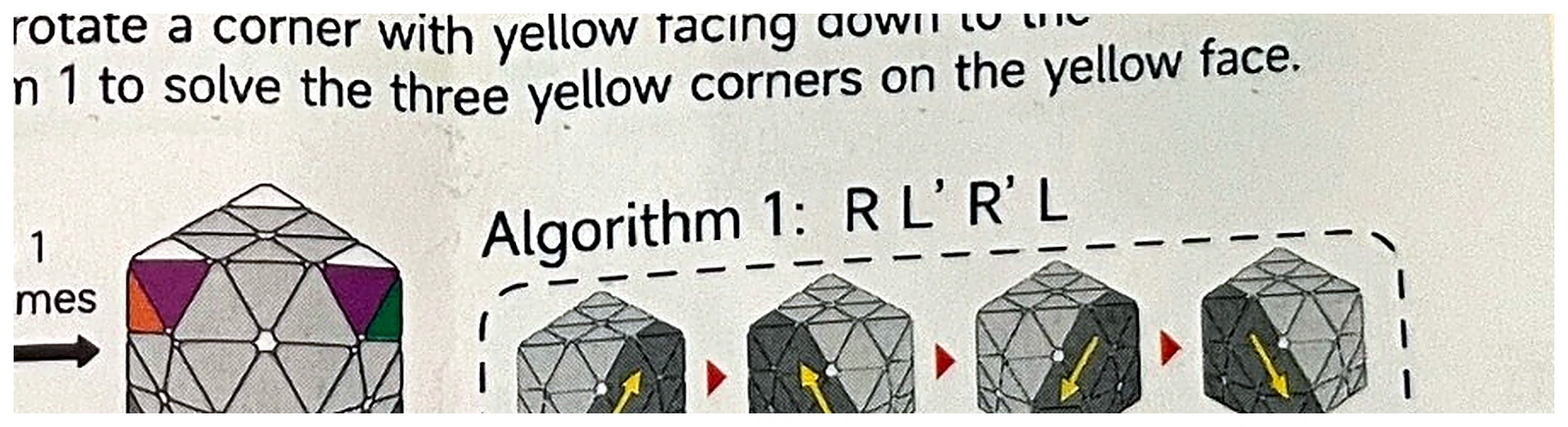
Hold the unsolved yellow corner in the bottom-left working position with its yellow sticker facing downward. Perform the sequence once or twice until yellow faces the yellow side.
This sequence cycles the relevant upper centers and edges clockwise while restoring the main structure of the puzzle.
This is the opposite cycle. It moves the corresponding upper centers and edges counterclockwise.
Step 1: Solve the Six Corners
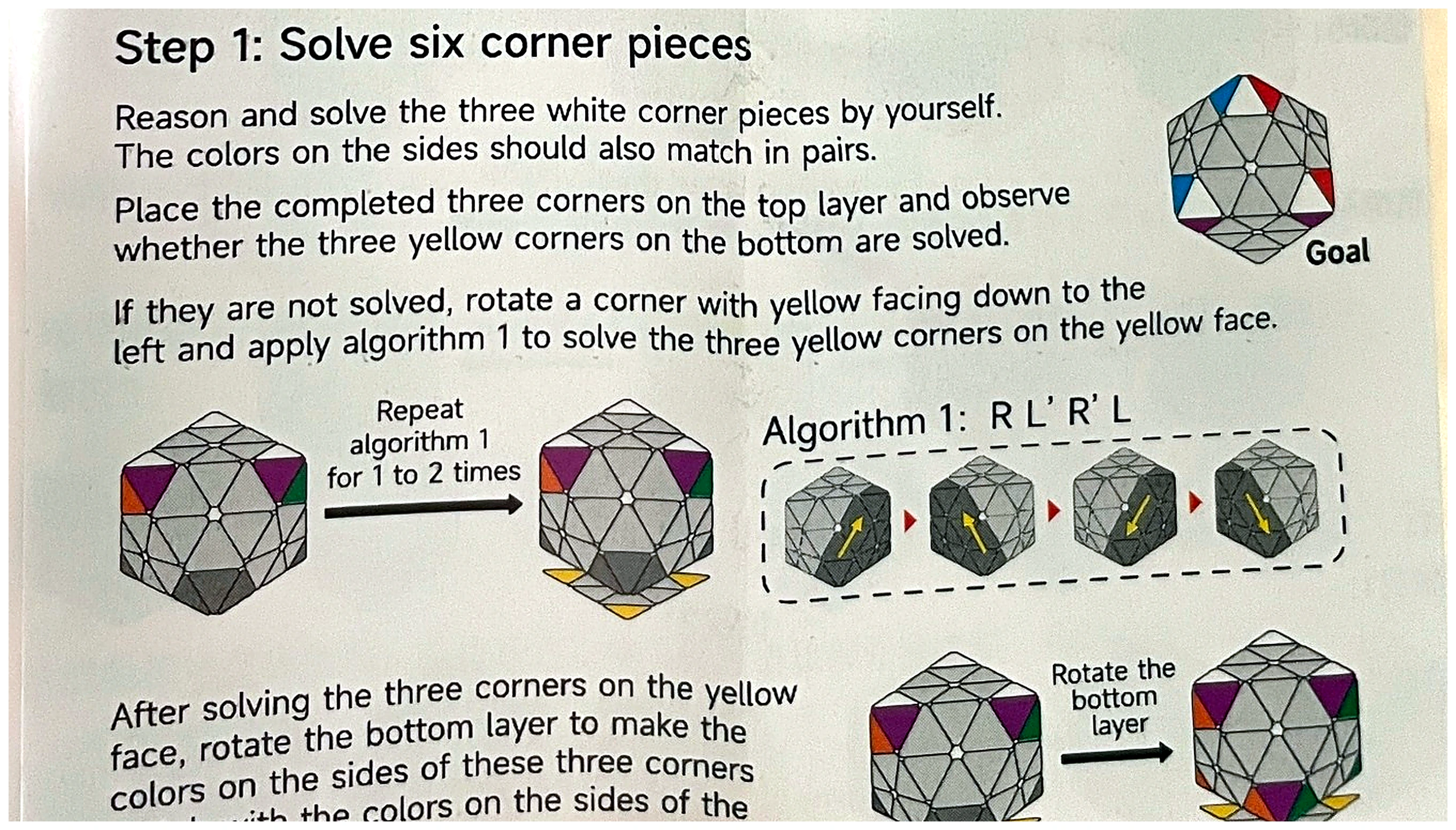
Begin with the three corners containing white. Place them around the white face by inspection. The non-white colors on neighboring corners must also match in pairs; three white stickers on one face are not enough if the side colors are mismatched.
- Solve the three white corners intuitively.
- Hold the completed white corner group on top.
- Inspect the three yellow corners on the bottom.
- When a yellow corner is twisted, place it in the bottom-left working position with yellow facing downward.
- Apply Algorithm 1 once or twice until that corner is oriented.
- Repeat for the other yellow corners.
- Turn the bottom layer until the side colors of the yellow corners line up with the corresponding side colors of the white corners.
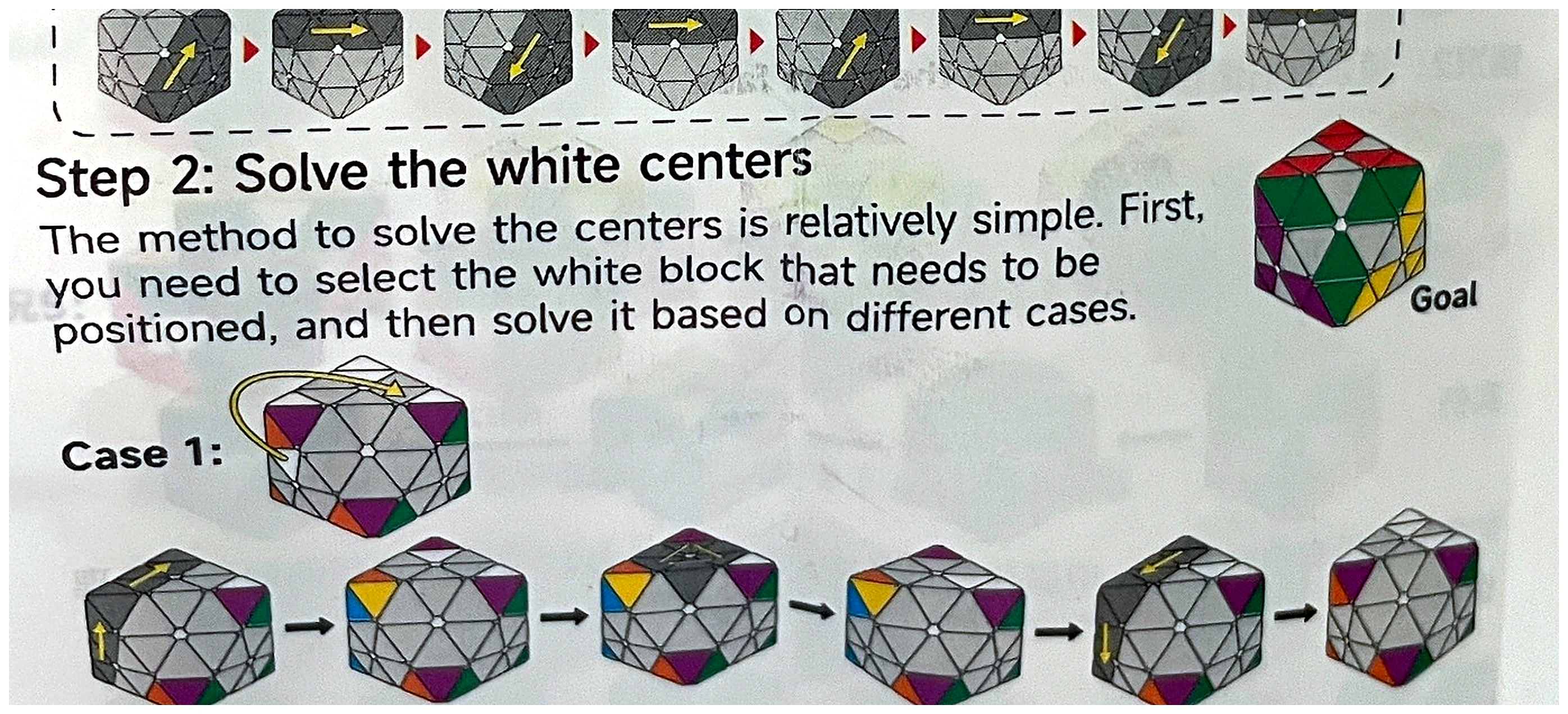
Step 2: Solve the White Centers
Choose one unsolved white center triangle at a time. Before using an algorithm, rotate the puzzle or an unsolved layer so the target center and its destination match one of the illustrated cases.
Case 1
Position the target white center as shown. Follow the setup turns, use the indicated upper-layer cycle, and restore the moved layer. The final diagram shows the white center inserted without breaking the solved corners.
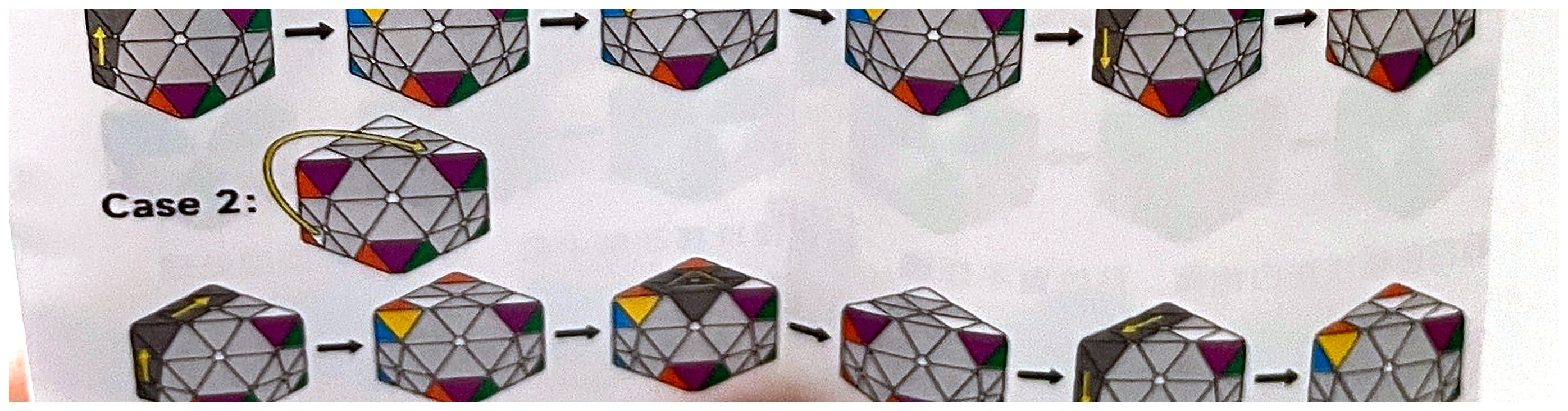
Case 2
Use this case when the target white center approaches its destination from the opposite side. Match the puzzle orientation exactly, then follow the illustrated sequence from left to right.
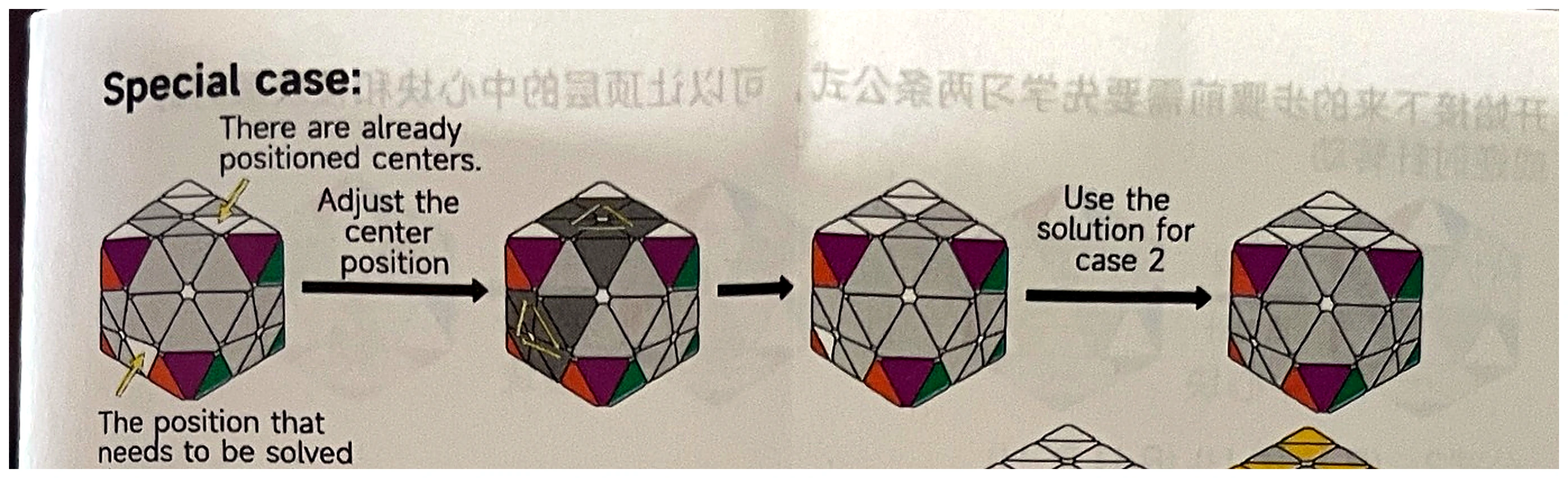
Special Case: Solved Centers Block the Target
Sometimes the unsolved center does not match either standard setup because one or more correctly placed centers occupy the useful positions. Temporarily adjust the center arrangement, create the Case 2 setup, and then use the Case 2 solution.
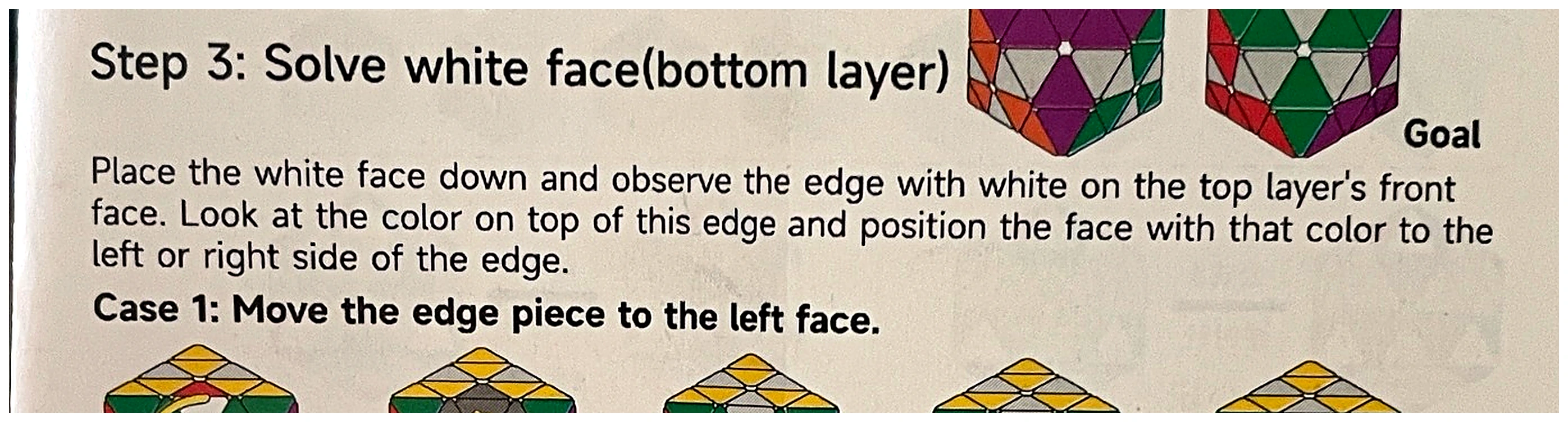
Step 3: Complete the White Face
Turn the puzzle so the white face points downward. You will now insert the three white edges while preserving the solved white corners and centers.
- Find a white edge in the upper layer and bring it to the front working position.
- Look at the edge's second color.
- Turn the upper layer until the face with that color is positioned on the left or right of the edge.
- Use Case 1 when the edge belongs on the left and Case 2 when it belongs on the right.
Case 1: Insert the White Edge to the Left
Match the second color with the face on the left. Follow the setup, apply the clockwise or counterclockwise cycle shown in the center diagram, then undo the setup turn.
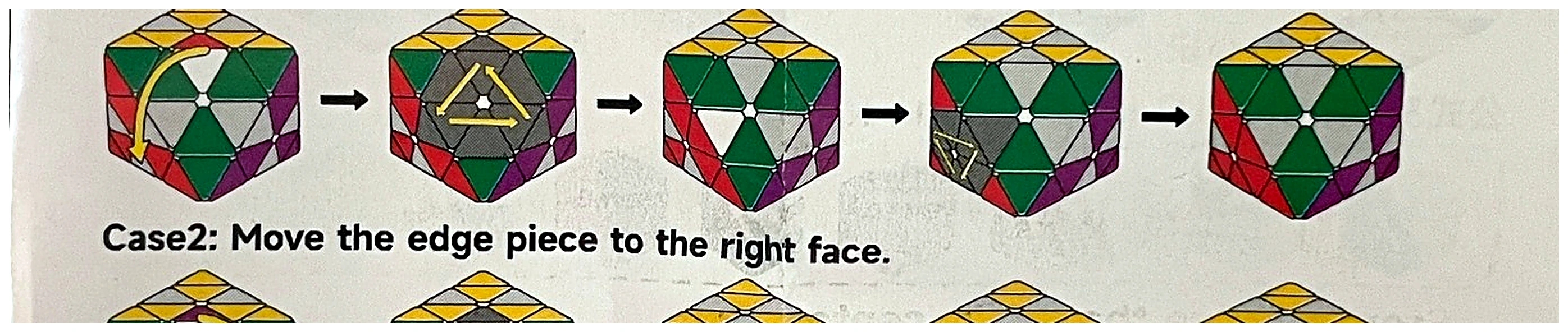
Case 2: Insert the White Edge to the Right
This is the mirrored insertion. Match the edge's second color with the face on the right and follow the illustrated sequence.
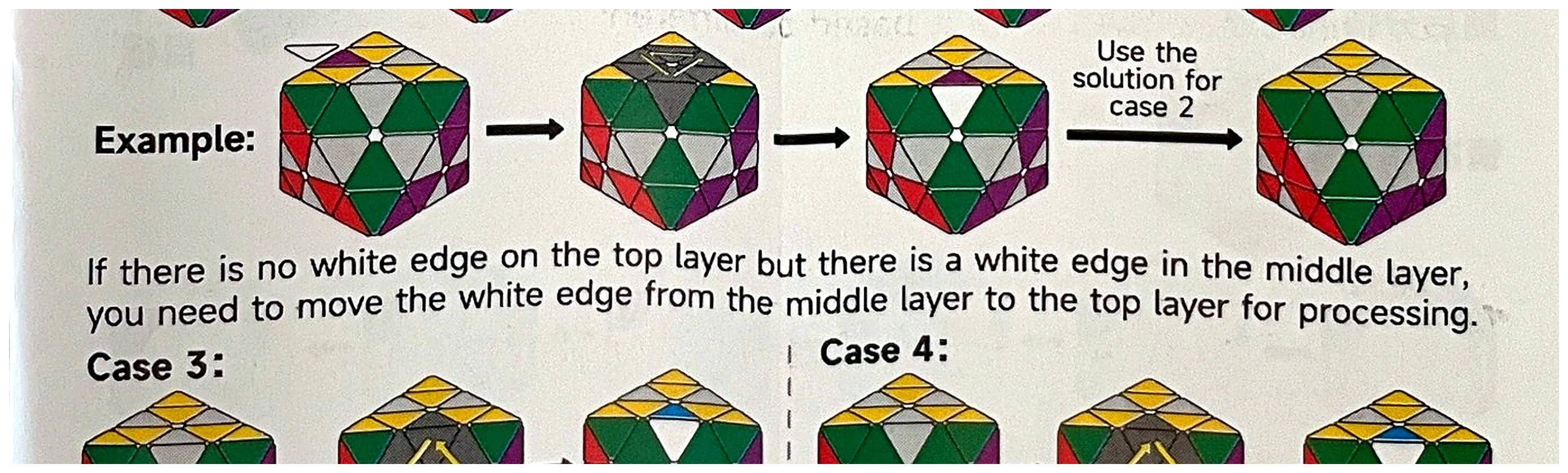
Example: Reposition the Upper Layer First
If the white edge is on top but not in the correct working position, turn the upper layer until its colors match the Case 1 or Case 2 setup. The example converts the state to Case 2.

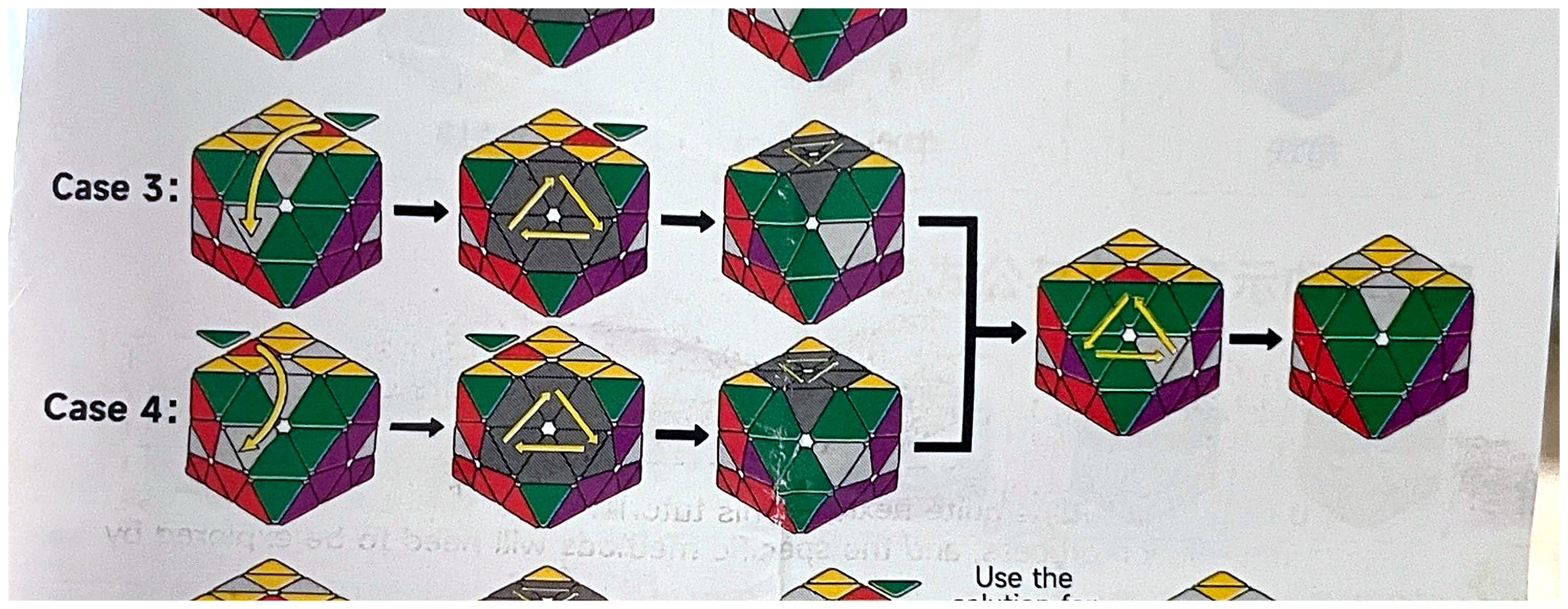
Cases 3 and 4: The White Edge Is in the Middle Layer
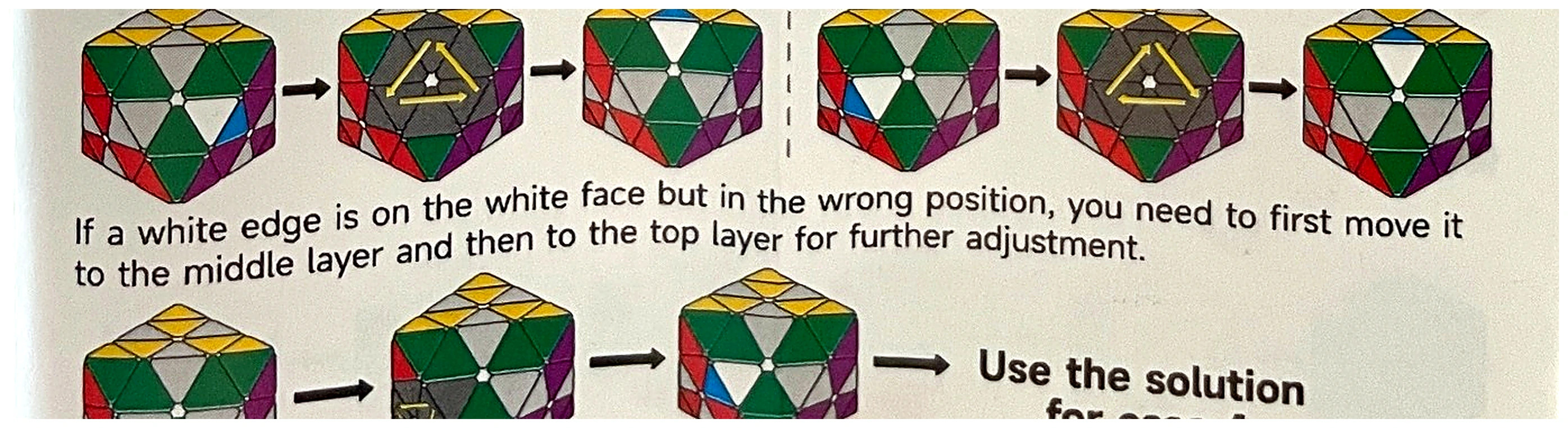
If no white edge is available on top, locate a white edge trapped in the middle layer. Use the matching extraction case to move it to the upper layer, then solve it with Case 1 or Case 2.
White Edge in the Bottom Layer but in the Wrong Position
An incorrectly inserted white edge must first be removed. Move it from the bottom layer to the middle layer, extract it to the top, and then use the appropriate normal insertion case. The leaflet converts the illustrated state to Case 4.
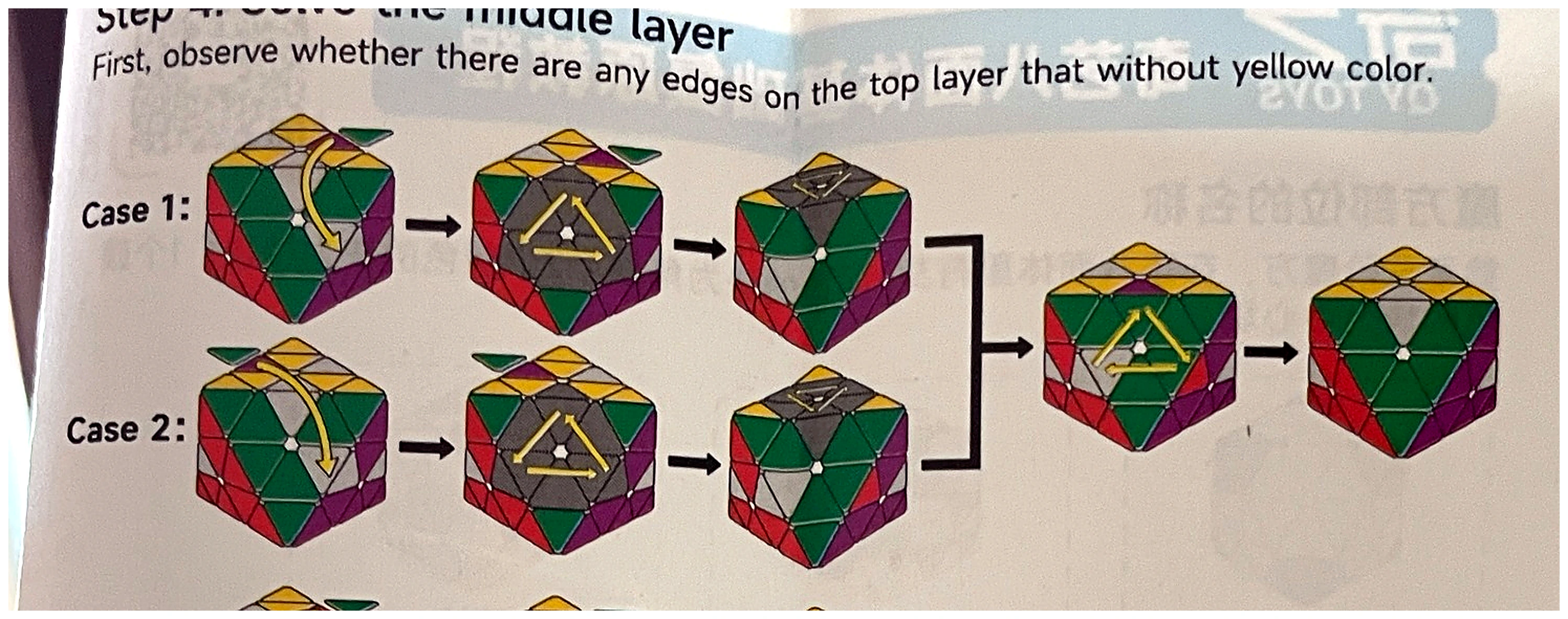
Step 4: Solve the Middle Layer
Inspect the upper layer for an edge that does not contain yellow. Such an edge belongs in the middle layer. Align one of its colors with the matching side and determine whether the other color sends the edge toward the left or right.
Cases 1 and 2
These two cases begin with a usable non-yellow edge on top. Perform the setup shown, use the indicated three-cycle, and restore the setup layer. Both sequences end with the same correctly inserted middle-layer edge.
Cases 3 and 4
Use these mirrored arrangements when the top edge is oriented toward the opposite side. As before, the diagram shows the setup turn, the required cycle and the restoring move.
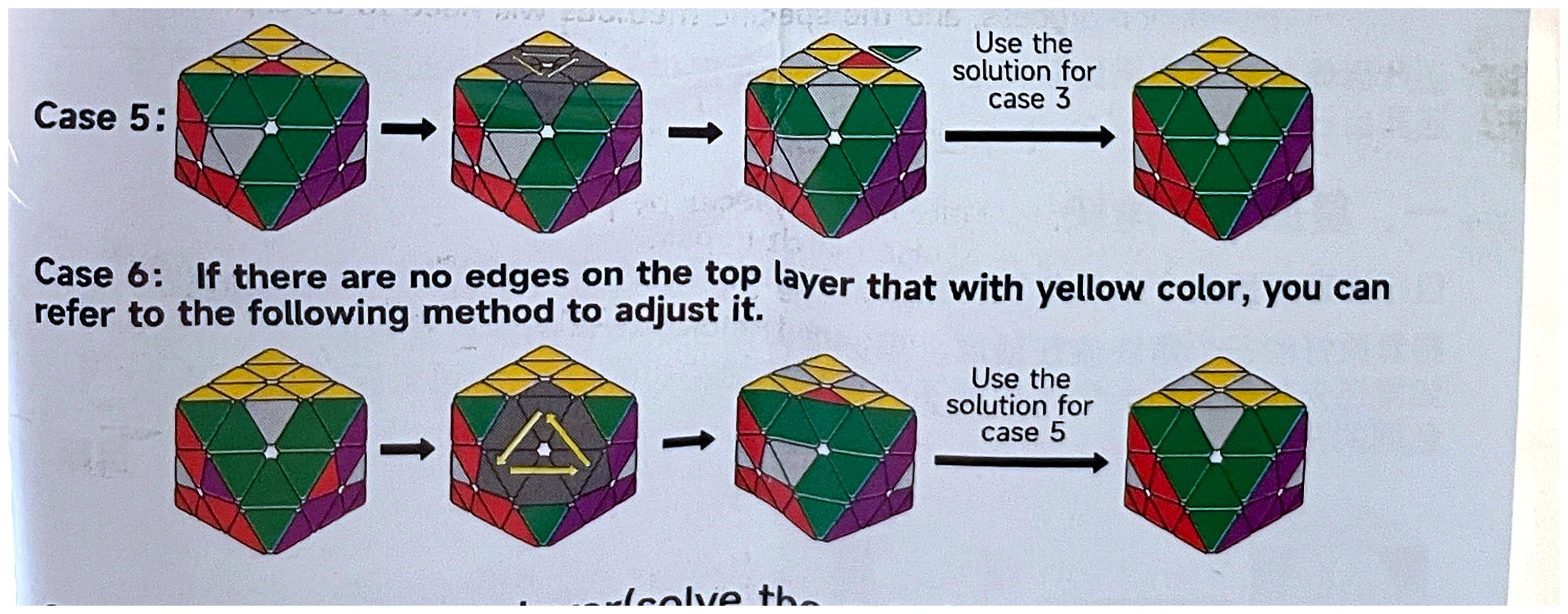
Case 5: An Incorrect Edge Is Already in the Middle Layer
Use the illustrated extraction to replace the incorrect middle edge with an upper-layer edge. The displaced edge moves to the top, where it can be solved with Case 3.
Case 6: No Usable Non-Yellow Edge Is on Top
If every upper edge contains yellow but the middle layer is unfinished, eject an incorrect middle-layer edge with the illustrated setup. This creates Case 5, which can then be solved normally.
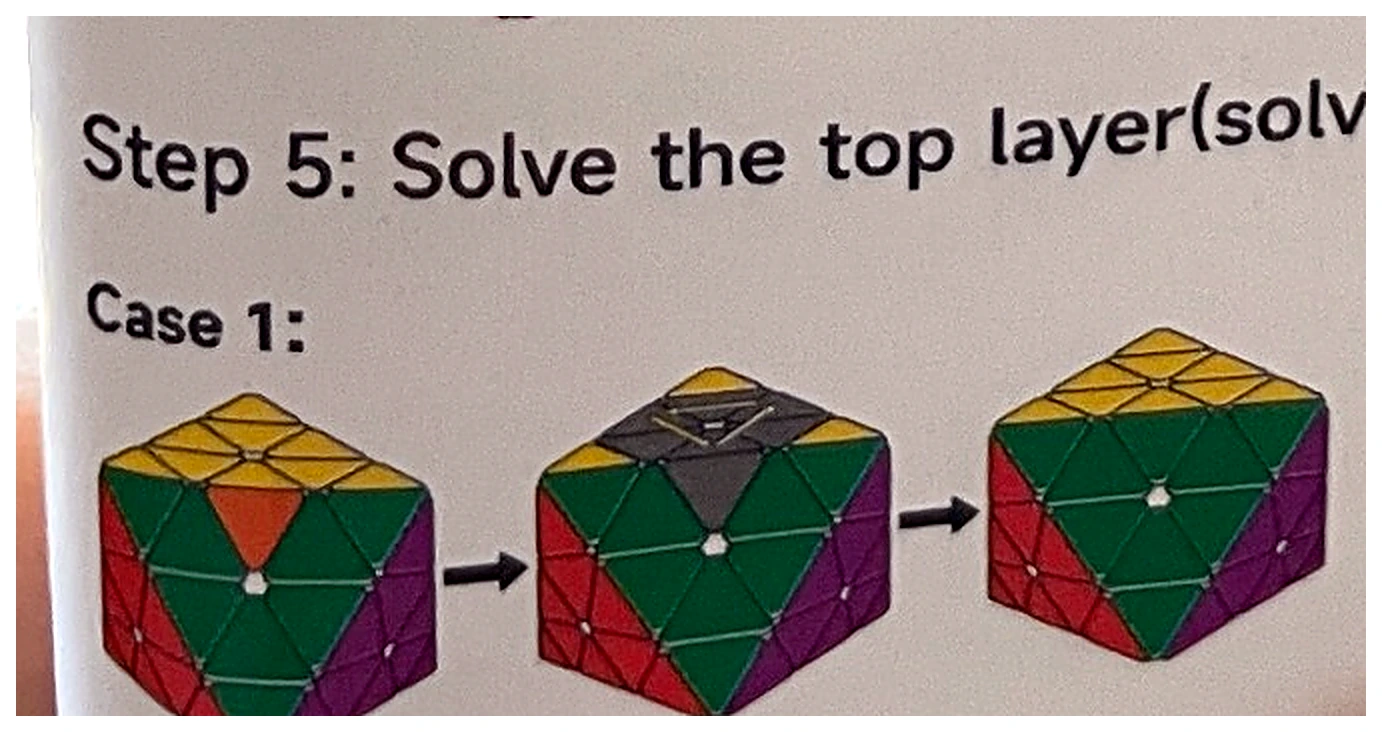
Step 5: Solve the Top Layer
Visible Case 1
Hold the last layer exactly as shown. Apply the upper-layer cycle indicated in the middle diagram to convert the starting pattern into a fully yellow top face.
| Algorithm | Sequence | Purpose |
|---|---|---|
| 1 | RL'R'L | Orient a yellow corner in the bottom-left working position. |
| 2 | (RUR'U)2 | Cycle the relevant upper centers and edges clockwise. |
| 3 | (RU'R'U')2 | Cycle the relevant upper centers and edges counterclockwise. |
The FTO as a WCA Event
On June 24, 2026, the World Cube Association announced that the Face Turning Octahedron would join its official event list. Organizers may include FTO in sanctioned competitions beginning on January 2, 2027. The event will use the same Average of 5 format used by most speedsolving events: five solves are attempted, the fastest and slowest results are removed, and the mean of the remaining three determines the average.
FTO is the first event added to the WCA program since Skewb joined in 2014. The WCA cited sustained community interest, survey support, compatibility with three-dimensional twisty-puzzle competition and the fact that FTO remains meaningfully different from existing events.
The announcement also begins the retirement of Clock, but the transition is not immediate. Clock may continue at competitions through the 2027 WCA World Championship, ending July 18, 2027. Results achieved in community FTO contests before the official launch are therefore unofficial results, not WCA world records.
Interesting Facts About the FTO
Frequently Asked Questions
What does FTO stand for?
FTO stands for Face-Turning Octahedron, also commonly written without the hyphen as Face Turning Octahedron.
How many faces does an FTO have?
It has eight triangular faces. Every face can rotate independently.
How many movable pieces are visible?
There are 42 external pieces: six corners, twelve edges and twenty-four center triangles.
How far does an FTO face turn?
One move rotates a face by 120 degrees. Three identical face turns return that layer to its starting position.
Is the FTO harder than a Rubik's Cube?
The answer depends on the method. The FTO initially looks more complicated because of its triangular centers and unfamiliar geometry, but a beginner solution can rely on a small collection of repeated cycles. Learning to recognize cases is usually harder than physically executing the algorithms.
Can one FTO corner be flipped by itself?
No. Legal moves can flip only an even number of corners. A puzzle with exactly one flipped corner has probably been disassembled and reassembled incorrectly.
Can any center triangle move to any center position?
No. The centers are divided into two mechanical orbits of twelve. Legal turns never transfer a center from one orbit to the other.
Is FTO already an official WCA event?
The WCA has officially approved the event, but sanctioned FTO results begin on January 2, 2027. Earlier community competition results remain unofficial.
What format will WCA FTO competitions use?
The standard format is Average of 5. The fastest and slowest of five attempts are discarded, and the remaining three times are averaged.
Which FTO notation should beginners learn first?
Start with the five face letters U, F, R, L and D, plus their prime versions. Slice notation can be introduced later when a method requires it.