Anyone who has tried to solve a scrambled cube knows the feeling: too many pieces, too many possible moves, and no obvious place to start. A thesis can feel like that too. You have notes, sources, chapter drafts, comments from your supervisor, half-formed arguments, and one large deadline sitting at the end of it all.
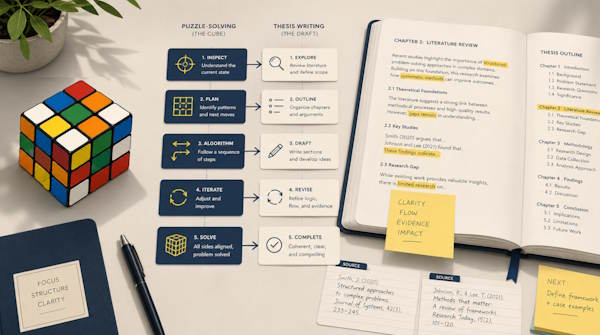
The useful part of algorithmic thinking is not that it makes academic writing mechanical. It does not. A good thesis still needs judgment, reading, and a real argument. But a step-by-step method can stop the project from turning into a pile of disconnected tasks.
That is why the comparison with cube solving works surprisingly well. On Ruwix, the beginner's method for solving the cube breaks a difficult puzzle into smaller stages. You do not solve all 54 stickers at once. You solve the cross, then the corners, then the next layer, and so on. Thesis writing is less tidy, of course, but the same habit helps: define the next stage clearly before you try to fix everything.
Start with the problem, not the pages
Many students begin by asking, "How many pages do I need to write this week?" That is understandable, but it is usually the wrong first question. Page counts can create movement without direction.
A better first question is: "What problem is this chapter supposed to solve?"
For example, the introduction may need to explain why the topic matters and what the research question is. The literature review has a different job: it should show what has already been said, where the debate is unclear, and where your work fits. The methods chapter should make the reader trust how the research was done. If those jobs are mixed together, the thesis becomes hard to follow even when the individual paragraphs are decent.
 This is where algorithmic thinking helps. It asks you to name the input, the process, and the output. In plain writing terms:
- What information does this section need before it can work?
- What should the reader understand by the end of it?
- Which part of the main research question does it support?
That small check prevents a common thesis problem: writing paragraphs because they are interesting, not because they belong.
Use an outline like a solving method
A cube algorithm is a sequence of moves that changes the puzzle in a known way. Ruwix explains this clearly in its guide to Rubik's Cube algorithms. In writing, an outline can do something similar. It gives each section a purpose before the drafting starts.
A useful thesis outline does not have to be beautiful. In fact, messy outlines are often better at the beginning. The point is to make the structure visible while it is still cheap to change.
Here is a simple version:
- Research question: one sentence, kept at the top of the document.
- Chapter goal: what this chapter must prove, explain, or prepare.
- Key sources: the 5-10 sources that actually matter for this section.
- Evidence: quotes, data, examples, interviews, or case material.
- Open problem: what is still missing or weak.
This kind of outline is less impressive than a polished paragraph, but it is more useful early on. It shows where the gaps are. If a chapter has twelve sources but no clear claim, the problem is not grammar. If the claim is clear but there is no evidence, the next task is research. If the evidence is strong but in the wrong order, the next task is structure.
Keep your sources from becoming a second thesis
Source management is where many thesis projects start to wobble. Students save PDFs in different folders, paste quotes into random documents, bookmark articles they never revisit, and then lose hours trying to remember why a source looked useful in the first place.
A basic research system is enough. It might be a spreadsheet, a notes app, or a reference manager such as Zotero. Cornell University Library also has a helpful overview of how to begin library research, including forming research questions, finding materials, evaluating sources, and citing them.
The important thing is to give every source a role. Do not only save the title and link. Add one sentence explaining why you saved it.
- Background source: useful for context, definitions, or history.
- Argument source: supports or challenges your main claim.
- Method source: explains how similar research has been done.
- Gap source: shows what previous studies did not answer.
- Example source: gives a case, quote, statistic, or comparison.
This is not fussy administration. It is future-you being kind to present-you. Three weeks later, when you are tired and your desktop is full of files called final_final_revised2.docx, those labels save real time.
Build feedback loops into the work
One mistake beginners make with the cube is repeating moves without checking what changed. Thesis writers do this too. They revise a sentence, add a paragraph, move a quotation, and keep going without asking whether the chapter is actually better.
A feedback loop is just a planned pause. After drafting a section, compare it with the outline and the research question. Ask:
- Does this section answer the question it was supposed to answer?
- Did I introduce a new idea that belongs somewhere else?
- Is there evidence for the claim, or only explanation?
- Would a reader know why this paragraph is here?
This is similar to using the online Rubik's Cube solver to check the state of a scramble. The solver needs an accurate position before it can give useful steps. A thesis outline works the same way: if your map is honest, the next move becomes easier to see.
Separate writing from editing
Trying to write and edit at the same time is one reason thesis work feels slow. The writer produces a sentence, dislikes it, rewrites it, checks a citation, changes a heading, rereads an old note, and ends the day with one polished paragraph and a lot of frustration.
A more algorithmic workflow separates the jobs:
- Research pass: collect and label sources.
- Planning pass: decide what each chapter must do.
- Drafting pass: write roughly, without fixing every sentence.
- Argument pass: check whether the claims follow each other.
- Evidence pass: check whether each claim is supported.
- Style pass: improve clarity, rhythm, citations, and formatting.
This does not mean every writer must follow the same order. Some people discover their argument while drafting. That is normal. The point is to know which kind of work you are doing at a given moment. If you are drafting, draft. If you are checking evidence, check evidence. Mixing every task together makes the project feel larger than it is.
Be careful with shortcuts
When deadlines become overwhelming, some students look for services such as https://essaymarket.net/buy-thesis-paper to receive a professionally written paper, save time and effort, and better manage their academic workload. Whatever kind of support a student considers, the safest approach is to keep ownership of the research question, argument, sources, and final academic responsibility. A thesis is not only a document to submit. It is supposed to show what the student can understand, organize, and defend.
Outside feedback can be useful when it improves clarity or helps a student see structural problems. It becomes dangerous when it replaces the student's own thinking. A clean-looking document with a weak argument is still a weak thesis.
A practical thesis workflow
Here is a simple workflow that borrows the spirit of cube algorithms without pretending that writing is a puzzle with one fixed solution:
- Write the research question at the top of your working document.
- List the chapters and give each one a job.
- Create a source table with one sentence explaining why each source matters.
- Draft the chapter in rough order, leaving notes where evidence is missing.
- Check the chapter against the research question before polishing the language.
- Ask for feedback on structure before spending too much time on style.
- Revise in passes: argument first, evidence second, wording last.
This kind of system will not make the work effortless. Nothing honest will. But it reduces the number of decisions you have to make at once. That matters, especially in a long project where confusion can quietly eat more time than writing itself.
Final thought
A cube solver learns not to panic at the scramble. The pieces look chaotic, but there is a method for reading the situation and choosing the next move. Thesis writing benefits from the same calm habit.
Break the work into stages. Give each section a job. Keep track of your sources. Build in small checks before problems become large ones. The result is not a mechanical thesis. It is a clearer path through a difficult piece of work.
This article is sponsored by essaymarket.net.