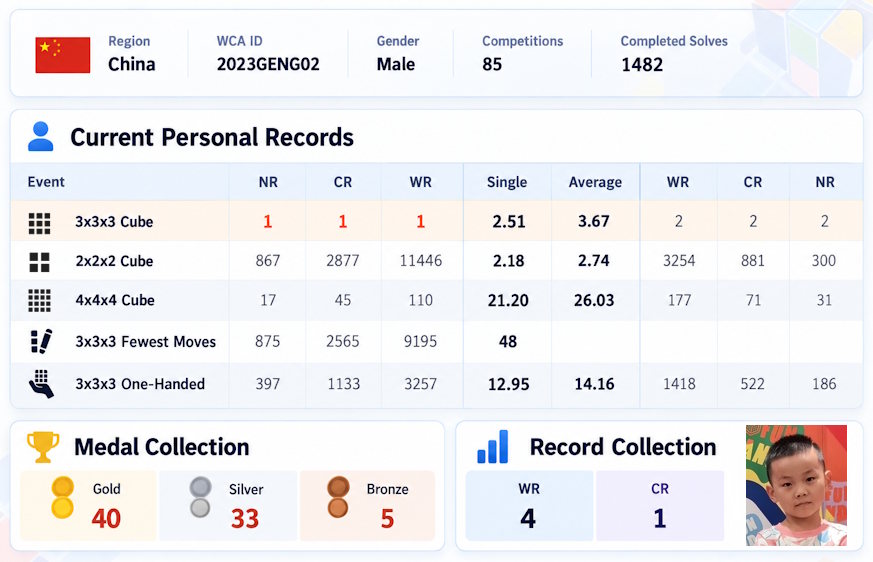
The Rubik's Cube world record has fallen again! Chinese speedcuber Xuanyi Geng (耿暄一) solved the 3x3 cube in an incredible 2.51 seconds at the Guangzhou Grand Open 2026 in Guangzhou, China.
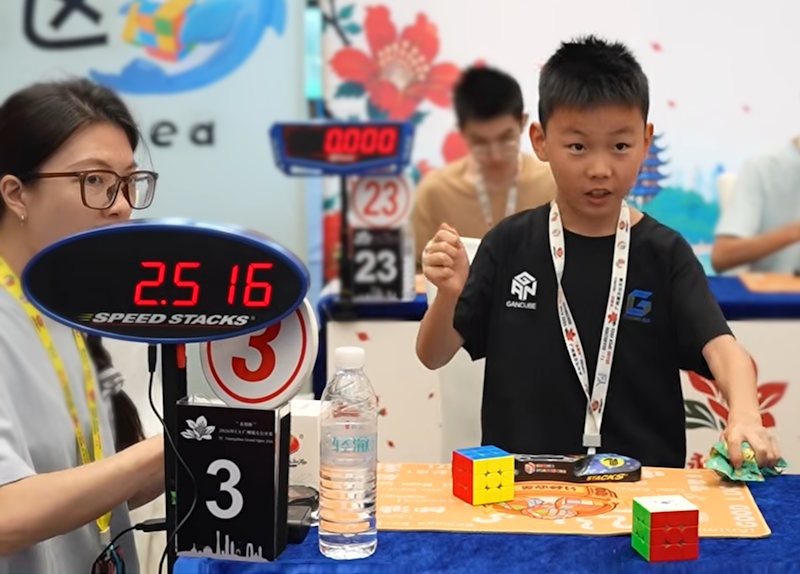
Xuanyi took a massive 0.25 seconds off Teodor Zajder's 2.76-second world record, which had only been set earlier in 2026.
That record had already been considered a huge jump. Teodor lowered Xuanyi's previous 3.05 record by 0.29 seconds and became the first person to officially solve a Rubik's Cube in under three seconds.
Now Xuanyi has taken the record back, and pushed it all the way down to 2.51.
A Massive Jump from 2.76 to 2.51
A quarter of a second doesn't sound like much in everyday life, but when an entire Rubik's Cube solve lasts barely two and a half seconds, 0.25 seconds is enormous.
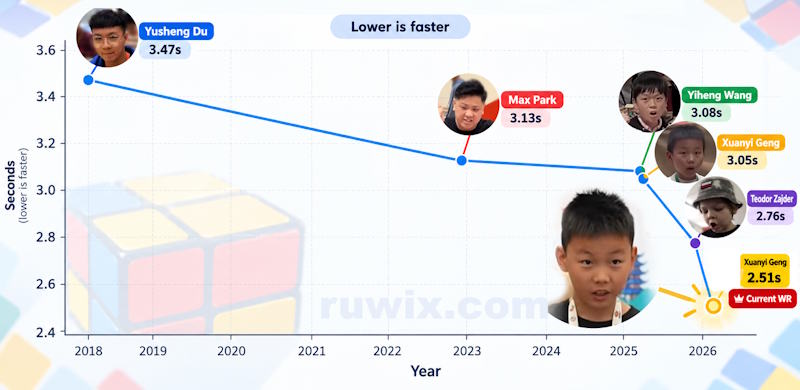
| Time | Speedcuber | Year |
|---|---|---|
| 3.47 | Yusheng Du | 2018 |
| 3.13 | Max Park | 2023 |
| 3.08 | Yiheng Wang | 2025 |
| 3.05 | Xuanyi Geng | 2025 |
| 2.76 | Teodor Zajder | 2026 |
| 2.51 | Xuanyi Geng | 2026 |
It is especially suprising because Teodor Zajder's 2.76 had itself been such a big jump that many speedcubers expected it to survive for quite some time.
The recent progression of the 3x3 single world record shows how quickly the event has accelerated.
Xuanyi's own journey is particularly interesting. He held the world record with 3.05, lost it when Teodor became the first official sub-3 solver, and has now reclaimed it by another quarter of a second.
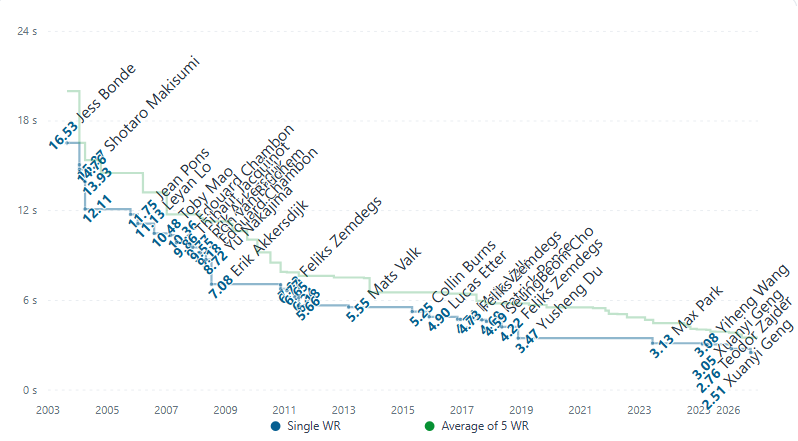
Evolution of the 3x3 world record single (2004-2026).
The Record Was Set with a GAN 16 Maglev MAX
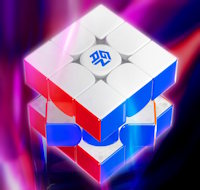 GAN 16
Xuanyi used a GAN 16 Maglev MAX for his 2.51-second world-record solve. The cube is one of GAN's flagship 3x3 models, built around a highly adjustable magnetic and Maglev system designed for extremely fast turning while maintaining stability and alignment.
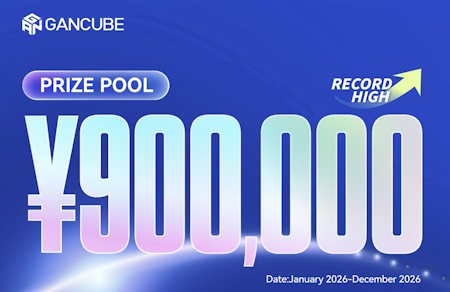
The result also has an extra connection to GAN beyond the cube itself. The company runs a GAN Breaking Records prize program, which rewards eligible record-breaking performances achieved with GAN cubes at WCA-sanctioned competitions. GAN currently advertises a total prize pool of ¥900,000, with different rewards depending on the event and record achieved.
That makes Xuanyi's 2.51 not only a showcase for the GAN16 Maglev MAX, but exactly the kind of performance the program was created to encourage: pushing official speedcubing records while competing with GAN hardware.
Watch the 2.51 World Record
The solve happens so quickly that at normal speed it's difficult to understand what Xuanyi actually did. Fortunately, the reconstruction reveals an extraordinary combination of luck, planning and advanced technique.
32 Moves in 2.51 Seconds
The published reconstruction counts the solve at just 32 STM - Slice Turn Metric moves. That gives an overall turning rate of approximately 12.75 turns per second.
Some video breakdowns describe the solution as 31 moves because move counts can differ depending on exactly how rotations, wide moves and move metrics are treated. Using the published STM reconstruction, the count is 32 moves.
A 32-move solution is exceptionally short for a full 3x3 speedsolve. But the low move count alone doesn't explain why this solve is so impressive.
The really difficult part was finding it.
The Complete 2.51 Reconstruction
The Scramble:
B2D2B2DR2U'F2D'U'B'D2B2U2R2DFD'F2RAt first glance, this doesn't look like an obviously ridiculous world-record scramble. The opportunities are hidden in the relationships between several cross edges, corners and already favorable F2L pieces.
Xuanyi somehow managed to recognize how these pieces could be preserved and connected during his 15 seconds of inspection.
x' z' // inspection
U' r' R2 U' R2' D' R2 U R' U' D' // double X-cross
R' U' R // 3rd pair
L' U' L // 4th pair / ZBLS
R' U R U R' U2 R U R D R' U2 R D' R' // ZBLL
Time: 2.51 seconds
Move count: 32 STM
TPS: approximately 12.75
F2L: approximately 1.23 seconds
Last layer: approximately 1.28 seconds
Technically, R2 and R2' represent the same physical turn, so the prime mark on an R2 doesn't change the move.
He May Have Seen Almost the Entire F2L in Inspection
This is probably the most astonishing part of the record.
WCA competitors receive up to 15 seconds to inspect the cube before starting the timer. A strong CFOP solver will usually plan the cross and perhaps track the first F2L pair. Elite solvers can go significantly further.
Xuanyi appears to have gone much further.
The extraordinary flow of the solution suggests that he may have understood essentially the entire route through the first two layers before beginning the solve, or at minimum predicted enough of it that the remaining cases were immediately obvious.
There is some debate over exactly how much was fully planned. One analysis argues that he may have predicted the entire F2L. Another notes that he only needed to explicitly plan the difficult opening because the final two pairs became extremely simple three-move cases.
Either interpretation is remarkable.
The Double X-Cross
Xuanyi started on white.
Several pieces in the scramble were already favorably positioned relative to one another. Two cross edges were conveniently aligned, while corner-edge relationships could be preserved through the opening moves.
Instead of building an ordinary cross and then starting F2L, Xuanyi manipulated cross pieces and F2L pieces at the same time.
The critical opening was:
U'r'R2U'R2'D'R2UR'U'D'The sequence ultimately produced a double X-cross: the complete cross together with two solved F2L pairs.
A normal X-cross is already an excellent start to a speedsolve. Creating a double X-cross this efficiently - while knowing what will happen to the remaining pieces - is on another level.
Two Three-Move Pairs Finish F2L
Once the double X-cross was complete, the remaining first-two-layer solution became almost absurdly clean.
The third pair was only three moves:
R'U'RAnd inserting that pair left another simple case on the other side.
The fourth pair was another three moves:
L'U'LSo after the complicated opening, Xuanyi could finish the rest of F2L in just six moves.
More importantly, these pairs flowed directly into each other. There was almost no searching or hesitation.
F2L in About 1.23 Seconds
The reconstruction puts the completion of the entire first two layers at approximately 1.23 seconds.
The double X-cross itself was effectively completed in under a second, after which the two three-move pairs were dispatched almost immediately.
At this level, the difference between a fast solver and a world-record solver isn't simply hand speed. If you have to stop for even a fraction of a second to locate the next pieces, the solve is already too slow.
Xuanyi's opening instead looks almost like one continuous algorithm.
The Fourth Pair Was Also ZBLS
The final three-move pair did something else extremely important.
L'U'LIt completed F2L while leaving all of the last-layer edges oriented. This is a ZBLS result.
For a conventional CFOP solve, a speedcuber would normally finish F2L, recognize an OLL case, execute OLL, recognize PLL and then execute PLL.
Because the edges were already oriented, Xuanyi could skip that normal two-step last layer and move directly to a ZBLL case.
What Is ZBLL?
ZBLL is one of the most advanced algorithm sets used in speedcubing.
When all four last-layer edges are already oriented, a ZBLL algorithm solves the remaining corners and edges of the last layer in a single step.
There are hundreds of cases to learn, which is why most speedcubers never learn the entire set. Recognizing and executing one instantly in a 2.5-second solve requires a completely different level of training.
Xuanyi's final algorithm was:
R'URUR'U2RURDR'U2RD'R'The Only Noticeable Pause
Interestingly, the world-record solve was not completely pause-free.
After finishing F2L, Xuanyi appears to take a very short recognition pause before starting ZBLL. The case was relatively awkward to identify from the angle at which he was viewing the cube.
From another angle, the pattern would have been more obvious because of three visible bars. But physically rotating the cube to inspect it would also cost time.
Xuanyi instead recognized the case from his existing angle and immediately executed it.
The ZBLL itself involves removing and reinserting pieces before cancelling efficiently into the final commutator. He also avoided a costly final adjustment at the end.
Was the World Record Lucky?
Yes, and that's completely normal.
Virtually every 3x3 single world record requires a favorable scramble. A 32-move solution is extraordinarily short, the F2L cases were highly favorable and the last layer was already prepared for ZBLL.
But describing the record as "just lucky" would miss the point.
The scramble provided opportunities. Xuanyi still had to see them.
Give the same scramble to another speedcuber and they still have to discover the double X-cross, understand which pieces need to be preserved, predict the short remaining pairs, recognize the ZBLL and execute everything under official competition pressure.
The lucky part was receiving the scramble. The extraordinary part was what Xuanyi did with it.
Was the ZBLS Lucky?
The final F2L insertion conveniently left the yellow edges oriented, which on the surface looks like another piece of luck.
But Xuanyi knows advanced ZBLS cases and has the ability to track what his F2L solutions will do to the last layer. It's therefore entirely possible that this result wasn't a surprise to him at all.
If he already understood during inspection that his planned sequence would orient the edges, then what looks like luck to most solvers was actually part of the solution.
The Last Layer Wasn't Even Perfect
Perhaps the strangest thing about the 2.51 is that Xuanyi did not receive the fastest possible finish.
The ZBLL was not an exceptionally short algorithm, and he needed a small amount of time to recognize it. There are considerably more favorable last-layer cases that could follow an opening this good.
In other words, the world-record solve was extraordinarily lucky - but it was not a theoretical perfect solve.
There was still time left on the table.
Could This Have Been Sub-2?
The inevitable question is whether an even better ending could have pushed the solve below two seconds.
Xuanyi's record is 0.52 seconds away from 1.99. At normal speeds that's nothing. At this level, it's an enormous gap.
Simply replacing the ZBLL with a shorter algorithm doesn't automatically turn 2.51 into sub-2. Recognition, transitions, finger tricks, execution speed and the final adjustment all matter.
But this solve demonstrates most of the ingredients a future sub-2 will probably require:
- an exceptionally short solution,
- a huge amount of planning during inspection,
- a double X-cross or similarly efficient opening,
- very easy remaining F2L pairs,
- almost zero pauses,
- last-layer edge orientation,
- a one-look last layer,
- and nearly flawless execution.
Add an exceptionally short ZBLL to an opening like this and sub-2 suddenly becomes much less ridiculous to imagine.
How the Speedcubing Community Reacted
The reaction throughout the speedcubing community has understandably been a mixture of disbelief, technical fascination and renewed speculation about how much further the single world record can fall.
One of the biggest talking points is the size of the jump itself. Teodor Zajder's 2.76 had already demolished Xuanyi's previous 3.05, so another quarter-second improvement so soon afterwards was not something most people expected.
The second major topic is the balance between luck and skill. Nobody seriously disputes that the scramble was extremely favorable. A world-record single almost has to be. But reconstruction analysis has shifted much of the attention toward the difficulty of actually finding Xuanyi's solution.
The double X-cross, the chained three-move pairs and the resulting ZBLL make the solve look simple after it has already been explained. Finding all of that during an official 15-second inspection is something else entirely.
The solve has also inevitably restarted the sub-2 discussion. When the world record was 3.47, two seconds sounded absurd. Even when Xuanyi reached 3.05, sub-2 belonged more to theoretical discussion than realistic predictions.
At 2.51, the conversation has changed.
There is still a gigantic performance gap between 2.51 and 1.99, but a time beginning with a "1" no longer feels completely disconnected from what elite human solvers can achieve.
The World-Record Round
Xuanyi's five solves in the round were:
(2.51), 3.99, 3.21, 4.42, (4.75)
The 2.51 and 4.75 were excluded as the fastest and slowest results when calculating the average. Even outside the world-record single, the round demonstrates just how far elite 3x3 solving has progressed: times that would once have been historic are now appearing in the same average as a 2.51.
From 3.05 to 2.51
Xuanyi first claimed the 3x3 single world record with 3.05 seconds in 2025.
That left the speedcubing world wondering who would finally break the three-second barrier.
In 2026, Teodor Zajder answered that question with 2.76 - not merely sneaking below three seconds, but jumping nearly three tenths below Xuanyi's record.
Then came Xuanyi's answer:
2.51 seconds.
His own world-record time has therefore gone from 3.05 to 2.51 in roughly a year and a half - an improvement of more than half a second at the very highest level of the event.
What's Next?
After Yusheng Du's 3.47 stood for more than four years, it was reasonable to wonder whether the 3x3 single was approaching a hard human limit.
Apparently not.
Max Park reached 3.13. Yiheng Wang reached 3.08. Xuanyi reached 3.05. Teodor finally broke the three-second barrier with 2.76. And now Xuanyi has moved the record to 2.51.
The next obvious milestone is sub-2.5. Xuanyi missed it by only two hundredths of a second.
Beyond that sits the barrier that still sounds almost impossible: sub-2.
Nobody knows whether that will happen soon or whether the final half-second will take years to find. Single records depend on an unusually favorable scramble aligning with a solver capable of recognizing and executing the opportunity perfectly.
But after a solve like this, ruling it out would be difficult.
Xuanyi Geng didn't simply regain the Rubik's Cube world record. He showed just how much information today's best speedcubers can extract from a scramble before the timer has even started.
Congratulations to Xuanyi Geng on an unbelievable 2.51-second 3x3 world record!