The Rubik's Cube can be a surprisingly stubborn little puzzle. Give one to someone who has never learned the solution and there is a good chance they will spend quite a while turning the sides, hoping the colors somehow fall back into place.
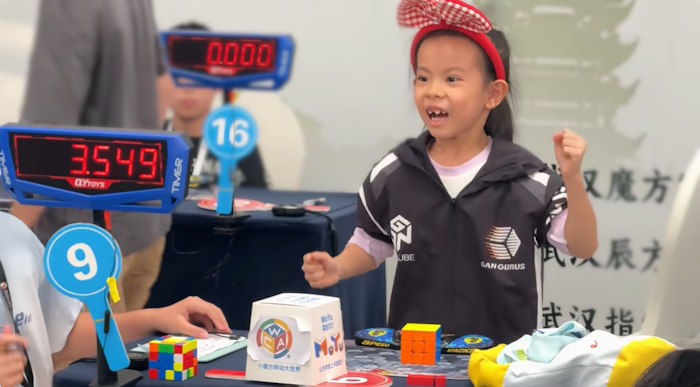
Lian Yunzhi has a very different relationship with the puzzle.
The six-year-old Chinese speedcuber Yunzhi Lian (连允之) can solve a 3x3 cube at a pace that is difficult to comprehend without seeing it happen. In September 2026, she set the women's 3x3 average world record twice within a few days. Her latest official average was 4.27 seconds on the Guangzhou GraDUAL 3x3 IV 2026 competition on Sep 16, 2026.
That number is remarkable on its own. What makes it even more striking is that Lian is still only six years old.
It All Began With a Much Slower Solve
Lian, also called Zhizhi, did not start out solving cubes at anything close to record pace.
She first became interested in the puzzle when she was four. At the time, one solve took her about a minute and a half. For a young child learning a complicated sequence of movements, that was already a meaningful starting point.
She kept coming back to the cube, however. Her interest gradually grew into a serious hobby, and her parents began giving her more opportunities to develop the skill.
That early stage is easy to overlook when a record-breaking performance is the headline. Going from around 90 seconds to an average of 4.27 seconds requires much more than simply getting faster hands. It means learning how the puzzle behaves, remembering large numbers of move sequences and becoming comfortable enough with the cube that decisions can be made almost instantly.
The Record Changed Twice
Lian's recent achievement came through official competitions held in China.
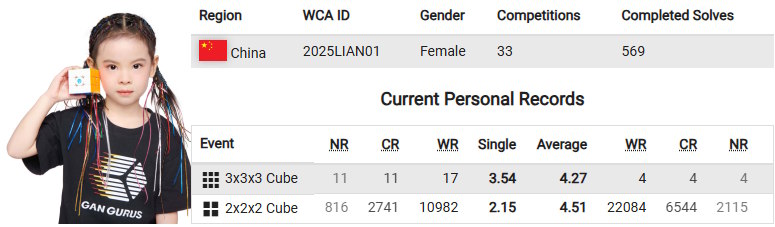
Her WCA profile in September 2026
Her first record-breaking average was 4.52 seconds in Wuhan. Instead of stopping there, she produced an even faster result soon afterward in Guangzhou.
The Guangzhou competition gave her a new average of 4.27 seconds.
 For people unfamiliar with speedcubing, an important detail is that this is not simply the time from one exceptionally quick solve. Competitors normally perform five solves in an average-of-five format. The fastest and slowest attempts are discarded, and the other three times are averaged.
That makes consistency essential.
A competitor could have one incredible solve and still fail to produce a strong average if the other attempts are significantly slower. Lian's results in Guangzhou were all extremely close to the four-second mark, with reported times ranging from roughly 4.02 to 4.54 seconds.
She had already shown how quickly she could solve the puzzle during the Wuhan event, where one of her individual solves was around 3.54 seconds.
What Is Happening During Those Four Seconds?
A fast Rubik's Cube solve can look almost chaotic to someone watching from the outside. The competitor's fingers move constantly, but every turn has a purpose.





Speedcubers do not simply memorize one giant sequence and repeat it every time. They learn many algorithms and use them according to the arrangement of the pieces they see. That requires quick recognition.
A solver needs to look at the cube, identify useful patterns and decide what to do next [lookahead]. At the same time, the hands have to carry out the required movements without hesitation [fingertricks].
There is also an element of efficiency. Turning the cube is not enough; the goal is to avoid unnecessary rotations and pauses.
For anyone getting into cubing, there are plenty of tutorials and online resources available. Sometimes you might need the best proxy sites free to access these online materials, for learning or practicing Rubik's Cube solving.
More Than 1,300 Algorithms
Reports about Lian's preparation give some idea of how seriously she approaches speedcubing.
She is said to have learned more than 1,300 algorithms and to spend around two to three hours a day practicing.
URU'L'UR'U'L
1299 more to go
That does not mean she is simply sitting down and solving the cube for hours without a plan. At this level, practice can involve many different things: working on finger movements, improving recognition, repeating difficult cases and trying to remove pauses from a solve.
When a person's final time is only a few seconds, even a tiny hesitation matters.
An extra movement here or a short pause there can change the result. This is why top speedcubers spend so much time refining details that an ordinary solver would probably never notice.
Her Family Took the Skill Seriously
Lian's development also involved professional coaching.
After her parents recognized her ability and growing interest, she was taken to Shanghai, where she could train with experienced coaches.
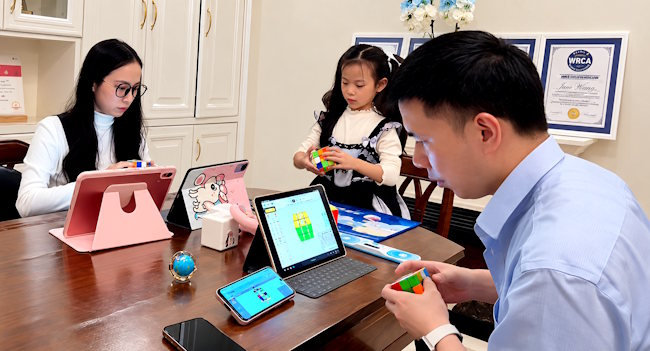
Solving on a conveyor belt with two scramblers
Having another person watch a solve can reveal problems that are difficult to notice when practicing alone. A coach can see whether a competitor is using inefficient finger movements, hesitating during recognition or taking a longer route through part of the solve.
Those changes may look tiny, but speedcubing is a sport where tiny changes add up.
For Lian, coaching appears to have become an important part of the process alongside her own daily practice.
From a Toy to a Competitive Sport
The Rubik's Cube has been around for more than half a century.
 Hungarian architect and professor Ernő Rubik created the original puzzle in 1974. It was initially called the Magic Cube before the name Rubik's Cube became internationally recognized.
Its popularity exploded during the 1980s, but the puzzle did not disappear when that craze faded. Instead, it developed a dedicated community of enthusiasts who wanted to solve it faster and faster.
That eventually helped speedcubing grow into an organized competitive activity.
Today, official competitions cover a variety of events. Competitors can solve different cube sizes, attempt one-handed solves and even solve while blindfolded. The traditional 3x3 remains the event most closely associated with speedcubing.
Lian's record came in that familiar category.
Why the Cube Can Be Useful for Young Learners
There is a reason parents and teachers often introduce puzzles to children.
A Rubik's Cube requires a child to remember information and then apply it in the correct order. It also requires an understanding of how individual actions affect the rest of the puzzle.
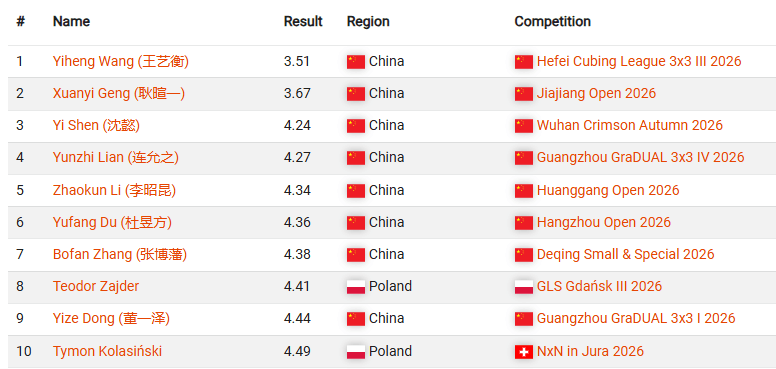
In 2026 China dominates speedcubing
The learning process can be frustrating at first. A child may understand one part of the solution and then accidentally disturb something that was already correct. That is part of the experience.
With enough practice, those mistakes become opportunities to understand the puzzle better. Lian's mother has associated her daughter's cubing experience with areas such as concentration, memory, logical thinking and spatial awareness.
Of course, children develop differently, and not every child will respond to a puzzle in the same way. For someone who enjoys it, though, a cube can turn problem-solving into something hands-on and measurable.
Competition Changed Her Confidence Too
There appears to have been another change in Lian besides her solving speed.
Her mother has described her as an introverted child when she was younger. Through competitions and her involvement in cubing, she reportedly became more confident.💪
Competition creates situations that are different from practicing at home. A child has to perform while being watched, deal with an official timer and accept that some attempts simply will not go according to plan.
Even the best speedcubers make mistakes. Sometimes a solve starts badly. Sometimes recognition takes longer than expected. Sometimes a competitor simply fails to reproduce a practice time.
Learning to put one bad attempt behind them and continue with the next one is part of competitive experience.
For Lian, the cube has therefore become more than a way to measure speed. It has also given her a setting in which she can challenge herself in front of other people.
A Four-Second Average at Six
The jump in Lian Yunzhi's performance is difficult to ignore.
At four, she needed roughly 90 seconds to solve the puzzle with the beginners' method. At six, she is averaging 4.27 seconds in an official competition and has already broken the women's 3x3 average record twice in a short period.
Those few seconds represent years of learning compressed into an incredibly fast routine.
There is no way to know how long Lian will remain involved in competitive speedcubing. She is still very young, and her interests may change as she grows.
For now, however, she has already produced a result that will stand out in the history of the event. Her story began with a child learning how to solve a colorful puzzle. It has now reached the world-record stage.