First Step: Advanced Fridrich Method CFOP: White Cross

I assume that at this point you are familiar with the notation of the Rubik's Cube and you can solve the cube with the beginner's method. If not then I strongly recommend you visit these pages to avoid any confusion.
It's up to you which face you want to start with, let's make a convention that for the sake of this tutorial we'll start with the white face. Our goal is to form a cross at the bottom of the Rubik's Cube in a way that the sides of the white edges match the lateral centre pieces. Experienced cubers foresee the steps when they inspect the cube and they plan this step. In most cases you'll need 6 rotations to complete this phase, and you should never need more than 8.
White face always down
Hold your cube in your hands with the white centre facing down to improve your solution time. With a lot of practice you won't need to see the white cross because you will know what's going on down there according to the color scheme of your puzzle, your moves and what you see on the top. This way you don't have to turn your cube around, saving this way a lot of time. Some speedcubers prefer solving the cross on the left side but if you choose to make it on the bottom you'll have a nice lookahead and is more suitable for finger tricks. The only bad thing is that it's weird for beginners and you can't notice in time if you messed the cross up.
It would be more intuitive to solve it on the top and turning upside down when it's done, but you'll need to learn it this way if you want to reach times below 20 seconds. To encourage you I have to tell that the knowledge of the next step (F2L) will help you a lot in the understanding of the manipulation of the cube upside down. You will discover the advantages of this perspective and you will admit that this is the best way of doing it. And if you really want to master the Rubik's Cube I recommend you to examine the cube and try to plan all the necessary steps and execute them without watching.
Examples - Basic idea
The examples below show a couple situations you can meet. The first one is very easy, you just have to turn the edge piece to the correct position. The second shows how to reorient a piece. The third example demonstrates how to place two pieces in one step. The last step shows the steps to fix the Superflip (the "most scrambled Rubik's Cube") in only 6 moves.
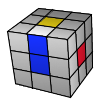
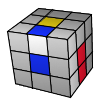
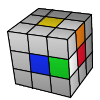
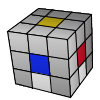
This first step of solving the white cross is actually an intuitive stage of the solution process. We couldn't even cover every possible situations because at this stage there are so many cases. Almost everyone could get this far without learning algorithms. But you'll need to practice forming the white cross to make it efficient. Do it smoothly, without stopping and with the cross facing downwards. If this works well, you can proceed in our tutorial to the second step: F2L
This is perfect, but it's a lot of information to absorb, and even more to learn to the point where it sticks, and it will take time to fully understand everything there is, but with constant practice, it takes no time at all. Everything we need to know is written on this page.
(1) Open the door.
(2) Let the cat out.
(3) Close the door.
(4) Cat goes to the back.
(5) Open the door.
(6) Cat comes long way back.
That is to say, after the top two layers are done and the bottom corners are in their proper corners, to rotate, solve the bottom corners you
(1) Right back.
(2) Bottom left.
(3) Right forwards.
(4) Bottom left.
(5) Right back.
(6) Bottom x 2.
(7) Right forwards.
90 seconds. I hope someday to get my time to less than a minute.
Beginner's method is easy, but CFOP is extremely difficult. If you're trying to learn CFOP, try learning some intermediate level things like 2-look OLL, which will improve your times without you having to memorize 100+ algs
Here are the animations: Ruwix.com/the-rubiks-cube/notation
Defenetly worth a try. Now I just need to try it...