A puzzle asks for something specific. You hold a goal in mind, scan for the piece or the move that fits, test it, and adjust when it does not. That loop of looking, trying and correcting runs the same way whether you are turning a Rubik's Cube, filling a crossword grid or fitting the last corner of a jigsaw. It is also why researchers have spent years measuring what solving does to the brain, and the benefits of puzzles turn out to be more specific than the usual "keeps your mind sharp🧠" line suggests.
What a single puzzle actually engages
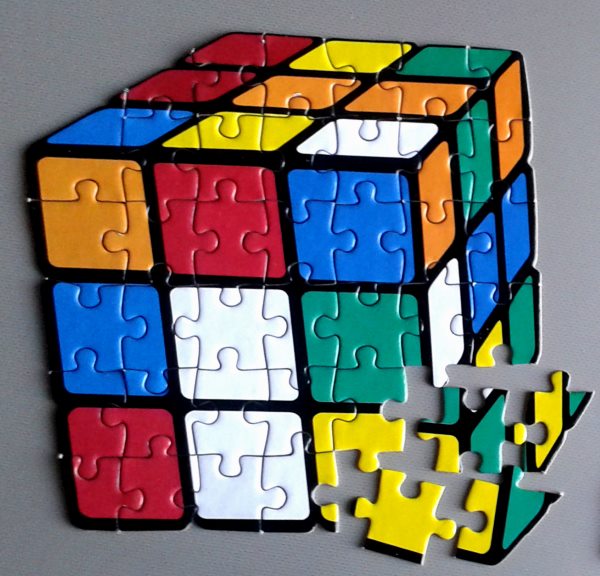
When psychologists study one puzzle type closely, they tend to find it pulling on several mental skills at once. In a study published in Frontiers in Aging Neuroscience, researchers at Ulm University reported that jigsaw puzzling draws on eight separate visuospatial abilities, among them perception, mental rotation, working memory, reasoning and processing speed. Assembling a picture from scattered pieces is not one skill but a small stack of them running together, which is part of why a hard puzzle can feel genuinely tiring.
 Spatial reasoning sits near the centre of that stack. To place a piece you rotate it in your head, compare its edges to a gap, and predict whether it will fit before your hand moves. The same work tied a lifetime of puzzle experience to stronger overall visuospatial cognition, the mental system you lean on to read a map, pack a car boot or judge a distance. It is the quiet skill that a cuber trains every time they plan a few moves ahead instead of turning at random.
Memory, focus and the pull of one more move
 Different puzzles lean on different strengths, and word puzzles have their own record. In a 78-week randomized trial run by Columbia and Duke, older adults with mild cognitive impairment who trained on web-based crosswords showed greater cognitive improvement than a group using computerized brain-training games, with less measurable brain shrinkage on MRI by the end. The researchers put part of the effect down to engagement, since a familiar puzzle held attention better than an unfamiliar game.
That point about attention matters as much as the memory result. A puzzle gives you a tight feedback loop where a wrong move visibly breaks the pattern, and that loop trains the same patient, self-correcting focus that any careful task needs. Work through a cube one algorithm at a time and you are practising exactly that, since staged, algorithmic solving builds the concentration that longer work depends on, and the habit transfers well beyond the cube.
The benefits are not all the same
The useful thing about puzzles is that the format decides which skill gets the workout. A rough map looks like this.
| Puzzle type | What it leans on most |
| Twisty puzzles | Mental rotation, sequence memory and planning |
| Jigsaw | Spatial reasoning and visual matching |
| Crossword | Verbal memory and word recall |
| Sudoku and number grids | Logic and working memory |
| Logic and deduction puzzles | Planning and ruling out options |
Across all of them, a single session tends to exercise a familiar set of abilities:
 sustained attention across a multi-step task
- pattern recognition, or spotting a case and knowing the response
- working memory, holding several constraints in mind at once
- error correction, catching a mistake before it compounds
None of this is a magic bullet, and the honest research says so. A long-running study of more than a thousand people born in 1936 found that regularly playing puzzles and other analog games was linked to a slower decline in thinking skills in later life, but the effect was modest rather than dramatic. The value builds up over years of small, steady engagement, not from a single marathon session.
Keeping the loop going between sessions
The practical problem with physical puzzles is friction. A jigsaw needs a table, a crossword needs the right book, and a cube is not always in your pocket. This is where browser games fill an obvious gap, giving solvers a way to keep the same mental loop running in spare minutes. Free platforms host a lot of this, with sites like Poki listing more than 250 puzzle games across types such as logic grids, number games and jigsaws. It is the low-friction, easy to reach version of the same workout, not a replacement for the puzzle on the table.
Final thought
Solving a puzzle is not a mechanical trick, and it will not rebuild your memory🧠 on its own. What the evidence points to is quieter and more believable: puzzles exercise spatial reasoning, working memory, pattern recognition and focus, and doing them often seems to help those skills hold up. For anyone who already reaches for a cube or a crossword out of habit, that is a reassuring thing to know. The pieces were doing more than passing the time.
This article is sponsored by poki.com.