Rubik's Cube Solution With Advanced Fridrich (CFOP) Method
The first speedcubing World championship was held in 1982 in Budapest and it was won by Minh Thai (USA) with a 22.95 seconds solution time. Since then the methods have evolved and we are capable of reaching solution times below 6 seconds. If you want to improve your cubing speed, all you need is a high quality, well lubricated Rubik's Cube with good corner cutting and optimal tensioning so the pieces don't pop. Practice finger tricks, the art of turning the cube like you can barely see the movements. You'll also need a Rubik's Cube timer to keep track of your evolution, and a lot of practice of the method described in the tutorial below.
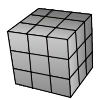
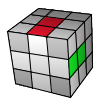
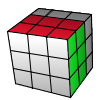
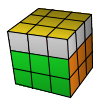
When talking about the advanced technique of solving the Rubik's Cube we have to mention the Petrus system and the Fridrich method (or full CFOP) which is used by the big majority of speedcubers these days. This advanced technique developed by Jessica Fridrich divides the puzzle into layers and you have to solve the cube layer by layer using algorithms in each step, not messing up the pieces already in place. These steps are the following: Cross, F2L, OLL and PLL, as seen on the illustration above.
The method developed by Jessica Fridrich involves memorizing a lot of algorithms, but there is a logical connection between them. After a lot of practice you will develop the ability to execute these operations intuitively.
Steps of the advanced method
1. First of all we have to solve the white edge pieces in the bottom. This seems to be the easiest but it's really hard if you want to do it right. You should be able to determine all the rotations needed to complete the white cross after inspecting the cube, and you'll succeed only if you foresee 7 steps. Read more >>
2. When the cross is done we solve the first two layers (F2L) in one step using a technique to pair the white corner and second layer edge pieces. We are talking about four corner blocks which usually require 4x7 steps. Read more >>
3. Orienting the last layer (OLL) of the Rubik's Cube is the step in which we solve the yellow face without matching the side colours. We are going to position them in the next step. Learn all the 57 algorithms to complete this step. Read more >>
4. Permutate the last layer (PLL) to finish the solution of your cube. There are 21 algorithms to memorize. Read more >>
I've solved it 48.52 seconds with the beginners method, then I switched to CFOP/Fridrich and now my best is 26.94.
zz
zz-ct
petrus
waterman
heise method
snyder method
ssc
Here are the animations: Ruwix.com/the-rubiks-cube/notation