5x5x5 Rubik's Cube -How To Solve The Professor's Cube
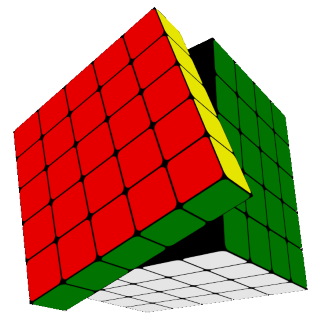
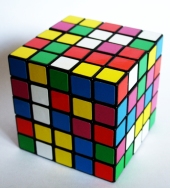 The 5x5x5 Rubik's Cube also known as the Professor's Cube is the invention of Udo Krell. On this page I'm going to present this puzzle and will give you a clue about how to solve the 5 layered Rubik's Cube.
Manufacturers of the 5x5x5 include Rubik's, although their cube is loose and lock up easily. Another classic is the V-cube 5x5x5, which used to be the cube for competitions, however newer Chinese brand cubes are often faster. The Moyu Aochuang and Yuxin 5x5 are the two go to speed cubes on the market today, they don't lock up as often, are smoother and have some corner cutting capability.
Online 5x5x5 Rubik's Cube Simulator
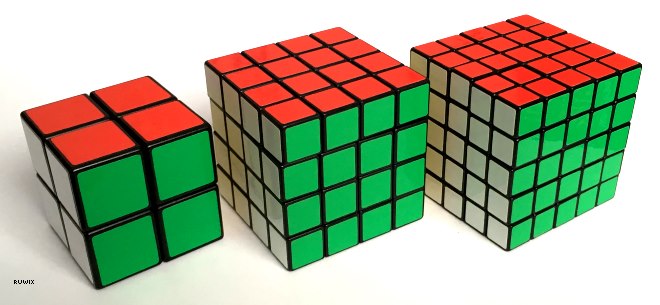
2x2, 4x4 and 5x5 cube puzzles
There are not so many shape mods like the 2x2 and 3x3 but we have to mention the 5x5 mirror cube, the siamese versions and sticker mods.
The 5x5x5 Rubik's Cube puzzle has approximately 2,82 x 1074 possible permutations. This number is close to the estimated number of atoms in the Universe.
The Solution Of The 5x5 Cube
The 5x5 is solved similarly to the 4x4x4 (or in fact, any NxNxN cube), which involves:
- solving the centres
- pairing up pieces to create the edges
- finally solving like a 3x3 cube
Solving the centres
Centres are solved similarly to a 4x4x4, in which 'strips' of inner pieces are created and lined up in place. First create the centre strip around the centre piece (conventionally around the white centre), then create more and move them into place. Continue this until there are two adjacent centres to complete, in which case in like to treat as if I'm solving one of them, in which the other ends up solved.
To solve this puzzle you have to know the solution of the 4x4x4 Cube. We are using the same notation (letters in the algorithms) and the basic idea is also the same:
- First we put together the centre 3x3 blocks,
- then we pair the edge pieces,
- then solve it like a regular 3x3x3 Rubik's Cube
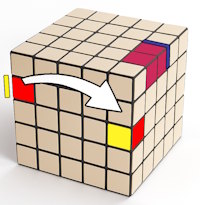
Pairing the edges:
Uw' R U R' Uw
This twisty puzzle might be even easier because it has fixed centre pieces, and there are no parity cases, but it takes more time to solve it because it has more pieces. Building the 3x3x3 is pretty intuitive, you have to use the same method you used in the case of the 4x4x4 cube.
Pairing the edges is a little different though. We'll have to place the two outer edge pieces next to the centre edge piece. To do this we're going to use the same Uw' R U R' Uw algorithm (and its symmetric) and we'll have to take care not to cut up the already solved pieces. You can see a blue line on the attached image where the pieces will be separated in the top layer. You can have paired pieces in the spots marked with pink without any problem because these will remain intact.
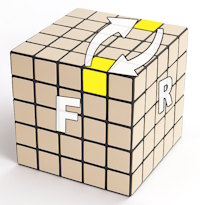 While pairing the edge pieces you might find yourself in a situation when you have to swap two edges like marked on the picture. You can't avoid using this longer algorithm when the two remaining edges are in this position and you don't have any unsolved edges to move in the top layer in the pink position. Do this algorithm, while holding the cube the way you see it on the picture:
Lw' U2 Lw' - U2 F2 Lw' F2 Rw U2 - Rw' U2 Lw2
When edge and the centre blocks are complete, just solve it like a 3x3x3 Rubik's Cube moving only the outer layers.
There are no parities on the 5x5x5 cube due to the cube having actual centre pieces. This means that for any NxNxN cube parities only occur when N is a even number.
Practice much with your 5x5 and you'll get into it!
Yes, it is easy now, and being just barely old enought to have held one of the first ones, I am amazed by how stupid I was at the age of six or so.
If they were so easy, there would be no point in doing them.
My favorites are the dodecohedrons and the mirror cubes. There is some issue I was/am running into with the 2x2 mirror cube, and I gave it to a buddy, and he eventually figured it out enough times that he thinks he can show me why I can't fit the last piece. And, to be noted here, it took him a rather long time to figure it out.
Edit: After re-reading your comment, I finally understood what you were saying. What you have there is still not parity, it's just an unfortunate edges-pairing case (People still (humorously) call it parity because it's also a pain to fix like even-layered cubes' parity). Refer to this to fix the last 2 edges:
Lw' U2 Lw' U2 F2 Lw' F2 Rw U2 Rw' U2 Lw' Lw'
Rw U2 x Rw U2 Rw U2 3Rw' U2 Lw U2 Rw' U2 Rw U2 Rw' U2 Rw'
Since one of the final 2 edges did solve properly, I don't know what I could have done wrong.