- 2x2x2 pocket cube
- 3x3x3 Rubik's Cube
- 4x4x4 Rubik's Revenge
- 5x5x5 Professor's Cube
- Big Cube
- Picture Cube
- Ghost Cube
- 3x3x3 Cube Heads
- Mirror Cube
- Fisher Cube
- Axis Cube
- Mastermorphix
- Windmill Cube
- Pandora Cube
- Penrose Cube
- Globe puzzle
- Bandaged Cube
- Siamese Cube
- Void Cube
- Mixup Cube
- QJ Dodecahedron
- Floppy Cube
- 2x2x3 tower cube
- 2x2x4 tower cube
- Domino Cube
- 3x3x4 cuboid
- Square-1
- Pyramorphix
- Pyraminx
- Helicopter Cube
- Curvy Copter
- Clover Cube
- Skewb
- Skewb Ultimate
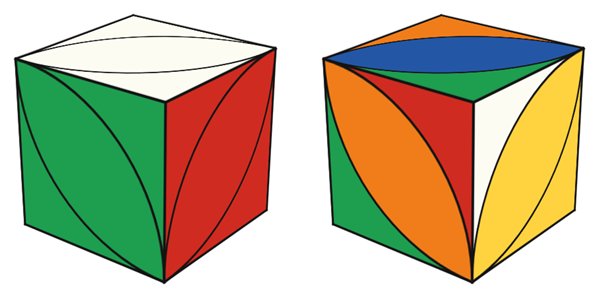
- Ivy Cube
- Rex Cube
- Dino Cube
- Redi Cube
- Face-Turning Octahedron
- Kilominx
- Master Kilominx
- Megaminx
- Pyraminx Crystal
- Starminx
- Rubik's Clock
- 4D Rubik's Cube
- Hungarian Rings
- Sliding 15 Puzzle
- Embed widgets
Algorithm notation. Only four corners of the Ivy Cube turn, so the notation uses four letters: R is the UFR corner, L the DFL corner, B the UBL corner and D the DBR corner. A plain letter turns that corner 120 degrees clockwise looking at it, a prime (R') turns it counter-clockwise, and R2 is the same as R'. The three-face names work too, in any order, so UFR equals R. Brackets repeat or invert a group: (R L')x3 or (R L')3 and (R L)'. The second input loads an algorithm into the player under the puzzle, played on the puzzle as it stands (set up a scramble with the first input): step through it with the buttons, press play, or click a move to jump there.
Online Ivy Cube Simulator
Free 3D Ivy Cube simulator: twist the four corners, move the leaf-shaped centres and learn the easy three-step solution. Scramble, timer and algorithm player.
Play and learn with the Ivy Cube simulator
The Ivy Cube is a corner-turning cube with curved cuts that draw a leaf shape on every face. It was originally hand-crafted by the puzzle designer Eitan Cher and later mass-produced by QiYi. Only four of its eight corners turn, every other corner around the cube, and each turn twists a corner by 120 degrees and carries three leaf-shaped centres with it. That leaves just ten visible pieces, four corners with three colours each and six single-coloured leaves, so it is one of the friendliest puzzles to start with if you know the 3x3 cube and want something new. It never changes shape.

How the simulator works
- Drag a sticker to turn the corner it belongs to, or drag the background to orbit and look at the other side.
- Keys: R, L, B and D turn the four corners clockwise, Shift turns them counter-clockwise.
- Scramble mixes the cube with an animated random sequence, Undo takes moves back and Reset returns it to solved.
- Timer: press Start/Stop or Space to time a solve. Scramble resets the timer but does not start it.
- Algorithms: type a sequence such as
R L R' L'and press Apply, or load it into the player under the cube to step through it move by move. The demo algorithms under the notation notes put a sequence into the input with one click. - Share or embed: the link box builds a URL with your scramble and algorithm, and the embed box gives you an iframe code for your own site.
How to solve the Ivy Cube
You do not need to memorise algorithms. The approach in the Ivy Cube tutorial has three stages:
- First face. Choose a colour and bring its leaf between the two corners that carry that colour, so the whole face shows one colour.
- Opposite face. Do the same for the opposite colour without breaking the first face.
- Last four leaves. Cycle the remaining centres into place. A commutator like
R L R' L', the first demo, moves three leaves around and leaves everything else where it was.
The simulator is a good place to learn that last step: reset the cube, play the commutator slowly in the player, and watch exactly which leaves travel. Once you can predict it, you can solve the puzzle from any scramble. The overall plan follows the same idea as Sarah's intermediate method for the Skewb, which makes the Skewb a natural next puzzle.
Is the Ivy Cube hard?
No, it is one of the easiest twisty puzzles. The corners never leave their positions, they only twist, and only the six leaves move around, so it can be solved intuitively with a little experimenting.
Why is R2 the same as R'?
A corner turn is a third of a full rotation, so two clockwise turns bring the corner to the same place as one counter-clockwise turn, just like the corner turns of the Pyraminx.
Which corner is which letter?
R is the up-front-right corner, L down-front-left, B up-back-left and D down-back-right. You can also type the three-face names, such as UFR for R, in any letter order.