- 2x2x2 pocket cube
- 3x3x3 Rubik's Cube
- 4x4x4 Rubik's Revenge
- 5x5x5 Professor's Cube
- Big Cube
- Picture Cube
- Ghost Cube
- 3x3x3 Cube Heads
- Mirror Cube
- Fisher Cube
- Axis Cube
- Mastermorphix
- Windmill Cube
- Pandora Cube
- Penrose Cube
- Globe puzzle
- Bandaged Cube
- Siamese Cube
- Void Cube
- Mixup Cube
- QJ Dodecahedron
- Floppy Cube
- 2x2x3 tower cube
- 2x2x4 tower cube
- Domino Cube
- 3x3x4 cuboid
- Square-1
- Pyramorphix
- Pyraminx
- Helicopter Cube
- Curvy Copter
- Clover Cube
- Skewb
- Skewb Ultimate
- Ivy Cube
- Rex Cube
- Dino Cube
- Redi Cube
- Face-Turning Octahedron
- Kilominx
- Master Kilominx
- Megaminx
- Pyraminx Crystal
- Starminx
- Rubik's Clock
- 4D Rubik's Cube
- Hungarian Rings
- Sliding 15 Puzzle
- Embed widgets
Algorithm notation. The Mastermorphix is a 3x3x3 inside a pyramid, so it reads standard cube notation on the cube within, the same layers the keys turn. U D L R F B turn the up, down, left, right, front and back face a quarter turn clockwise as you look at that face; an apostrophe (R') turns it counter-clockwise and a 2 (R2) turns it 180 degrees. M E S are the middle slices (M follows L, E follows D, S follows F), a w or a lowercase letter (Rw or r) turns two layers together, and x y z rotate the whole puzzle. A group in brackets repeats or inverts: (R U R' U')x3 or (R U R' U')3 plays the trigger three times and (R U)' plays its inverse. Because the pieces are shaped for the tetrahedron, a quarter turn shape-shifts the puzzle and the whole shape has to come back together to solve it. The second input loads an algorithm into the player under the puzzle, played on the puzzle as it stands (set up a scramble with the first input): step through it with the buttons, press play, or click a move to jump there.
Online Mastermorphix Simulator
Free Mastermorphix simulator: a pillowed pyramid with a 3x3 inside, in 4-colour or 1-colour mode. Scramble, solve by shape, time yourself and test algorithms.
Mastermorphix simulator: a 3x3 inside a pyramid
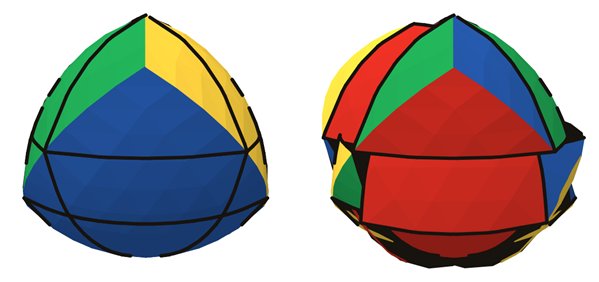
The Mastermorphix looks like a four-sided pyramid with gently curved, pillowed faces, but despite its appearance it is a shape modification of the 3x3x3 Rubik's Cube. Meffert's sold the commercial pillowed version, and this simulator recreates that curved shell. Every layer of the hidden cube can turn, and because the pieces are cut to fit a tetrahedron rather than a cube, almost every quarter turn throws the pyramid out of shape. You can play it in two versions: 4 colours, with one colour per face, and 1 colour, a gold pyramid that you solve by shape alone.

Which piece is which?
Knowing how the pyramid maps onto the cube inside is the key to solving it:
- The four tips and the four triangular centres of the faces are the eight corners of the cube. The face centres are solid triangles, so their twist is invisible and only their position matters.
- The six long pieces along the edges of the pyramid are the six centres of the cube.
- The remaining wedge-shaped pieces on each face are the twelve edges of the cube.
With that mapping in mind, the method you use on a regular cube carries over. One workable plan is to solve the cube inside layer by layer as usual, using the long edge pieces as your centres, and to check the pyramid shape after every step rather than only at the end. If you need a refresher on the cube itself, the beginner's method explains each step.
Practising with the simulator
Drag a piece to turn its layer and drag the empty background to orbit the pyramid. The keys u e d r l f b m s turn layers and Shift reverses them. Scramble mixes the puzzle, Undo steps back and Reset returns to the solved pyramid. Time your solves with the Start button or the Space bar; the timer resets when you scramble but only runs when you start it.
Notation follows the cube inside, so R U R' U' means the same thing here as on a 3x3. Type an algorithm into the first input to apply it, or load it into the step-by-step player to watch each move. The demos below the notation notes, including the T-perm and the checkerboard M2 E2 S2, are a good way to see how familiar sequences look on a pyramid. Start in the 4-colour version, and switch to 1 colour once you can read the pieces by shape. Changing the version recolours the puzzle without scrambling it. The link box saves your scramble and algorithm as a URL, and the embed code puts the simulator on your own page.
Is the Mastermorphix the same as the Pyramorphix?
No. The Pyramorphix is the smaller relative, a pyramid shape mod of the 2x2x2 cube. The Mastermorphix is its 3x3x3 counterpart, with more pieces and a centre triangle on each face.
Is the 1-colour version harder?
Usually, yes. Without colours you have to match pieces purely by their curved outlines, much like on the Mirror Cube. The simulator counts the 1-colour pyramid as solved as soon as the shape is restored.
When is the 4-colour version solved?
When the pyramid shape is back and each of the four curved faces shows a single colour, in any orientation. The status line then shows the number of moves.