- 2x2x2 pocket cube
- 3x3x3 Rubik's Cube
- 4x4x4 Rubik's Revenge
- 5x5x5 Professor's Cube
- Big Cube
- Picture Cube
- Ghost Cube
- 3x3x3 Cube Heads
- Mirror Cube
- Fisher Cube
- Axis Cube
- Mastermorphix
- Windmill Cube
- Pandora Cube
- Penrose Cube
- Globe puzzle
- Bandaged Cube
- Siamese Cube
- Void Cube
- Mixup Cube
- QJ Dodecahedron
- Floppy Cube
- 2x2x3 tower cube
- 2x2x4 tower cube
- Domino Cube
- 3x3x4 cuboid
- Square-1
- Pyramorphix
- Pyraminx
- Helicopter Cube
- Curvy Copter
- Clover Cube
- Skewb
- Skewb Ultimate
- Ivy Cube
- Rex Cube
- Dino Cube
- Redi Cube
- Face-Turning Octahedron
- Kilominx
- Master Kilominx
- Megaminx
- Pyraminx Crystal
- Starminx
- Rubik's Clock
- 4D Rubik's Cube
- Hungarian Rings
- Sliding 15 Puzzle
- Embed widgets
Algorithm notation. The simulator reads WCA Skewb notation: U L R B twist the half of the puzzle around that corner, with U the top-left-back corner, R the bottom-right-back, L the bottom-left-front and B the bottom-left-back. A plain letter is clockwise as you look at the corner and a prime is counter-clockwise; there is no 2, since U2 is the same as U'. F and D twist the front-right and bottom-front-right corners like the F and D keys. The Master Skewb, picked from the menu above the puzzle, cuts every corner less deep, so all eight corners turn on their own and each face shows 13 pieces: a centre, four off-centres, four edges and four corners - 50 pieces in all, 19 of them in every twist. Name its corners by their three faces in any order (UFR, UBL, DFR, DBL ...), plain clockwise and prime counter-clockwise, as on Jaap Scherphuis' Master Skewb page; the one-letter Skewb names still work. Brackets repeat or invert a group: (R U R' U')x3 or (R U R' U')3 plays it three times and (R U)' plays its inverse. The second input loads an algorithm into the player under the puzzle, played on the puzzle as it stands (set up a scramble with the first input): step through it with the buttons, press play, or click a move to jump there.
Online Skewb Simulator
Free 3D Skewb simulator with a Master Skewb mode: twist the corners in WCA notation, time your solves, step through algorithms and learn the beginner method.
Getting started with the Skewb simulator
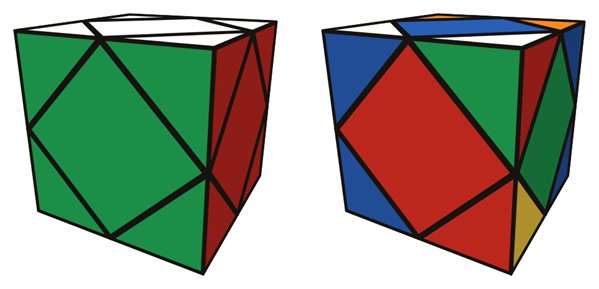
The Skewb looks like a cube, but it does not turn its faces. Every cut runs diagonally through the middle of the puzzle, so each move twists half of the cube around one corner by 120 degrees and carries four corners and three centres with it. It has just eight corners and six centres. The Skewb was invented by Tony Durham and marketed by Uwe Mèffert, who first called it the Pyraminx Cube; the name Skewb came from Douglas Hofstadter's Metamagical Themas column. In December 2013 it became an official World Cube Association event, and today it is one of the quickest events to learn.

What the simulator offers
- Natural turning: grab any sticker and drag. The corner nearest to the point you grabbed is the one that turns, whether you grab a corner or a centre. Drag the background to orbit the view.
- Keyboard: U, R, L and B turn the four WCA corners, F and D twist the front-right and bottom-front-right corners, and Shift reverses any of them.
- WCA scrambles: Scramble plays an animated random sequence in official notation, the same format as the Skewb scramble generator, and shows it in the status line. Undo and Reset are there when you need them.
- Timer: Start/Stop or the Space bar. Scramble zeroes the timer but leaves it stopped, so inspection is up to you.
- Algorithm practice: apply any sequence from the first input, or load it into the player to step through it. The demo list starts with the sledgehammer,
R' L R L', and its inverse. - Master Skewb: choose it from the menu for a deeper challenge: shallower cuts let all eight corners turn on their own, and every face shows 13 pieces. The curvy Rex Cube is a close relative.
How to solve the Skewb
The Skewb beginner's solution works in three stages:
- First face. Pick a centre and bring the four matching corners around it, making sure their side colours agree. This is mostly intuitive.
- Centres. With the solved face at the top, cycle the remaining centres into place with a short eight-move centre three-cycle.
- Last corners. Finish the four bottom corners with another short eight-move sequence, applied from the right angle and repeated if needed.

The tutorial lists the exact sequences, and you can paste each one into the player here to watch what it does piece by piece. Practising the cases slowly in the player, then timing full solves with the stopwatch, is a simple routine for getting faster.
Why is there no U2 on the Skewb?
A corner turn is a third of a full rotation, so two clockwise turns are the same as one counter-clockwise turn. The simulator therefore writes it as U'.
Which corners are U, L, R and B?
In the notation of the WCA regulations they are fixed corners of the puzzle in its holding position: U is top-left-back, R bottom-right-back, L bottom-left-front and B bottom-left-back. The F and D keys are a convenience for the corners nearest to you; the simulator records them as the matching WCA moves.
What is different on the Master Skewb?
It has 8 corners, 12 edges, 6 centres and 24 more face pieces, 50 in all. Its moves are named by the three faces at the corner, such as UFR or DBL. Once you are comfortable with both, try the twelve-sided Skewb Ultimate.
