- 2x2x2 pocket cube
- 3x3x3 Rubik's Cube
- 4x4x4 Rubik's Revenge
- 5x5x5 Professor's Cube
- Big Cube
- Picture Cube
- Ghost Cube
- 3x3x3 Cube Heads
- Mirror Cube
- Fisher Cube
- Axis Cube
- Mastermorphix
- Windmill Cube
- Pandora Cube
- Penrose Cube
- Globe puzzle
- Bandaged Cube
- Siamese Cube
- Void Cube
- Mixup Cube
- QJ Dodecahedron
- Floppy Cube
- 2x2x3 tower cube
- 2x2x4 tower cube
- Domino Cube
- 3x3x4 cuboid
- Square-1
- Pyramorphix
- Pyraminx
- Helicopter Cube
- Curvy Copter
- Clover Cube
- Skewb
- Skewb Ultimate
- Ivy Cube
- Rex Cube
- Dino Cube
- Redi Cube
- Face-Turning Octahedron
- Kilominx
- Master Kilominx
- Megaminx
- Pyraminx Crystal
- Starminx
- Rubik's Clock
- 4D Rubik's Cube
- Hungarian Rings
- Sliding 15 Puzzle
- Embed widgets
Algorithm notation. The Domino is a 3x3x2, so its moves follow Rubik's Cube notation with one rule from the mechanism: the two square layers U and D turn a quarter turn (U, U', U2), but the side layers R L F B and the slices M and S only turn 180 degrees and are written R2, L2, F2, B2, M2 and S2; a 90-degree side move is rejected. There is no E layer between two layers. Rw2 turns the right face and the M slice together, y spins the puzzle around its axis and x2 or z2 flips it over. Brackets repeat or invert a group: (U R2 U' F2)x3 or (U R2 U' F2)3 and (U R2)'. The second input loads an algorithm into the player under the cube, played on the cube as it stands (set up a scramble with the first input): step through it with the buttons, press play, or click a move to jump there.
Online Rubik's Domino Simulator
Free Rubik's Domino simulator: turn a 3D 3x3x2 cube online with real half-turn sides, scramble, time your solves and step through swap algorithms to solve it.
Rubik's Domino simulator: the 3x3x2 cube online
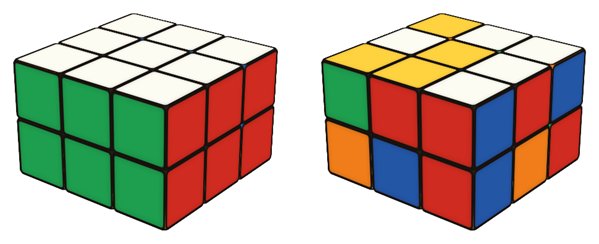
The Rubik's Domino is a 3x3x2 cuboid: a Rubik's Cube with only two layers, top and bottom. Ernő Rubik invented it and received a US patent for it on 29 March 1983. The classic version from the 1980s showed dots instead of colours, which is where its name comes from; today most Dominoes use the familiar six-colour stickers. The two square 3x3 layers turn freely, but the four 2x3 sides only make half turns, since a quarter turn would leave a side standing up out of the flat shape. The puzzle has 406,425,600 distinct positions, a tiny number next to a 3x3, yet it still needs a plan of its own.

Using the Domino simulator
- Turning: drag a sticker to turn its layer, drag the background to orbit. The top and bottom layers snap to quarter turns, the sides to half turns, as on the real puzzle.
- Keyboard: U and D turn the square layers (Shift reverses them), R L F B and the slices M and S always make a half turn, and Y spins the puzzle around its axis.
- Notation: in standard notation side moves are written R2, L2, F2, B2, M2 and S2; a 90-degree side move is rejected. There is no E slice, because there is no layer between two layers.
- Algorithms: type a sequence into the first input and Apply it, or load it into the player below the puzzle to step through it move by move.
- Practice tools: Scramble, Undo and Reset, a move counter, and a timer that Scramble resets without starting; Space starts and stops it. The link and embed boxes share your position.
How to solve the Rubik's Domino
The half-turn rule makes one part of the Domino easy: a top or bottom sticker can only ever move to the top or the bottom, so nothing is ever flipped or twisted. Every step is about position. The Ruwix Domino Cube solution works layer by layer:
- Bottom corners: collect the four white corners around the white centre.
- Top corners: place the yellow corners, swapping two at a time with a short algorithm.
- Sort the edges: bring all yellow edges into the top layer and all white edges into the bottom.
- Place the edges: finish with one algorithm for opposite edges and another for adjacent ones.

The simulator is ideal for learning those swaps. Load an algorithm into the second input, play it on a solved Domino and follow which two pieces trade places; then Reset and use it on a scramble. Algorithms from a 3x3 rarely help here, because most of them rely on quarter turns of the sides.
Tips
- Get used to
R2 U R2-style moves. Taking a piece down to the other layer and back is the main building block of every Domino algorithm. - Before an algorithm, turn U or D to line up as many pieces as possible; often one quarter turn saves a whole sequence.
- Watch the centres: a half turn of M or S swaps pieces between top and bottom too.
Is the Domino easier than the Rubik's Cube?
For most people, yes. It has far fewer positions and no orientation to fix. It feels unfamiliar at first because the usual 3x3 algorithms do not work, but a few swap sequences are enough to solve it.
Is there a bigger version?
Stacking two Dominoes gives the 3x3x4 cuboid, which has the same half-turn sides plus two inner layers that turn freely. If you want to go back to the original, the Rubik's Cube simulator is one click away.