- 2x2x2 pocket cube
- 3x3x3 Rubik's Cube
- 4x4x4 Rubik's Revenge
- 5x5x5 Professor's Cube
- Big Cube
- Picture Cube
- Ghost Cube
- 3x3x3 Cube Heads
- Mirror Cube
- Fisher Cube
- Axis Cube
- Mastermorphix
- Windmill Cube
- Pandora Cube
- Penrose Cube
- Globe puzzle
- Bandaged Cube
- Siamese Cube
- Void Cube
- Mixup Cube
- QJ Dodecahedron
- Floppy Cube
- 2x2x3 tower cube
- 2x2x4 tower cube
- Domino Cube
- 3x3x4 cuboid
- Square-1
- Pyramorphix
- Pyraminx
- Helicopter Cube
- Curvy Copter
- Clover Cube
- Skewb
- Skewb Ultimate
- Ivy Cube
- Rex Cube
- Dino Cube
- Redi Cube
- Face-Turning Octahedron
- Kilominx
- Master Kilominx
- Megaminx
- Pyraminx Crystal
- Starminx
- Rubik's Clock
- 4D Rubik's Cube
- Hungarian Rings
- Sliding 15 Puzzle
- Embed widgets
Algorithm notation. The 2x2x3 tower follows Rubik's Cube notation with the tower's own rule: the three horizontal layers U, E and D turn a quarter turn (U, U', U2), while the four side layers R L F B only turn 180 degrees and are written R2, L2, F2 and B2; a 90-degree side move is rejected. Uw turns the top two layers together, y spins the tower and x2 or z2 rolls it over. Brackets repeat or invert a group: (U R2 U' F2)x3 or (U R2 U' F2)3 and (U R2)'. The second input loads an algorithm into the player under the cube, played on the cube as it stands (set up a scramble with the first input): step through it with the buttons, press play, or click a move to jump there.
Online 2x2x3 Cube Simulator
Free 2x2x3 cube simulator: turn a 3D tower cube online with real half-turn sides, scramble, time your solves and step through algorithms, plus solving tips.
2x2x3 cube simulator: the tower cube online
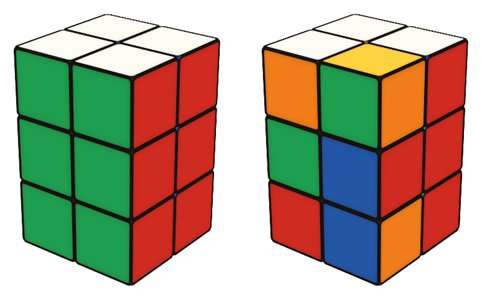
The 2x2x3, also called the Tower Cube or Slim Tower, is a pocket cube with an extra middle layer: two square 2x2 faces on top and bottom and four tall 2x3 sides. According to the Ruwix tower cube page it was designed by Katsuhiko Okamoto, shown at least once before January 2002, and mass production started in 2009 on a 3x3x3 kernel. The shape brings one important rule. The top, middle and bottom layers turn freely, but the four sides can only make half turns, because a quarter turn would not fit back into the tower. Jaap Scherphuis counts 241,920 positions and found that any of them can be solved in at most 14 face turns.
Using the 2x2x3 simulator
- Turning: drag a sticker to turn its layer. Horizontal layers snap to quarter turns, side layers to half turns, exactly like the real puzzle. Drag the background to orbit.
- Keyboard: U, E and D turn the top, middle and bottom layers, Shift reverses them; R L F B always make the half turn, and Y spins the whole tower.
- Algorithms: in standard cube notation write side moves as R2, L2, F2 and B2; a 90-degree side move is rejected with an error. Apply plays a sequence, and the player under the puzzle steps through an algorithm one move at a time.
- Practice tools: Scramble, Undo and Reset, plus a timer that Scramble resets but does not start; press Space to start and stop it. The link and embed boxes share your exact scramble.
How to solve the 2x2x3
A simple plan has two phases. First solve the top and bottom layers as if they were a 2x2: make the top face one colour, fix the side colours of its four corners, then do the same for the bottom. Because the side layers only make half turns, the top and bottom colours can never end up on the sides, so you never have to twist a corner in place. Second, solve the middle layer: turn it to match as many of its four pieces as possible, then swap the remaining ones with a short sequence of half turns.
The Ruwix guide to 2x2xN tower cubes gives the algorithms for each step. A handy way to learn them here: paste one into the second input, play it on a solved tower and watch which pieces move, then Reset and try it from a scramble. The demo algorithms under the notation are all legal on this shape too, so you can click one and see how quarter and half turns combine.
Tips
- Think in half turns. R2 U R2 style sequences are the basic tool of this puzzle, so practise their effect until you can predict it.
- Solve the whole top layer, including its side colours, before you touch the bottom; it keeps the second layer easy.
- If the middle layer looks almost right, turn it with E before you start an algorithm. One quarter turn often solves two pieces at once.
Is the 2x2x3 harder than a 2x2?
Not much. The top and bottom are solved almost exactly like a 2x2, and the restriction to half turns on the sides actually removes corner twisting. The new part is the middle layer, which only needs a couple of short algorithms.
Why can't the sides turn 90 degrees?
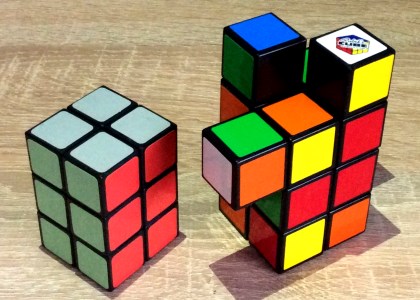
A side of the tower is two pieces wide and three tall. Turned by a quarter, it would stick out of the box, so the mechanism only allows the half turn that brings it back into place; the 2x3 sides of the Rubik's Domino follow the same rule. The 2x2x4 tower behaves differently: its sides are two by four, both even, so they do turn 90 degrees and the puzzle changes shape.