- 2x2x2 pocket cube
- 3x3x3 Rubik's Cube
- 4x4x4 Rubik's Revenge
- 5x5x5 Professor's Cube
- Big Cube
- Picture Cube
- Ghost Cube
- 3x3x3 Cube Heads
- Mirror Cube
- Fisher Cube
- Axis Cube
- Mastermorphix
- Windmill Cube
- Pandora Cube
- Penrose Cube
- Globe puzzle
- Bandaged Cube
- Siamese Cube
- Void Cube
- Mixup Cube
- QJ Dodecahedron
- Floppy Cube
- 2x2x3 tower cube
- 2x2x4 tower cube
- Domino Cube
- 3x3x4 cuboid
- Square-1
- Pyramorphix
- Pyraminx
- Helicopter Cube
- Curvy Copter
- Clover Cube
- Skewb
- Skewb Ultimate
- Ivy Cube
- Rex Cube
- Dino Cube
- Redi Cube
- Face-Turning Octahedron
- Kilominx
- Master Kilominx
- Megaminx
- Pyraminx Crystal
- Starminx
- Rubik's Clock
- 4D Rubik's Cube
- Hungarian Rings
- Sliding 15 Puzzle
- Embed widgets
Algorithm notation. The simulator reads standard Megaminx notation. The twelve faces are U R F L BL BR DR DL DBL DBR B and D, written in capitals. A plain face name turns it 72 degrees clockwise, a prime turns it counter-clockwise, and 2 or 2' is a 144-degree turn either way. The WCA scramble moves also work: R++ and R-- turn everything except the L face 144 degrees clockwise or counter-clockwise seen from the right, D++ and D-- turn everything except U, and U and U' turn the top. y rotates the whole puzzle around U, and brackets repeat or invert a group: (R U R' U')x3 or (R U R' U')3 plays it three times and (R U)' plays its inverse. On the Gigaminx and larger sizes, a number picks an inner layer (2R, 3R) and Rw or 3Rw turns the outer layers together. The second input loads an algorithm into the player under the puzzle, played on the puzzle as it stands (set up a scramble with the first input): step through it with the buttons, press play, or click a move to jump there.
Online Megaminx Simulator
Free 3D Megaminx simulator in your browser: scramble, turn and time solves, step through WCA notation algorithms, and switch to Gigaminx, Teraminx or Petaminx.
How to use the Megaminx simulator
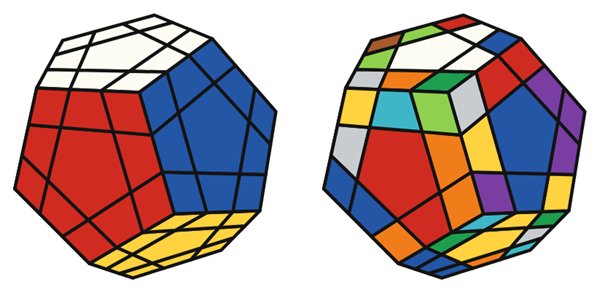
The Megaminx is the dodecahedral cousin of the Rubik's Cube: twelve pentagon faces, each with a fixed centre, five edges and five corners, for 50 movable pieces in all. As on the cube, every turn moves one face, so most 3x3 ideas carry over - you build layers, insert edge-corner pairs and finish with a last layer - only with fifths of a turn instead of quarters. It has been an official World Cube Association event since 2003. At the time of writing (October 2026) the single record is 21.04 seconds by Ziyu Wu and the average record is 23.40 seconds by Timofei Tarasenko.
Controls
- Turn a face by dragging its stickers. On the Gigaminx, Teraminx and Petaminx a drag can also turn an inner slice, depending on the piece you grab.
- Look around by dragging the background to orbit the puzzle.
- Keyboard: U, F, R, L and D turn the five labelled faces clockwise; hold Shift for counter-clockwise.
- Scramble, Undo and Reset sit under the puzzle. Scrambling does not start the clock: press Start or the Space bar when you begin, and again when you finish.
Practising with algorithms
The first input applies a move sequence straight to the puzzle, which is handy for setting up a scramble you got from a competition, a friend or the Megaminx scramble generator. The second loads an algorithm into the step-by-step player: play it, step forwards and back, or click any move to jump there. That is a comfortable way to learn last-layer algorithms slowly before drilling them by hand. The demo list includes the sexy move, Sune, a WCA scramble line and "every face once", which turns U, the upper ring, the lower ring and D in order, so you can learn which label belongs to which face. Notation follows the WCA: R++ and D-- turn everything except one face by two fifths, U turns the top and y rotates the whole puzzle. The link and embed boxes let you share a position or put the simulator on your own site.

A beginner's route to solving it
If you can solve a 3x3 layer by layer, you already know the plan:
- Make a star on the first face by matching its five edges to the neighbouring centres, then insert the five corners.
- Solve the second layer as edge-corner pairs, then keep working face by face until only the opposite face is left.
- On the last face, orient the edges into a star, then place the edges, place the corners and finally twist the corners.
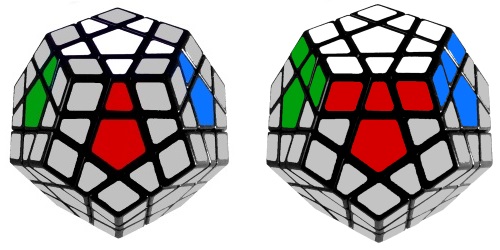
The Ruwix Megaminx solution gives the algorithms for each step. Try them here with Undo as a safety net: a wrong move costs one click instead of a fresh scramble.
Bigger and smaller minxes
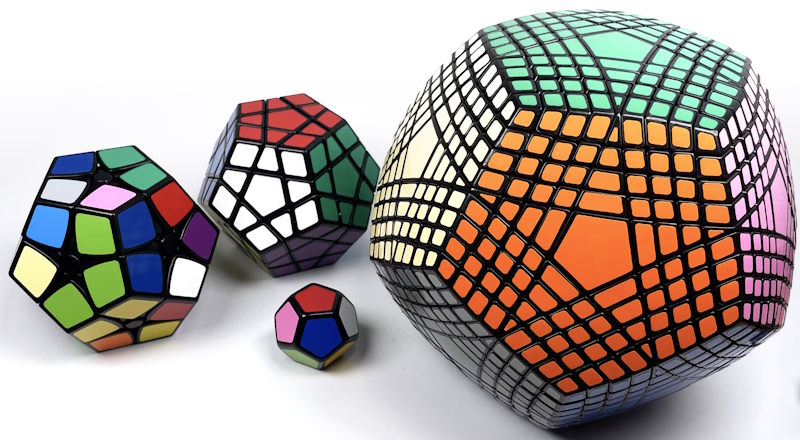
The menu above the puzzle switches in place to the Gigaminx (5 layers per face), Teraminx (7) and Petaminx (9), and the page link remembers the choice as #Gigaminx and so on. The big ones are solved by reduction: build the centres, pair up the edges, then finish like a Megaminx. In the other direction, the Kilominx keeps only the corners and the Master Kilominx is the 4x4 version.
Who invented the Megaminx?
Several people designed dodecahedral puzzles independently in the early 1980s. Christoph Bandelow's Hungarian Supernova came out first, and Uwe Meffert, who bought the rights to some of the patents, sells it under the Megaminx name.
Is the Megaminx harder than a Rubik's Cube?
It has more pieces and a solve takes longer, but it is not much harder in principle: almost every step reuses an idea from the 3x3. Most of the extra effort is recognition and the sheer number of faces to work through.
Does it work on a phone?
Yes. It runs in the browser and works with touch: drag a face to turn it and drag the empty space to rotate the view. No app or account is needed.