- 2x2x2 pocket cube
- 3x3x3 Rubik's Cube
- 4x4x4 Rubik's Revenge
- 5x5x5 Professor's Cube
- Big Cube
- Picture Cube
- Ghost Cube
- 3x3x3 Cube Heads
- Mirror Cube
- Fisher Cube
- Axis Cube
- Mastermorphix
- Windmill Cube
- Pandora Cube
- Penrose Cube
- Globe puzzle
- Bandaged Cube
- Siamese Cube
- Void Cube
- Mixup Cube
- QJ Dodecahedron
- Floppy Cube
- 2x2x3 tower cube
- 2x2x4 tower cube
- Domino Cube
- 3x3x4 cuboid
- Square-1
- Pyramorphix
- Pyraminx
- Helicopter Cube
- Curvy Copter
- Clover Cube
- Skewb
- Skewb Ultimate
- Ivy Cube
- Rex Cube
- Dino Cube
- Redi Cube
- Face-Turning Octahedron
- Kilominx
- Master Kilominx
- Megaminx
- Pyraminx Crystal
- Starminx
- Rubik's Clock
- 4D Rubik's Cube
- Hungarian Rings
- Sliding 15 Puzzle
- Embed widgets
Algorithm notation. The Pyraminx Crystal is a dodecahedron with deeper cuts, so it reads the same face names as the Megaminx. The twelve faces are U R F L BL BR DR DL DBL DBR B and D, written in capitals. A plain face name turns it 72 degrees clockwise, a prime turns it counter-clockwise, and 2 or 2' is a 144-degree turn either way. The WCA scramble moves also work: R++ and R-- turn everything except the L face 144 degrees clockwise or counter-clockwise seen from the right, D++ and D-- turn everything except U, and U and U' turn the top. y rotates the whole puzzle around U, and brackets repeat or invert a group: (R U R' U')x3 or (R U R' U')3 plays it three times and (R U)' plays its inverse. The second input loads an algorithm into the player under the puzzle, played on the puzzle as it stands (set up a scramble with the first input): step through it with the buttons, press play, or click a move to jump there.
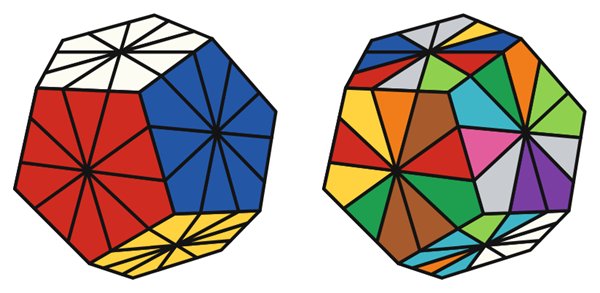
Online Pyraminx Crystal Simulator
Free 3D Pyraminx Crystal simulator: the deeper-cut Megaminx with 50 pieces and no centres. Scramble, time your solves and step through algorithms online.
Pyraminx Crystal simulator
The Pyraminx Crystal looks like a Megaminx at first glance, but its cuts go deeper: each face's cut reaches the centres of the five neighbouring faces. That removes the centre pieces altogether and leaves 50 pieces - 20 corners and 30 edges - with five corner kites and five edge triangles meeting at the middle of every face. A single turn moves 15 pieces: the face's 5 corners, its 5 edges and 5 more edges hanging below its corners. Despite the name it has little in common with the tetrahedral Pyraminx, apart from both being sold by Uwe Meffert.
A short history
The design was first built in 2006 by Aleh Hladzilin, a member of the Twisty Puzzles forum, under the name Brilic. Meffert began manufacturing it in late 2007 and shipped the first puzzles in February 2008. The WCA does not hold official events for it, so it is a puzzle for collectors and hobby solvers rather than competitions.
Using the simulator
- Drag a sticker to turn a face, and drag the background to orbit and look underneath.
- Keyboard: U, F, R, L and D turn the labelled faces clockwise; Shift turns them the other way.
- Scramble, Undo and Reset are under the puzzle. The timer is separate: press Start or Space to begin and stop it, since scrambling does not start it.
- Algorithm player: type or pick a demo and step through it move by move, or click a move to jump there.
Notation is the same as in the Megaminx tutorial: twelve faces named U R F L BL BR DR DL DBL DBR B D, a plain letter for a clockwise fifth of a turn and a prime for counter-clockwise. Because an edge belongs to four layers here instead of two, familiar sequences behave differently. The demo "18 sexy moves, back to the start" shows it well: R U R' U' needs 18 repetitions to return the Crystal to solved, against 6 on the Megaminx.
How to solve the Pyraminx Crystal
A common approach splits the puzzle by piece type:
- Corners first. Solve the 20 corners as you would on a Kilominx or the corner stages of a Megaminx. Edges can be ignored completely at this point.
- Edges second. Use commutators that cycle edges while returning every corner home, working face by face and leaving the last few faces for the end.
The simulator is a good place to find and test edge commutators: load a candidate into the algorithm player, step through it slowly, and check that the corners come back. Undo lets you back out of an experiment one move at a time.
Is the Pyraminx Crystal a Megaminx?
It is best described as a deeper-cut Megaminx. Both are dodecahedra with twelve turning faces, like the face-turning Starminx, but the Crystal has no centres and its edges are shared by more layers, so a turn disturbs more of the puzzle.
Is it harder than the Megaminx?
It has the same number of moving pieces, but without centres you have no fixed reference for the colours, and the edges take more planning. Learning the Megaminx first makes the corner stage familiar.