- 2x2x2 pocket cube
- 3x3x3 Rubik's Cube
- 4x4x4 Rubik's Revenge
- 5x5x5 Professor's Cube
- Big Cube
- Picture Cube
- Ghost Cube
- 3x3x3 Cube Heads
- Mirror Cube
- Fisher Cube
- Axis Cube
- Mastermorphix
- Windmill Cube
- Pandora Cube
- Penrose Cube
- Globe puzzle
- Bandaged Cube
- Siamese Cube
- Void Cube
- Mixup Cube
- QJ Dodecahedron
- Floppy Cube
- 2x2x3 tower cube
- 2x2x4 tower cube
- Domino Cube
- 3x3x4 cuboid
- Square-1
- Pyramorphix
- Pyraminx
- Helicopter Cube
- Curvy Copter
- Clover Cube
- Skewb
- Skewb Ultimate
- Ivy Cube
- Rex Cube
- Dino Cube
- Redi Cube
- Face-Turning Octahedron
- Kilominx
- Master Kilominx
- Megaminx
- Pyraminx Crystal
- Starminx
- Rubik's Clock
- 4D Rubik's Cube
- Hungarian Rings
- Sliding 15 Puzzle
- Embed widgets
Algorithm notation. Every head hides a 3x3x3 core, so the input reads standard Rubik's Cube notation on that core. U D L R F B turn the up, down, left, right, front and back face a quarter turn clockwise as you look at that face; an apostrophe (R') turns it counter-clockwise and a 2 (R2) turns it 180 degrees. M E S are the middle slices (M follows L, E follows D, S follows F), a w or a lowercase letter (Rw or r) turns two layers together, and x y z rotate the whole puzzle. A group in brackets repeats or inverts: (R U R' U')x3 or (R U R' U')3 plays the trigger three times and (R U)' plays its inverse. Each quarter turn shape-shifts the portrait; solving means bringing every fragment back to its place. The second input loads an algorithm into the player under the puzzle, played on the puzzle as it stands (set up a scramble with the first input): step through it with the buttons, press play, or click a move to jump there.
Online 3x3x3 Cube Heads Simulator
Free 3x3x3 Cube Heads simulator: Einstein, Chaplin, Minecraft Steve, Santa and more sculpted on a 3x3 core. Every turn reshapes the face. Scramble and solve.
3x3x3 Cube Heads: portraits sculpted on a Rubik's Cube core
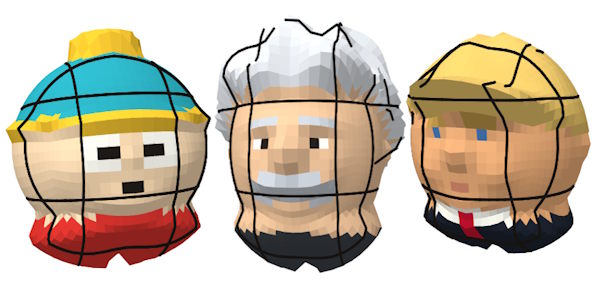
A cube head is a 3x3x3 shape mod with a sculpted shell: instead of a cube you hold a portrait, and the hidden cube inside cuts it into 26 pieces. Each turn slices the face apart and reassembles it into a strange cubist sculpture, where an ear can end up next to the chin or the hair halfway down a cheek. Like the Ghost Cube, it has to be solved by shape rather than by stickers, because no two pieces are alike. The head menu above the puzzle lets you choose between Einstein, Chaplin, Minecraft Steve, Trump, Santa Claus and Eric Cartman. All of them share the same 3x3 core, so the same moves and algorithms work on every head.

How to solve a head puzzle
Because the core is a standard 3x3, you can follow any 3x3 solving method. The difference is in how you read the pieces:
- Use features as landmarks. The nose, eyes, ears and hairline are easy to recognise and tell you where the front, sides and top belong.
- Find the centres. The six centres of the hidden cube only spin in place, so they define where each face goes. Turn a layer and watch which piece stays put.
- Check orientation. A piece in the right place can still be turned the wrong way, and a portrait shows it immediately. That includes the centres: the simulator only counts the head as solved when every fragment is back in place and facing the right way.
- Work layer by layer. Rebuild the top of the head first, then the middle with the face, and finish the chin or neck with last-layer algorithms.
Centre orientation is the part that surprises cube solvers. On a coloured cube a twisted centre is invisible; on a portrait it is not. The Ruwix guide to centre orientation explains how to twist centres without disturbing the rest, and the same algorithms work here.
Using the simulator
Drag a piece to turn its layer and drag the background to orbit the head. The keys u e d r l f b m s turn the layers of the core, with Shift for the opposite direction. Scramble mixes the portrait, Undo takes back a move and Reset rebuilds the head. Press Start or Space to time a solve; the timer never starts on its own after a scramble. The algorithm input applies a sequence such as the checkerboard pattern M2 E2 S2, and the step-by-step player under the puzzle lets you watch a demo like Sune one move at a time. The link and embed boxes let you share a scramble or show the puzzle on your own site.
Which head is the easiest?
The mechanism is the same for all of them, but they play differently. Minecraft Steve's head is almost a plain block with a pixel face, so it feels more like a picture cube where you match the pattern. The sculpted heads such as Einstein or Santa change shape much more, so you rely on the outline as well as the colours.
Do I need to know how to solve a Rubik's Cube first?
It helps a lot. Solving a normal 3x3 first teaches you the moves; the head then adds the challenge of reading shapes. If a portrait is too hard at first, try the Mirror Cube, which is also solved by shape but uses simple blocks.