- 2x2x2 pocket cube
- 3x3x3 Rubik's Cube
- 4x4x4 Rubik's Revenge
- 5x5x5 Professor's Cube
- Big Cube
- Picture Cube
- Ghost Cube
- 3x3x3 Cube Heads
- Mirror Cube
- Fisher Cube
- Axis Cube
- Mastermorphix
- Windmill Cube
- Pandora Cube
- Penrose Cube
- Globe puzzle
- Bandaged Cube
- Siamese Cube
- Void Cube
- Mixup Cube
- QJ Dodecahedron
- Floppy Cube
- 2x2x3 tower cube
- 2x2x4 tower cube
- Domino Cube
- 3x3x4 cuboid
- Square-1
- Pyramorphix
- Pyraminx
- Helicopter Cube
- Curvy Copter
- Clover Cube
- Skewb
- Skewb Ultimate
- Ivy Cube
- Rex Cube
- Dino Cube
- Redi Cube
- Face-Turning Octahedron
- Kilominx
- Master Kilominx
- Megaminx
- Pyraminx Crystal
- Starminx
- Rubik's Clock
- 4D Rubik's Cube
- Hungarian Rings
- Sliding 15 Puzzle
- Embed widgets
Algorithm notation. The 2x2x4 uses Rubik's Cube notation over its four horizontal layers: U and D are the top and bottom, 2U and 2D the two inner layers, and Uw or lowercase u turns U and 2U together. All of them turn a quarter turn, with ' for counter-clockwise and 2 for a half turn. The side moves R L F B are quarter turns too, and they shape-shift the tower: half of it swings out of the box and must be turned back to solve the shape. y spins the tower, x2 and z2 roll it over, and a quarter x or z is refused because the tower cannot stand sideways in its box. Brackets repeat or invert a group: (U R2 U' F2)x3 or (U R2 U' F2)3 and (U R)'. The second input loads an algorithm into the player under the cube, played on the cube as it stands (set up a scramble with the first input): step through it with the buttons, press play, or click a move to jump there.
Online 2x2x4 Cube Simulator
Free 2x2x4 cube simulator: a 3D tower that really shape-shifts on 90-degree side turns. Scramble, time your solves, step through algorithms and learn to solve.
2x2x4 cube simulator: a tower that changes shape
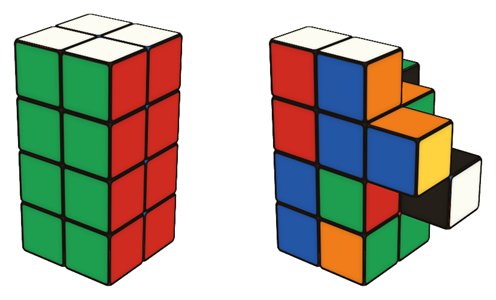
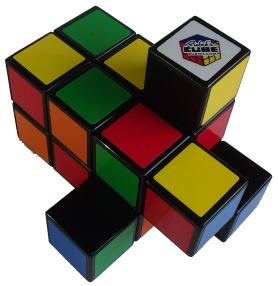
The 2x2x4 is a tower four layers tall with 2x2 faces on top and bottom. The Ruwix tower cube page credits Tony Fisher with building one in the late 1990s from a standard 4x4 Rubik's Revenge, while noting that it is unknown whether he was the first. Unlike the 2x2x3 tower, whose sides only make half turns, every face of the 2x2x4 can turn 90 degrees. Its sides are two by four, both even numbers, so a quarter turn still lines up with the rest of the puzzle, only no longer as a tower: half of it swings out sideways and the puzzle shape-shifts. Solving it means restoring both the colours and the shape.
How the 2x2x4 simulator works
- Turning: drag a sticker to turn its layer, drag the background to orbit. Side turns snap to quarter turns and really move the pieces out of the box, just like the physical puzzle; a layer carries along anything hanging on it.
- Allow impossible: a layer that sits completely outside the original box has nothing to turn it in a real puzzle, so it stays blocked. Tick the Allow impossible box to spin such layers anyway.
- Keyboard: U and D turn the top and bottom layers, J and K the two inner layers, R L F B the sides, Shift reverses a turn and Y spins the tower. A quarter X or Z is refused, because the tower cannot lie sideways in its box.
- Notation: 2U and 2D are the inner layers, Uw or u turns U and 2U together, as in the big cube notation. Apply plays a sequence at once; the player below steps through an algorithm move by move.
- Practice tools: Scramble, Undo, Reset, a move counter, and a timer that Scramble zeroes without starting. Space starts and stops it.
How to solve the 2x2x4
The key observation from the Ruwix guide to 2x2xN tower cubes is that the shape-shifting always leaves the pieces joined in 1x1x2 bars, so you can treat the tower as eight bars rather than sixteen loose pieces. That suggests a plan in three stages:
- Back to the box: if the puzzle is out of shape, turn the sides until it is a tower again. The guide suggests solving a single layer of bars first and then finishing the last one like a 2x2.
- Build the bars: pair up pieces of the same colours into 1x1x2 bars and gather the finished bars in one layer, until all eight are solved.
- Solve it like a 2x2: with eight solved bars the puzzle behaves like an elongated 2x2x2, so a pocket cube method finishes it.
If you have never solved a pocket cube, learn that first on the 2x2x2 simulator; the last stage of the 2x2x4 is exactly that.
Tips for practice
- Make a few side turns from solved, look at the shape, then Undo them one by one. Seeing how a shape arises makes it far easier to undo later.
- When building bars, use the inner layers J and K to bring a matching piece next to its partner, then fix the outer layers.
- Keep the timer for the full solve but time the "back to the box" stage separately too; on a scrambled 2x2x4 it is often the slowest part.
Why does the 2x2x4 change shape but the 2x2x3 does not?
A layer can only make a quarter turn if, after turning, its pieces line up with the rest of the puzzle. That works when both sides of the layer have the same parity: two by four (both even) works, two by three (even and odd) does not. Same parity with unequal lengths, as on the 2x2x4, means the turned layer lines up but no longer fits the tower outline.
Is the 2x2x4 hard to solve?
It is more confusing than difficult. Once you are back in tower form and the bars are paired, the rest is a pocket cube solve.