- 2x2x2 pocket cube
- 3x3x3 Rubik's Cube
- 4x4x4 Rubik's Revenge
- 5x5x5 Professor's Cube
- Big Cube
- Picture Cube
- Ghost Cube
- 3x3x3 Cube Heads
- Mirror Cube
- Fisher Cube
- Axis Cube
- Mastermorphix
- Windmill Cube
- Pandora Cube
- Penrose Cube
- Globe puzzle
- Bandaged Cube
- Siamese Cube
- Void Cube
- Mixup Cube
- QJ Dodecahedron
- Floppy Cube
- 2x2x3 tower cube
- 2x2x4 tower cube
- Domino Cube
- 3x3x4 cuboid
- Square-1
- Pyramorphix
- Pyraminx
- Helicopter Cube
- Curvy Copter
- Clover Cube
- Skewb
- Skewb Ultimate
- Ivy Cube
- Rex Cube
- Dino Cube
- Redi Cube
- Face-Turning Octahedron
- Kilominx
- Master Kilominx
- Megaminx
- Pyraminx Crystal
- Starminx
- Rubik's Clock
- 4D Rubik's Cube
- Hungarian Rings
- Sliding 15 Puzzle
- Embed widgets
Algorithm notation. The Fisher Cube is read on its own layers: U and D are the top and bottom, and R L F B are the four side layers that sit at 45 degrees to a normal cube, the same layers the r l f b keys turn. M E S are the middle slices (M follows L, E follows D, S follows F), Rw or r turns a face with its slice, and x y z rotate the whole cube. A plain letter is clockwise seen from outside, an apostrophe is counter-clockwise and 2 is a half turn. Brackets repeat or invert a group: (R U R' U')x3 or (R U R' U')3 plays the trigger three times and (R U)' plays its inverse. The second input loads an algorithm into the player under the cube, played on the cube as it stands (set up a scramble with the first input): step through it with the buttons, press play, or click a move to jump there.
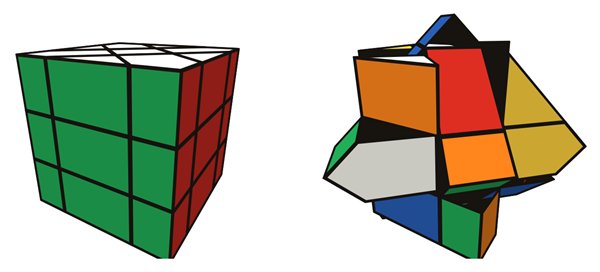
Online Fisher Cube Simulator
Free Fisher Cube simulator: turn the 45-degree 3x3 shape mod in your browser, scramble it, time your solves and step through algorithms move by move.
Fisher Cube simulator: a 3x3 turned 45 degrees
The Fisher Cube is one of the classic shape mods of the Rubik's Cube, named after the British puzzle designer Tony Fisher. Inside it is an ordinary 3x3x3 mechanism, but the whole cutting grid is rotated 45 degrees around the vertical axis. The top and bottom layers still turn like on a normal cube and keep the cube shape. The four side layers, however, face the vertical edges of the shell, so a single quarter turn of R, L, F or B (or of the M and S slices) bends the puzzle out of shape. Because the pieces move exactly like on a 3x3, every algorithm you know still works; what changes is how the pieces look.
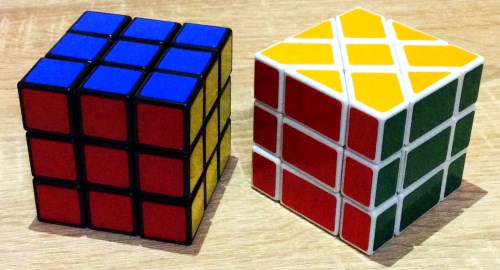
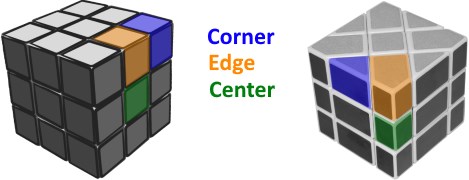
How the pieces map to a normal cube
This is the main difficulty. As the Ruwix Fisher Cube tutorial explains, the three-coloured "house" pieces that look like corners are really edges, the two-coloured triangles are the corners, and the one-coloured rectangles in the middle layer are edges as well. Once you read the puzzle this way, a solve follows the familiar layer-by-layer plan. Be careful during the last layer: an E permutation can look like a Z permutation at first glance, because the edges look like corners.
Practising in the simulator
- Drag a layer to turn it and drag the empty background to orbit the cube. On a keyboard, u e d r l f b m s turn the layers and Shift reverses the direction.
- Scramble mixes the cube with random moves. The timer does not start by itself: press Start or the Space bar when you begin and again when you finish.
- Undo takes back the last move and Reset returns to the solved cube, so you can experiment freely.
- Type a sequence such as
R U R' U'into the algorithm input to apply it, or load it into the player to step through it move by move and watch which pieces travel. The demo algorithms under the notation notes, including Sune and the T-perm, fill the input with one click. - The link box saves your scramble and algorithm in a URL you can share, and the embed box gives iframe code for your own site.
A good exercise is to run a demo slowly in the player and follow one house-shaped edge through the whole sequence. Doing that a few times trains the recognition you need far faster than random turning.
Do normal 3x3 algorithms work on the Fisher Cube?
Yes. The simulator names the layers by the mechanism, so R is the 45-degree side layer on the right and U is the top. Any 3x3 algorithm typed in this notation moves the pieces exactly as it would on a standard cube. If you are new to solving, learn the beginner's method first and then apply it here.
When does the simulator count the cube as solved?
As soon as the puzzle is a cube again with one colour on each face, in any orientation. The status line then shows how many moves you used.
How is it different from the Windmill and Axis cubes?
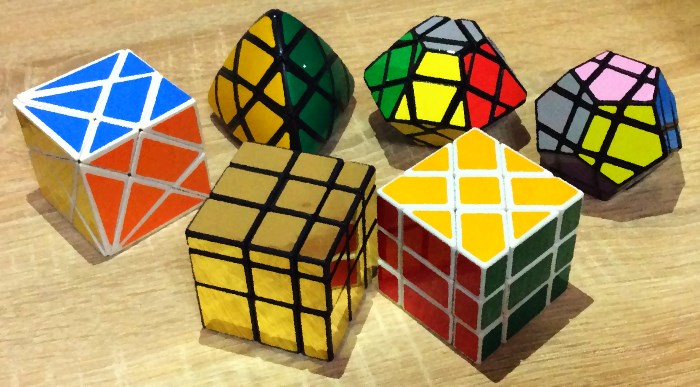
All three hide a 3x3 under a rotated grid. The Windmill Cube twists the grid by a smaller angle, so the top shows a pinwheel, while the Axis Cube tilts it around a corner-to-corner diagonal, so every single turn changes the shape. Because U and D turns keep the Fisher Cube in shape, it is easier to follow than the Axis Cube.