- 2x2x2 pocket cube
- 3x3x3 Rubik's Cube
- 4x4x4 Rubik's Revenge
- 5x5x5 Professor's Cube
- Big Cube
- Picture Cube
- Ghost Cube
- 3x3x3 Cube Heads
- Mirror Cube
- Fisher Cube
- Axis Cube
- Mastermorphix
- Windmill Cube
- Pandora Cube
- Penrose Cube
- Globe puzzle
- Bandaged Cube
- Siamese Cube
- Void Cube
- Mixup Cube
- QJ Dodecahedron
- Floppy Cube
- 2x2x3 tower cube
- 2x2x4 tower cube
- Domino Cube
- 3x3x4 cuboid
- Square-1
- Pyramorphix
- Pyraminx
- Helicopter Cube
- Curvy Copter
- Clover Cube
- Skewb
- Skewb Ultimate
- Ivy Cube
- Rex Cube
- Dino Cube
- Redi Cube
- Face-Turning Octahedron
- Kilominx
- Master Kilominx
- Megaminx
- Pyraminx Crystal
- Starminx
- Rubik's Clock
- 4D Rubik's Cube
- Hungarian Rings
- Sliding 15 Puzzle
- Embed widgets
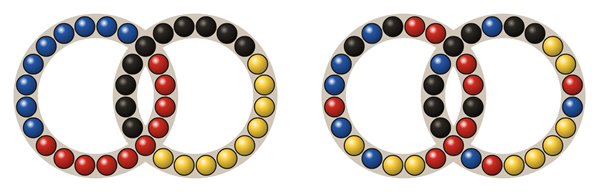
Solved position

counter-clockwise
clockwise
counter-clockwise
clockwise
Algorithm notation. The Hungarian Rings has two rings of 20 balls that cross at two points, so the two crossing balls belong to both rings. L and R turn the left or the right ring one ball clockwise, a prime (L') turns it counter-clockwise, and a number turns it several balls at once: L3 is three steps clockwise and R5' five steps counter-clockwise; 20 steps make a full turn. On the keyboard Z and X turn the left ring counter-clockwise and clockwise, N and M the right ring, and Shift reverses a key. You can also drag a ball along its ring or scroll the mouse wheel over a ring. Brackets repeat or invert a group: (L R L' R')x3 or (L R L' R')3 plays it three times and (L R)' plays its inverse. The second input loads an algorithm into the player under the puzzle, played on the puzzle as it stands (set up a scramble with the first input): step through it with the buttons, press play, or click a move to jump there.
Online Hungarian Rings Simulator
Play the Hungarian Rings puzzle online for free: turn two intersecting rings of 38 coloured balls, scramble, time your solves and practise the solution.
Play the Hungarian Rings Puzzle Online
The Hungarian Rings is a sliding puzzle built from two loops of coloured balls that cross each other. Turning one loop carries the two shared balls into the other loop, and that simple idea is enough to mix the colours thoroughly. This Hungarian Rings simulator lets you scramble, turn and solve the puzzle in your browser, so you can practise without owning the physical toy.

What is the Hungarian Rings puzzle?
Each ring holds 20 balls and the two rings share 2 of them, so the puzzle has 38 balls in four colours: 10 red, 10 black, 9 blue and 9 yellow. The two crossing points are five steps apart, which splits each ring into a short inner arc and a long outer arc. Counting balls of the same colour as identical, there are 75,406,424,215,922,599,800 different positions.
The flat two-ring version was designed by the Hungarian engineer Endre Pap and produced by Politoys in Hungary in 1982. The mechanism itself is much older: intersecting rings of balls already appear in a US patent by William Churchill granted in 1893. Today it sits on the puzzle shelf next to another Hungarian classic, the cube of Erno Rubik, and it is a nice change from the twisty puzzles most cubers know.
How to use the simulator
- Drag any ball along its ring to turn that ring. When you let go, the ring snaps to the nearest full ball step.
- Roll the mouse wheel over a ring to turn it one step at a time.
- Use the keyboard:
Z/Xturn the left ring counter-clockwise / clockwise,N/Mdo the same for the right ring. - Press Scramble to mix the balls, Undo to take back moves and Reset to return to the solved state.
- Start and stop the timer with the button or the Space key. Scrambling does not start it, so you can study the position first, just like with a speedcubing timer.
- Open the Solved position panel if you are unsure what the goal looks like, and copy the link or embed code to share your puzzle.
Hungarian Rings notation
L and R turn the left or right ring one ball step clockwise, while L' and R' turn them counter-clockwise. A number gives several steps, so L3 is three steps clockwise and R5' is five steps counter-clockwise. Twenty steps make a full turn. Type a sequence into the algorithm box and play it step by step, or load one of the demo sequences to watch how the balls travel between the rings.
How to solve the Hungarian Rings
- Gather the 10 black balls into one unbroken group in the outer arc of the left ring. This step is intuitive: bring a black ball to a crossing point, then turn the other ring to park it.
- Collect the 10 red balls in the outer arc of the right ring without breaking the black group.
- Sort the blue and yellow balls in the remaining positions. Here you swap two balls with a short sequence that returns everything else to its place, the same idea as commutators on a cube. Our Hungarian Rings solution explains this swap in detail.
- The puzzle counts as solved when every colour forms one unbroken group.
Tip: write your swap sequence into the algorithm player and step through it slowly. Watching which balls move, and which come back, is the fastest way to understand why it works.

Does scrambling start the timer?
No. Scramble only mixes the balls. Start the timer yourself with the button or Space when you are ready, and stop it the same way.
Can I share or embed the simulator?
Yes. Use the link box to copy a URL to the simulator, or the embed box to place the puzzle on your own website or blog.
What other puzzles can I practise online?
If you like moving pieces around a track, try the Sliding 15 Puzzle simulator next. For a classic twisty challenge, open the Rubik's Cube simulator.