- 2x2x2 pocket cube
- 3x3x3 Rubik's Cube
- 4x4x4 Rubik's Revenge
- 5x5x5 Professor's Cube
- Big Cube
- Picture Cube
- Ghost Cube
- 3x3x3 Cube Heads
- Mirror Cube
- Fisher Cube
- Axis Cube
- Mastermorphix
- Windmill Cube
- Pandora Cube
- Penrose Cube
- Globe puzzle
- Bandaged Cube
- Siamese Cube
- Void Cube
- Mixup Cube
- QJ Dodecahedron
- Floppy Cube
- 2x2x3 tower cube
- 2x2x4 tower cube
- Domino Cube
- 3x3x4 cuboid
- Square-1
- Pyramorphix
- Pyraminx
- Helicopter Cube
- Curvy Copter
- Clover Cube
- Skewb
- Skewb Ultimate
- Ivy Cube
- Rex Cube
- Dino Cube
- Redi Cube
- Face-Turning Octahedron
- Kilominx
- Master Kilominx
- Megaminx
- Pyraminx Crystal
- Starminx
- Rubik's Clock
- 4D Rubik's Cube
- Hungarian Rings
- Sliding 15 Puzzle
- Embed widgets
Algorithm notation. The Dino Cube turns at its corners, so its notation names corners rather than faces. A move is named by the three faces that meet at the corner it turns: URF, URB, ULF, ULB, DRF, DRB, DLF and DLB. A plain name turns that corner 120 degrees clockwise as you look at it, a prime (URF') turns it counter-clockwise, and URF2 is the same as URF'. The letters can come in any order, so RUF equals URF, and the digits 1 to 8 name the same corners as the keyboard. Brackets repeat or invert a group: (URF ULB')x3 or (URF ULB')3 plays it three times and (URF ULB)' plays its inverse. The second input loads an algorithm into the player under the puzzle, played on the puzzle as it stands (set up a scramble with the first input): step through it with the buttons, press play, or click a move to jump there.
Online Dino Cube Simulator
Free Dino Cube simulator in 3D: twist the corners, scramble, time your solves and step through algorithms. An easy first corner-turning puzzle to learn.
Dino Cube Simulator: A Friendly Corner-Turning Puzzle
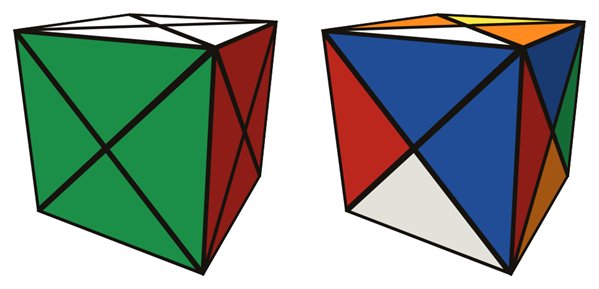
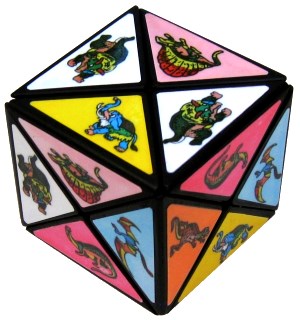
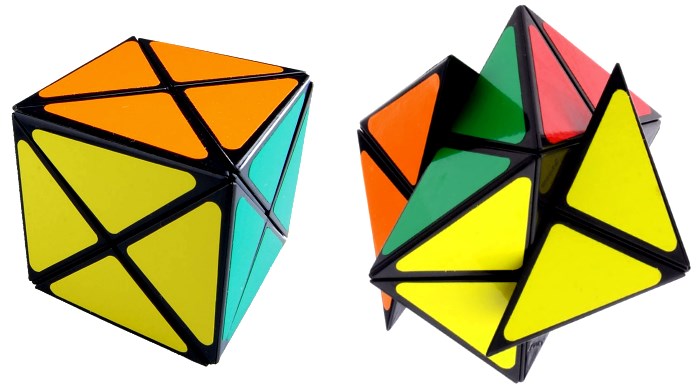
The Dino Cube is a cube that turns around its corners. Its only visible pieces are 12 edges, and each twist moves the three edges around one corner. Robert Webb made the first prototype out of paper in 1985, but mass production only started in 1995; the name comes from that first commercial version, which had dinosaur pictures on its pieces. Because each edge fits its slot only one way, there is nothing to orient, and the Dino Cube is often called one of the easiest twisty puzzles to solve. The six-colour version has 19,958,400 possible positions.
That makes this Dino Cube simulator a good first step beyond the 3x3x3 cube, and a quick puzzle to keep in a browser tab for practice.
Using the simulator
- Twist: drag a triangle and the cube tip nearest to where you grabbed it turns. Drag the background to orbit the cube.
- Keys: the digits 1 to 8 turn the eight corners clockwise; hold Shift to turn counter-clockwise.
- Scramble, Undo, Reset: Scramble plays an animated random scramble, Undo takes back a move and Reset gives you the solved cube again.
- Timer: after a scramble the timer sits at zero until you press Start or the Space bar, so you decide how long to inspect. Space stops it again.
- Algorithms: type moves such as
URF ULB'and press Apply, or load them into the player and step through one twist at a time. The demo algorithms under the notation notes are ready to try. - Share: the link and embed boxes save your scramble and algorithm as a URL or iframe code.
How to solve the Dino Cube
A simple layer method, as in the Ruwix Dino Cube solution, needs hardly any memorised moves:
- First face: place the four edges of one colour. The last one usually has to knock out a solved piece; move that piece aside and put it back.
- Middle layer: place the four vertical edges without disturbing the first face.
- Last layer: solve one top edge with a short sequence, turn the cube so it sits at the back, then solve the edge opposite it. That finishes the puzzle.
The one real trap is the colour scheme. With no centres to show which colour belongs where, it is easy to build a first face whose side colours are in the wrong order, and then the puzzle cannot be finished. The simulator uses the standard Rubik's Cube colour scheme (white opposite yellow, green opposite blue, red opposite orange), so orbit the solved cube before you scramble and note the order of the side colours around white. There is no parity to worry about.
Is the Dino Cube good for beginners?
Yes. Each move only touches three pieces and there is nothing to orient, so most people can solve it with intuition and a couple of short sequences. It is a gentle introduction to corner-turning puzzles such as the Rex Cube.
How is it related to the Redi Cube and the Skewb?
All three turn around the corners. The Redi Cube adds eight corner pieces to the Dino Cube's edges, and the Skewb cuts through the middle of the cube, so every turn moves half the puzzle.