- 2x2x2 pocket cube
- 3x3x3 Rubik's Cube
- 4x4x4 Rubik's Revenge
- 5x5x5 Professor's Cube
- Big Cube
- Picture Cube
- Ghost Cube
- 3x3x3 Cube Heads
- Mirror Cube
- Fisher Cube
- Axis Cube
- Mastermorphix
- Windmill Cube
- Pandora Cube
- Penrose Cube
- Globe puzzle
- Bandaged Cube
- Siamese Cube
- Void Cube
- Mixup Cube
- QJ Dodecahedron
- Floppy Cube
- 2x2x3 tower cube
- 2x2x4 tower cube
- Domino Cube
- 3x3x4 cuboid
- Square-1
- Pyramorphix
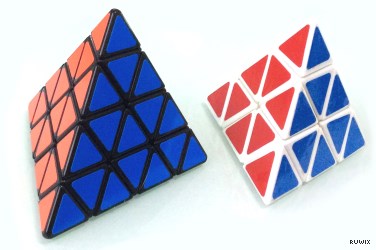
- Pyraminx
- Helicopter Cube
- Curvy Copter
- Clover Cube
- Skewb
- Skewb Ultimate
- Ivy Cube
- Rex Cube
- Dino Cube
- Redi Cube
- Face-Turning Octahedron
- Kilominx
- Master Kilominx
- Megaminx
- Pyraminx Crystal
- Starminx
- Rubik's Clock
- 4D Rubik's Cube
- Hungarian Rings
- Sliding 15 Puzzle
- Embed widgets
Algorithm notation. The simulator reads WCA Pyraminx notation. U L R B turn a corner together with the layer under it, two layers in all, and the lowercase u l r b turn only the tip. A plain letter is clockwise looking at that corner, and an apostrophe or a 2 reverses it, since two turns bring a corner back. On the Master Pyraminx, Uw Lw Rw Bw turn the wide three-layer corner. F and D rotate the front and bottom face like the F and D keys and are recorded as B' and U'. Brackets repeat or invert a group: (U L' u)x3 or (U L' u)3, and (U L)'. The second input loads an algorithm into the player under the puzzle, played on the puzzle as it stands (set up a scramble with the first input): step through it with the buttons, press play, or click a move to jump there.
Online Pyraminx Simulator
Free 3D Pyraminx simulator with a 4-layer Master Pyraminx mode: twist corners and tips in WCA notation, time your solves and learn a simple beginner method.
Learn and practise with the Pyraminx simulator
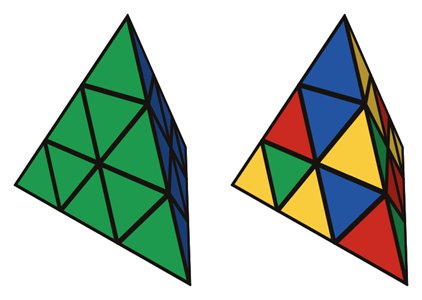
The Pyraminx is the tetrahedral twisty puzzle made and patented by Uwe Mèffert and introduced by Tomy in 1981. Instead of turning faces like a 3x3, it turns around its four corners in 120-degree steps. It has four tips that spin on their own, four axial centre pieces under them and six edges, and it has 933,120 positions if you ignore the trivial tips, every one solvable in at most 11 twists. It is also an official World Cube Association event, and one of the fastest: the world record average is well under two seconds, so clean, efficient turning matters more than on almost any other puzzle.
Controls
- Mouse or touch: grab a sticker and drag. The corner closest to where you grabbed is the one that turns; grab the small tip region and only the tip spins. Drag the background to orbit.
- Keyboard: U, L, R and B turn the two-layer corners, the number keys 1 to 4 turn the tips u, l, r and b, and F and D rotate the front and bottom face. Hold Shift to turn the other way.
- Master Pyraminx: pick it from the menu above the puzzle for four layers and 16 triangles per face. Hold W with a corner key, or type Uw Lw Rw Bw, to turn the wide three-layer corner.
- Scramble, Undo, Reset work as you would expect; the scramble is animated and printed in WCA notation, like the ones from the Pyraminx scrambler.
- Timer: the Start/Stop button or Space starts and stops it. Scramble resets it to zero without starting, so you still get your inspection.
A simple way to solve it
The beginner method in the Pyraminx tutorial needs only a few short steps:
- Turn each tip to match the centre piece beneath it. This takes at most one turn per tip.
- Turn the corners until the centre colours agree on every face.
- Solve the three edges around one corner with short four-move inserts.
- Finish the last edges with a three-edge cycle or a two-edge flip.

Many top speedsolvers use V-first methods such as Layer by Layer or L4E instead. The algorithm player is ideal for learning those last-step cases: enter the case, find a solution with the Pyraminx solver, load it into the player and step through it until your hands know it.
Pyraminx notation in short
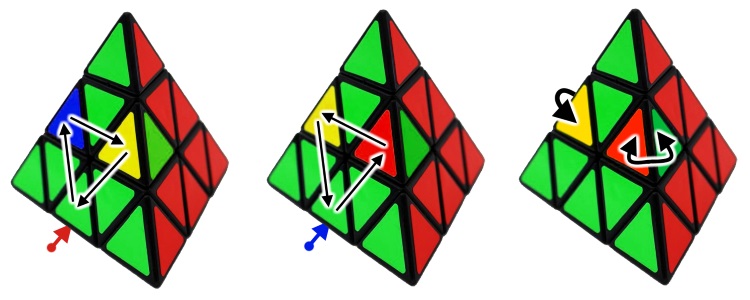
Capital letters U, L, R and B turn a corner together with the layer below it, and lower-case letters turn only the tip. A plain letter is clockwise as you look at that corner, an apostrophe is counter-clockwise, and there is no 2 because two clockwise turns equal one counter-clockwise turn, just as on the Skewb.
Do I need to solve the tips at all?
Yes, but they are the easy part. Each tip turns on its own without moving anything else, so most solvers fix them at the start or the very end.
Is the Master Pyraminx much harder?
It is a big step up: about 2.68 quadrillion combinations and new piece types, face centres and inner edges, on top of the tips, axial pieces and outer edges. The tips and corner turns still work the way you know from the Pyraminx, so switch between the two sizes here to compare them before you try a full solve.