- 2x2x2 pocket cube
- 3x3x3 Rubik's Cube
- 4x4x4 Rubik's Revenge
- 5x5x5 Professor's Cube
- Big Cube
- Picture Cube
- Ghost Cube
- 3x3x3 Cube Heads
- Mirror Cube
- Fisher Cube
- Axis Cube
- Mastermorphix
- Windmill Cube
- Pandora Cube
- Penrose Cube
- Globe puzzle
- Bandaged Cube
- Siamese Cube
- Void Cube
- Mixup Cube
- QJ Dodecahedron
- Floppy Cube
- 2x2x3 tower cube
- 2x2x4 tower cube
- Domino Cube
- 3x3x4 cuboid
- Square-1
- Pyramorphix
- Pyraminx
- Helicopter Cube
- Curvy Copter
- Clover Cube
- Skewb
- Skewb Ultimate
- Ivy Cube
- Rex Cube
- Dino Cube
- Redi Cube
- Face-Turning Octahedron
- Kilominx
- Master Kilominx
- Megaminx
- Pyraminx Crystal
- Starminx
- Rubik's Clock
- 4D Rubik's Cube
- Hungarian Rings
- Sliding 15 Puzzle
- Embed widgets
Algorithm notation. The Rex Cube turns around its corners, so a move is named by the three faces that meet at that corner: UFR, UFL, UBR, UBL, DFR, DFL, DBR and DBL. A plain name turns the corner 120 degrees clockwise as you look at it, a prime (UFR') turns it counter-clockwise, and UFR2 is the same as UFR'. The letters can come in any order, so RUF equals UFR. Brackets repeat or invert a group: (UFR DBL')x3 or (UFR DBL')3 plays it three times and (UFR DBL)' plays its inverse. The second input loads an algorithm into the player under the cube, played on the cube as it stands (set up a scramble with the first input): step through it with the buttons, press play, or click a move to jump there.
Online Rex Cube Simulator
Free 3D Rex Cube simulator: twist all eight corners of this curvy corner-turning cube, scramble it, time your solves and follow a clear five-step solving plan.
Explore the Rex Cube simulator
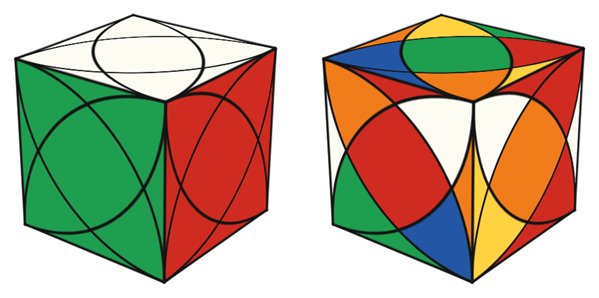
The Rex Cube is a corner-turning cube with curved cuts on all eight corners. It is closely related to the Master Skewb, but its cuts are curved so that they meet exactly at the corners of the cube, which means it has no corner pieces at all. What you get instead are 42 moving pieces: 6 four-pointed face centres, 12 edges and 24 small petal-shaped face pieces. Every move twists one corner by 120 degrees and drags three centres, three edges and nine petals around with it, and the puzzle has about 402 sextillion positions. Compared with a 3x3 it feels very different: nothing ever turns as a flat layer, and the pieces travel diagonally across the faces.
Using this simulator
- Mouse or touch: drag a piece to twist a corner, drag the background to orbit the view.
- Keyboard: the top row Q, W, E and R turns the four upper corners and the home row A, S, D and F the four lower ones. Hold Shift for a counter-clockwise turn.
- Scramble, Undo and Reset: scramble with an animated random sequence, take moves back one by one or return straight to solved.
- Timer: Start/Stop or Space. Scramble resets the time to zero but does not start it, so look the cube over first.
- Algorithm input and player: type moves such as
UFR' UFL UFR UFL'and press Apply, or load a sequence into the player and step through it. The demos include corner commutators and a sequence that turns every corner once. - Link and embed: share your exact scramble and algorithm as a URL, or copy the iframe code to show the puzzle on your own page.
How to approach a solve
Jaap Scherphuis, whose puzzle pages are a standard reference, solves it in this order:
- Edges. Solve the twelve edges relative to each other. A Dino Cube method works for this step.
- Face centres. Turn the centres so they match the edges around them.
- Pair the petals. Arrange the petals so that diagonally opposite pieces on each face have the same colour.
- Solve the petals. Swap pairs until every face is complete apart from the centres.
- Finish the centres with three-cycles and swaps.
For the later steps you need sequences that move only a few pieces. Load the demo commutators, such as UFR' UFL UFR UFL', into the player on a solved cube and step through them to see exactly which pieces travel; that is the quickest way to build your own toolkit before you rely on it in a solve.
How is the Rex Cube different from the Dino Cube?
Both turn around their corners, but the Dino Cube has only its twelve edge pieces to solve. The Rex Cube adds centres and petals on top of that, so the edges are just the first stage of the solve.
How do I write Rex Cube moves?
A move is named by the three faces of its corner: UFR, UFL, UBR, UBL, DFR, DFL, DBR and DBL. A plain name is a clockwise turn as you look at the corner, a prime is counter-clockwise, and the letters can come in any order, so RUF is the same as UFR.
Is there a puzzle that looks different but works the same?
Yes. Ignoring the colouring, the Rex Cube is equivalent to the Face-Turning Octahedron, which is a fun comparison once you know one of them.