- 2x2x2 pocket cube
- 3x3x3 Rubik's Cube
- 4x4x4 Rubik's Revenge
- 5x5x5 Professor's Cube
- Big Cube
- Picture Cube
- Ghost Cube
- 3x3x3 Cube Heads
- Mirror Cube
- Fisher Cube
- Axis Cube
- Mastermorphix
- Windmill Cube
- Pandora Cube
- Penrose Cube
- Globe puzzle
- Bandaged Cube
- Siamese Cube
- Void Cube
- Mixup Cube
- QJ Dodecahedron
- Floppy Cube
- 2x2x3 tower cube
- 2x2x4 tower cube
- Domino Cube
- 3x3x4 cuboid
- Square-1
- Pyramorphix
- Pyraminx
- Helicopter Cube
- Curvy Copter
- Clover Cube
- Skewb
- Skewb Ultimate
- Ivy Cube
- Rex Cube
- Dino Cube
- Redi Cube
- Face-Turning Octahedron
- Kilominx
- Master Kilominx
- Megaminx
- Pyraminx Crystal
- Starminx
- Rubik's Clock
- 4D Rubik's Cube
- Hungarian Rings
- Sliding 15 Puzzle
- Embed widgets
Algorithm notation. The Skewb Ultimate is a Skewb in a dodecahedral shell, so it uses the WCA Skewb letters over the corners of its hidden cube. The simulator reads WCA Skewb notation: U L R B twist the half of the puzzle around that corner, with U the top-left-back corner, R the bottom-right-back, L the bottom-left-front and B the bottom-left-back. A plain letter is clockwise as you look at the corner and a prime is counter-clockwise; there is no 2, since U2 is the same as U'. F and D twist the front-right and bottom-front-right corners like the F and D keys. Brackets repeat or invert a group: (R U R' U')x3 or (R U R' U')3 plays it three times and (R U)' plays its inverse. The second input loads an algorithm into the player under the puzzle, played on the puzzle as it stands (set up a scramble with the first input): step through it with the buttons, press play, or click a move to jump there.
Online Skewb Ultimate Simulator
Free 3D Skewb Ultimate simulator: the Skewb mechanism in a twelve-sided dodecahedron. Twist the corners, scramble, time your solves and learn how to solve it.
About this Skewb Ultimate simulator
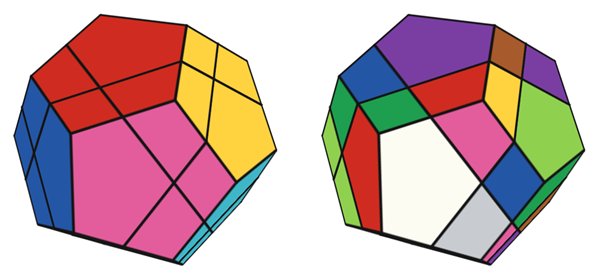
The Skewb Ultimate is a Skewb in a twelve-sided shell. It has the shape of a dodecahedron, like the Megaminx, but it is cut very differently: four planes through the centre, the same deep cuts as a Skewb, so every move twists half of the puzzle by 120 degrees. Uwe Mèffert produced it, and it was originally marketed as the Pyraminx Ball. Inside there are only 14 pieces, eight small corners and six large four-sided pieces, and the puzzle has 100,776,960 combinations.
Why it is harder than the Skewb
Mechanically the two puzzles are identical, and every Skewb move has the same effect here. The difference is what you can see. On a Skewb a centre looks the same in either of its two orientations, but on the Skewb Ultimate each large piece spans several faces, so a piece that sits in the right place can still be turned the wrong way, much like the centres of a picture cube. Solving it as a Skewb therefore leaves you with one extra job: orienting those large pieces. The irregular shape also makes it harder to see which colours belong together. Most physical copies use six colours, with opposite faces sharing a colour, and some early ones used twelve; this simulator gives all twelve faces their own colour.
Using the simulator
- Turning: drag a piece to twist the half it belongs to, and drag the background to orbit and look at the hidden side.
- Keyboard: U, R, L and B turn the four WCA Skewb corners of the hidden cube, F and D the front-right and bottom-front-right ones; Shift reverses the turn.
- Scramble, Undo and Reset mix the puzzle with an animated random sequence, take back moves or return it to solved.
- Timer: Start/Stop or Space. Scramble resets the clock to zero but does not start it.
- Algorithms: type Skewb notation into the first input, or load a sequence into the step-by-step player. The demos include the sledgehammer
R' L R L'and a pattern that returns to the start after six repeats. - Sharing: the link and embed boxes rebuild your scramble and algorithm as a URL or an iframe.
How to solve it
A practical route is to solve it like a Skewb first: get the eight corners into a solved arrangement and place the six large pieces in their correct spots, then turn your attention to their orientation. If you do not know a Skewb method yet, start with the Skewb beginner's solution; the same sequences work here because the moves are the same. Before using a sequence on a scrambled puzzle, load it into the player on a solved one and step through it slowly: seeing exactly which pieces it moves and turns is the fastest way to find the right tool for the orientation step.
Is the Skewb Ultimate a WCA event?
No. The Skewb is on the list of official World Cube Association events, but the Skewb Ultimate is not, so it is a puzzle for fun and personal challenge rather than competition.
Can I use Skewb notation?
Yes. The simulator reads WCA Skewb notation over the corners of the hidden cube, so U, L, R and B mean the same as on a Skewb and sequences from the Skewb scrambler work here too. A plain letter is clockwise as you look at that corner, a prime is counter-clockwise, and there is no 2 because U2 equals U'.