- 2x2x2 pocket cube
- 3x3x3 Rubik's Cube
- 4x4x4 Rubik's Revenge
- 5x5x5 Professor's Cube
- Big Cube
- Picture Cube
- Ghost Cube
- 3x3x3 Cube Heads
- Mirror Cube
- Fisher Cube
- Axis Cube
- Mastermorphix
- Windmill Cube
- Pandora Cube
- Penrose Cube
- Globe puzzle
- Bandaged Cube
- Siamese Cube
- Void Cube
- Mixup Cube
- QJ Dodecahedron
- Floppy Cube
- 2x2x3 tower cube
- 2x2x4 tower cube
- Domino Cube
- 3x3x4 cuboid
- Square-1
- Pyramorphix
- Pyraminx
- Helicopter Cube
- Curvy Copter
- Clover Cube
- Skewb
- Skewb Ultimate
- Ivy Cube
- Rex Cube
- Dino Cube
- Redi Cube
- Face-Turning Octahedron
- Kilominx
- Master Kilominx
- Megaminx
- Pyraminx Crystal
- Starminx
- Rubik's Clock
- 4D Rubik's Cube
- Hungarian Rings
- Sliding 15 Puzzle
- Embed widgets
Algorithm notation. The Globe is a 3x3x3 ball, so the input reads standard Rubik's Cube notation. U D L R F B turn the up, down, left, right, front and back face a quarter turn clockwise as you look at that face; an apostrophe (R') turns it counter-clockwise and a 2 (R2) turns it 180 degrees. M E S are the middle slices (M follows L, E follows D, S follows F), a w or a lowercase letter (Rw or r) turns two layers together, and x y z rotate the whole puzzle. A group in brackets repeats or inverts: (R U R' U')x3 or (R U R' U')3 plays the trigger three times and (R U)' plays its inverse. The second input loads an algorithm into the player under the puzzle, played on the puzzle as it stands (set up a scramble with the first input): step through it with the buttons, press play, or click a move to jump there.
Online Globe Puzzle Simulator
Free Globe puzzle simulator: a sphere with a 3x3 inside. Scramble the Earth map and put the continents back, or play with 6, 4 or 3 colours in 3-D.
Globe Puzzle Simulator: a 3x3 Hidden in a Sphere
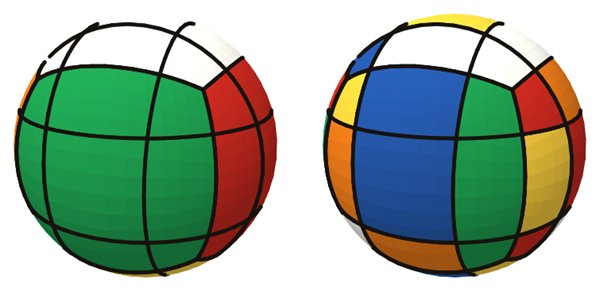
The Globe puzzle is a ball with an ordinary 3x3x3 mechanism inside. The cuts that divide a cube into layers become three pairs of circles around the sphere, and each piece carries a curved patch of the surface. Because the ball looks the same after any quarter turn, it never changes shape: only the picture painted on it gets mixed up. In this simulator you can paint that picture four ways with the dropdown above the puzzle.

- Earth - a world map wrapped around the ball. Scramble it and put the continents back together.
- 6 colors - the classic cube colour scheme projected onto the sphere.
- 4 colors - left and right share one colour, and front and back share another.
- 3 colors - each colour covers two neighbouring regions, the same pairs as on the Penrose Cube.
How it differs from a Rubik's Cube
Mechanically it is a 3x3, so every algorithm you know works. The difficulty is visual. A sphere has no flat faces or sharp edges, so you cannot simply look at "the front"; instead you follow the dark cut circles that separate the layers. In Earth mode there are no colour blocks at all, and a piece is placed correctly only when its part of the map lines up with its neighbours. As on a Picture Cube, that includes the centre pieces: a centre can be in the right place but turned the wrong way, which a plain colour scheme would never show. The well-known sequence (R U R' U)x5 turns the top centre by 180 degrees without disturbing anything else.

Using the simulator
- Drag any piece to turn its layer and drag the background to roll the whole ball around. Keys U E D R L F B M S turn layers; Shift reverses them.
- Scramble, Undo and Reset work as on a cube. The Start/Stop button or the Space bar times your solve, and a scramble resets the clock without starting it.
- The algorithm input accepts standard notation, and the player under the ball steps through a sequence one move at a time. Try the checkerboard demo in Earth mode to see what it does to the map.
- Use the link box to share a scramble and the embed code to show the puzzle on another page.
Tips for solving the globe
Start in 6-colour mode, where the ball behaves like a round Rubik's Cube and you can use any 3x3 solving method you know. Once that feels easy, switch to Earth and solve one hemisphere first: the poles and a recognisable coastline make good anchors for the first layer. The 4- and 3-colour modes are a different kind of challenge, because fewer colours mean more pieces that look alike, so check each piece against all of its neighbours before you commit to a move. The simulator treats a ball turned to any orientation as solved, so you never need to bring a particular continent to the front.
Is a globe puzzle harder than a 3x3?
It uses the same moves and the same algorithms. What makes it harder is recognition on a curved surface, plus centre orientation when you play with the map.
Does the ball ever change shape?
No. Every turn maps the sphere onto itself, so it stays perfectly round however you scramble it.
Can I practise with a normal colour scheme?
Yes. Pick "6 colors" in the dropdown for a standard colour scheme, or one of the other options for a fresh challenge.