- 2x2x2 pocket cube
- 3x3x3 Rubik's Cube
- 4x4x4 Rubik's Revenge
- 5x5x5 Professor's Cube
- Big Cube
- Picture Cube
- Ghost Cube
- 3x3x3 Cube Heads
- Mirror Cube
- Fisher Cube
- Axis Cube
- Mastermorphix
- Windmill Cube
- Pandora Cube
- Penrose Cube
- Globe puzzle
- Bandaged Cube
- Siamese Cube
- Void Cube
- Mixup Cube
- QJ Dodecahedron
- Floppy Cube
- 2x2x3 tower cube
- 2x2x4 tower cube
- Domino Cube
- 3x3x4 cuboid
- Square-1
- Pyramorphix
- Pyraminx
- Helicopter Cube
- Curvy Copter
- Clover Cube
- Skewb
- Skewb Ultimate
- Ivy Cube
- Rex Cube
- Dino Cube
- Redi Cube
- Face-Turning Octahedron
- Kilominx
- Master Kilominx
- Megaminx
- Pyraminx Crystal
- Starminx
- Rubik's Clock
- 4D Rubik's Cube
- Hungarian Rings
- Sliding 15 Puzzle
- Embed widgets
Shape settings
Distance of each face from the core centre (1–100). MES sets the middle-layer thickness (one mechanism, so M, E and S match; on the 4×4×4 it sets both inner slices). Changing a value rebuilds the puzzle and resets it to solved.
Algorithm notation. The Mirror Cube is a 3x3x3 under its uneven blocks, so the input reads standard notation on the mechanism layers. U D L R F B turn the up, down, left, right, front and back face a quarter turn clockwise as you look at that face; an apostrophe (R') turns it counter-clockwise and a 2 (R2) turns it 180 degrees. M E S are the middle slices (M follows L, E follows D, S follows F), a w or a lowercase letter (Rw or r) turns two layers together, and x y z rotate the whole puzzle. A group in brackets repeats or inverts: (R U R' U')x3 or (R U R' U')3 plays the trigger three times and (R U)' plays its inverse. The 2x2x2 mirror has no slices, and on the 4x4x4 mirror a lowercase r, u or f is an inner slice while Rw turns both right layers, matching the way the move list prints them. The second input loads an algorithm into the player under the cube, played on the cube as it stands (set up a scramble with the first input): step through it with the buttons, press play, or click a move to jump there.
Online Mirror Cube Simulator
Free Mirror Cube simulator: solve Mirror Blocks by shape in 2x2, 3x3 or 4x4, in gold, silver or colour, with custom layer sizes, a timer and algorithm player.
Mirror Cube simulator: solve by shape, not colour
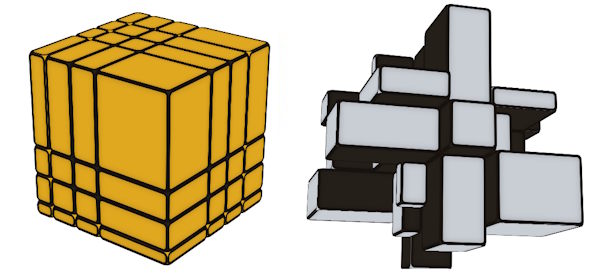
The Mirror Cube, sold as Mirror Blocks, was invented by Hidetoshi Takeji in 2006. He first called it the Bump Cube because of its uneven surface when scrambled, and it went into mass production in 2008. Inside it is a normal 3x3x3 mechanism, but every layer has a different thickness, so each piece is a block of its own size. All stickers share one reflective colour, which means you cannot rely on colours at all: the puzzle is solved when it is a perfect cube again.

What you can set in this simulator
- Size: a 2x2x2, 3x3x3 or 4x4x4 mechanism inside the same uneven block.
- Finish: Golden or Silver for the classic shape-only puzzle; Colored adds normal cube colours, so you solve colours and shape at once; Chaotic bakes the colours on in a scrambled state, so the colour solution is a bumpy shape and the cube shape becomes a separate puzzle.
- Shape settings: sliders move each face closer to or further from the core and set the thickness of the middle layers. Changing a value rebuilds the puzzle in its solved state.

How to solve the Mirror Cube
Because the mechanism is a 3x3, it can be solved the same way as the Rubik's Cube; you just read heights and widths instead of colours. The Ruwix Mirror Blocks guide follows the beginner's method with a few adjustments:
- Build the cross on the thinnest layer, where the small pieces are easy to spot, and match each edge to the centre of the same height.
- Place the first-layer corners by checking that they sit flush with their neighbours; expect some trial and error.
- Insert the middle-layer edges as on a 3x3, comparing their height with the centres beside them.
- Orient and then permute the last layer, judging each case by shape. A layer that is truly finished looks flat on every side.
If you get stuck, switch the finish to Colored for a few solves. The colours tell you instantly whether a piece is in the right place, which is a quick way to learn what a correct block looks like before you go back to gold or silver.
Practice tools
Drag a layer to turn it and drag the background to orbit the puzzle; keyboard turns use the face letters, with Shift for the inverse. Scramble mixes the cube, Undo takes back a move and Reset restores the solved block. The Start button or Space toggles the timer, which waits for you after a scramble instead of starting by itself. Type a sequence into the algorithm input to apply it, or load it into the player to step through it move by move. The demo list changes with the size: the 3x3 has Sune, the T-perm and a checkerboard, and the 4x4 adds wide moves and an OLL parity algorithm. Use the link box to share a scramble, or the embed code to show the puzzle on your own page.
Is the Mirror Cube harder than a normal 3x3?
The moves are identical, so any 3x3 method works. It feels harder because you cannot see at a glance which pieces belong together, and the scrambled shape hides what is going on. The extra work is almost all recognition, which is exactly what repeated practice here trains.
Are there other one-colour shape puzzles to try?
Yes. The Ghost Cube is a one-colour puzzle designed to be as challenging as possible, with layers cut at odd angles, and the gold version of the Mastermorphix is solved by shape in the same way.
