- 2x2x2 pocket cube
- 3x3x3 Rubik's Cube
- 4x4x4 Rubik's Revenge
- 5x5x5 Professor's Cube
- Big Cube
- Picture Cube
- Ghost Cube
- 3x3x3 Cube Heads
- Mirror Cube
- Fisher Cube
- Axis Cube
- Mastermorphix
- Windmill Cube
- Pandora Cube
- Penrose Cube
- Globe puzzle
- Bandaged Cube
- Siamese Cube
- Void Cube
- Mixup Cube
- QJ Dodecahedron
- Floppy Cube
- 2x2x3 tower cube
- 2x2x4 tower cube
- Domino Cube
- 3x3x4 cuboid
- Square-1
- Pyramorphix
- Pyraminx
- Helicopter Cube
- Curvy Copter
- Clover Cube
- Skewb
- Skewb Ultimate
- Ivy Cube
- Rex Cube
- Dino Cube
- Redi Cube
- Face-Turning Octahedron
- Kilominx
- Master Kilominx
- Megaminx
- Pyraminx Crystal
- Starminx
- Rubik's Clock
- 4D Rubik's Cube
- Hungarian Rings
- Sliding 15 Puzzle
- Embed widgets
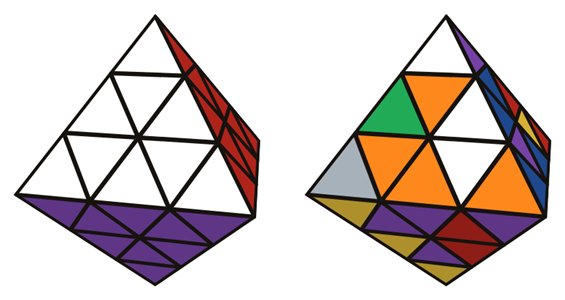
Algorithm notation. The Face-Turning Octahedron has eight faces, written U R F L B BL BR and D, where BL and BR are the two back faces beside B. A plain face name turns it 120 degrees clockwise seen from outside, a prime (U') is counter-clockwise, and U2 is the same as U'. On the Master FTO, which has four rows, 2U turns the slice under U. Brackets repeat or invert a group: (U R')x3 or (U R')3 plays it three times and (U R)' plays its inverse. The second input loads an algorithm into the player under the puzzle, played on the puzzle as it stands (set up a scramble with the first input): step through it with the buttons, press play, or click a move to jump there.
Online FTO Simulator
Free FTO simulator in 3D: practise the Face-Turning Octahedron, a new WCA event from 2027, plus Skewb Diamond and Master FTO. Scramble, time, learn.
FTO Simulator: Practise the Face-Turning Octahedron
The Face-Turning Octahedron, or FTO, is an eight-sided puzzle whose triangular faces each turn 120 degrees. It has 42 visible pieces: 6 corners, 12 edges and 24 triangle centres, with nine stickers on each face and eight colours in all. The idea is old (Erno Rubik filed a Hungarian patent for an octahedral puzzle in 1980, and US and German patents followed in 1982), but working versions only appeared much later: David Pitcher built a mechanism between 2001 and 2003, and Xie Zongliang's design reportedly reached about 1,000 copies in 2008.
Today the FTO is a speedcubing puzzle. In June 2026 the World Cube Association announced that FTO becomes an official event from 2 January 2027, the first new event since Skewb was added in 2014, solved as an average of five. This FTO simulator is a free way to learn the puzzle or keep your turning fresh when your own FTO is not at hand.
Three puzzles in one
- 3x3 FTO: the standard puzzle and the one used in competition.
- 2x2 Skewb Diamond: the FTO without its middle layers, sometimes called the 2x2 FTO. It is a good warm-up because it has only corners and centres.
- 4x4 Master FTO: four rows per face, with inner slices you can turn on their own, written 2U and so on.
Pick the size from the menu above the puzzle.
Controls and practice tools
- Drag a face to twist it, or drag the background to orbit. Keys 1 to 8 turn the eight faces clockwise, Shift reverses them, and on the Master FTO the keys Q to I turn the inner slices.
- Scramble mixes the puzzle and resets the timer without starting it. Start and stop timing with the Start button or the Space bar, so you can take your inspection first.
- Undo takes back a move and Reset restores the solved puzzle.
- Paste a scramble from a competition or a training session into the first input and press Apply to reproduce it exactly. Load an algorithm into the player to step through it move by move, or try the demo algorithms under the notation notes.
- The link and embed boxes turn a scramble and algorithm into a URL you can share with a friend or save for later.
How to approach a solve
A sensible way in is to work outward from one face: solve its triangles, edges and corners first, then the pieces around it, and save the last few pieces for short algorithms. Use the Skewb Diamond setting to learn how corners and centres move before adding the edges of the full FTO. For speed, a widely known approach is Bencisco, a method Ben Streeter began developing in 2018 that led to the first documented sub-minute FTO solve. Whatever method you learn, the simulator's step-by-step player is useful for drilling a new algorithm until the move order is automatic.
What do the face names mean?
The simulator names the eight faces U, R, F, L, B, BL, BR and D, where BL and BR are the two back faces beside B. A plain letter turns that face clockwise as seen from outside, and a prime turns it counter-clockwise, just as in cube notation.
Is the FTO hard to learn?
It usually takes longer to learn than a Pyraminx or a Skewb, because there are more pieces and the turns feel unfamiliar, but the ideas carry over from cube solving: build blocks, then finish with a few algorithms. The Skewb Diamond setting is an easy way to get used to the octahedral turns first.