- 2x2x2 pocket cube
- 3x3x3 Rubik's Cube
- 4x4x4 Rubik's Revenge
- 5x5x5 Professor's Cube
- Big Cube
- Picture Cube
- Ghost Cube
- 3x3x3 Cube Heads
- Mirror Cube
- Fisher Cube
- Axis Cube
- Mastermorphix
- Windmill Cube
- Pandora Cube
- Penrose Cube
- Globe puzzle
- Bandaged Cube
- Siamese Cube
- Void Cube
- Mixup Cube
- QJ Dodecahedron
- Floppy Cube
- 2x2x3 tower cube
- 2x2x4 tower cube
- Domino Cube
- 3x3x4 cuboid
- Square-1
- Pyramorphix
- Pyraminx
- Helicopter Cube
- Curvy Copter
- Clover Cube
- Skewb
- Skewb Ultimate
- Ivy Cube
- Rex Cube
- Dino Cube
- Redi Cube
- Face-Turning Octahedron
- Kilominx
- Master Kilominx
- Megaminx
- Pyraminx Crystal
- Starminx
- Rubik's Clock
- 4D Rubik's Cube
- Hungarian Rings
- Sliding 15 Puzzle
- Embed widgets
Algorithm notation. The Professor's Cube uses standard big cube notation. The outer faces U D L R F B turn a quarter turn clockwise, with ' for counter-clockwise and 2 for a half turn. A number picks an inner slice: 2R is the second layer from the right and 3R the middle one, which is also M' (M follows L, E follows D, S follows F). A wide move turns layers together: Rw or lowercase r is the face plus one slice, 3Rw three layers, and the Ruwix subscript F₂ equals Fw while a plain F2 is a half turn of the front face. 5Rw turns every layer, which is the x rotation; x y z rotate the cube. Brackets repeat or invert a group: (3Rw U 3Rw' U')x3 or (3Rw U 3Rw' U')3 and (R U)'. The second input loads an algorithm into the player under the cube, played on the cube as it stands (set up a scramble with the first input): step through it with the buttons, press play, or click a move to jump there.
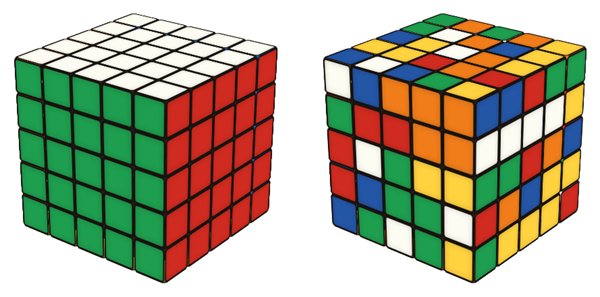
Online 5x5 Rubik's Cube Simulator
Free 5x5 Rubik's Cube simulator: turn a 3D Professor's Cube online, practise centres and edge pairing, time your solves and step through any algorithm.
5x5 Rubik's Cube simulator: the Professor's Cube online
The 5x5x5, known as the Professor's Cube, was invented by Udo Krell in 1981 by expanding the mechanism of a 3x3x3; from 1983 his design was manufactured and sold by Uwe Mèffert. Its surface has 98 pieces: 8 corners, 36 edges (12 middle edges and 24 "wings") and 54 centre pieces, of which the six in the middle of each face are fixed. That gives about 2.83 × 10^74 positions. Compared with a 4x4 it is more work but often feels friendlier, because the fixed centres tell you the colour scheme. This 5x5 Rubik's Cube simulator lets you practise every stage of the solve without wearing out a real puzzle.
How to use the 5x5 simulator
- Turning: drag a sticker to turn its layer, including the inner slices; drag the background to orbit the cube.
- Keyboard: U R F D L B turn the outer faces, M E S the exact middle slices, J and K the second layer from the top and from the bottom, X Y Z rotate the cube and Shift reverses a turn.
- Notation input: in big cube notation 2R is the second layer from the right, 3R the middle slice, Rw or r two layers and 3Rw three layers together. Apply plays a sequence on the cube; the player below steps through an algorithm move by move, forwards or backwards.
- Scramble, Undo, Reset and timer: Scramble mixes the cube and zeroes the clock without starting it; press Space or Start when you begin and again when you are done.
- Share: the link and embed boxes turn your scramble and algorithm into a URL or iframe code.
How to solve the 5x5: reduction in three stages
The Ruwix 5x5 solution uses the same reduction idea as the 4x4, so it helps to know that one first:
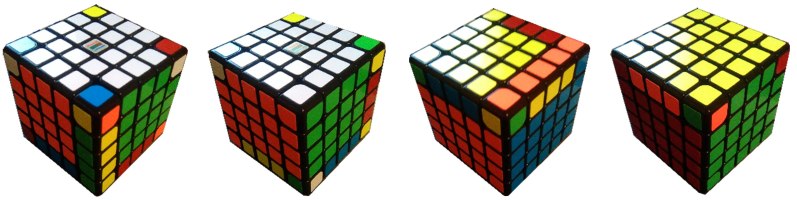
- Centres: build the 3x3 block of centre pieces on each face around its fixed middle piece.
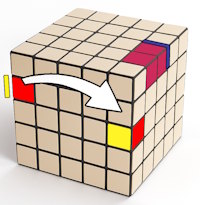
- Edges: join each middle edge with its two wings into a single 1x3 edge bar.
- 3x3 stage: solve the result like a big 3x3 Rubik's Cube, using only outer face turns.
Because the 5x5 has an odd number of layers, the parity errors sometimes seen on the 4x4 cannot occur here. Edge pairing is the longest stage, so that is where practice pays off most.
Practice tips
- Learn the centre stage in pieces: build one centre, Undo a few moves and rebuild it until the inner-slice moves become natural.
- For edge pairing, set up a case with the first input, then load the pairing algorithm into the player and step through it to see how the slice moves the wings and back again.
- Time a full solve, then time just the centres; the difference shows you where to focus next.
- Orbit the cube often. On a big cube many mistakes come from not seeing the back faces.
Is the 5x5 harder than the 4x4?
It takes longer, because there are many more pieces to place. Many solvers still find it easier to understand, since the fixed centres show where each colour belongs and the 4x4 parity cases do not appear.
Which puzzle should I learn before the 5x5?
A 3x3 and then the 4x4 Rubik's Revenge. Once you can reduce a 4x4 and a 5x5, the same method works on every bigger cube up to 10x10x10 in this simulator.