- 2x2x2 pocket cube
- 3x3x3 Rubik's Cube
- 4x4x4 Rubik's Revenge
- 5x5x5 Professor's Cube
- Big Cube
- Picture Cube
- Ghost Cube
- 3x3x3 Cube Heads
- Mirror Cube
- Fisher Cube
- Axis Cube
- Mastermorphix
- Windmill Cube
- Pandora Cube
- Penrose Cube
- Globe puzzle
- Bandaged Cube
- Siamese Cube
- Void Cube
- Mixup Cube
- QJ Dodecahedron
- Floppy Cube
- 2x2x3 tower cube
- 2x2x4 tower cube
- Domino Cube
- 3x3x4 cuboid
- Square-1
- Pyramorphix
- Pyraminx
- Helicopter Cube
- Curvy Copter
- Clover Cube
- Skewb
- Skewb Ultimate
- Ivy Cube
- Rex Cube
- Dino Cube
- Redi Cube
- Face-Turning Octahedron
- Kilominx
- Master Kilominx
- Megaminx
- Pyraminx Crystal
- Starminx
- Rubik's Clock
- 4D Rubik's Cube
- Hungarian Rings
- Sliding 15 Puzzle
- Embed widgets
Algorithm notation. The simulator reads WCA Rubik's Clock notation. A move such as UR3+ first puts only the named pins up (UR, DR, DL, UL, the pairs U, R, D, L, or ALL), then turns a wheel next to them the given number of hours, + for clockwise and - for counter-clockwise, and finally puts every pin down. y2 turns the clock round with 12 staying on top, so later moves act on the back face. Pin names at the very end of an older scramble, such as UR DL, are left up on the side facing you. Brackets repeat or invert a group: (UR3+ DL2-)x3 or (UR3+ DL2-)3 plays it three times and (UR3+ DL2-)' plays it backwards with every wheel turned the other way. The second input loads an algorithm into the player under the puzzle, played on the puzzle as it stands (set up a scramble with the first input): step through it with the buttons, press play, or click a move to jump there.
Online Rubik's Clock Simulator
Free Rubik's Clock simulator with both faces side by side: set pins, turn wheels, paste WCA scrambles, time your solves and step through algorithms online.
Rubik's Clock Simulator With Both Faces Side by Side
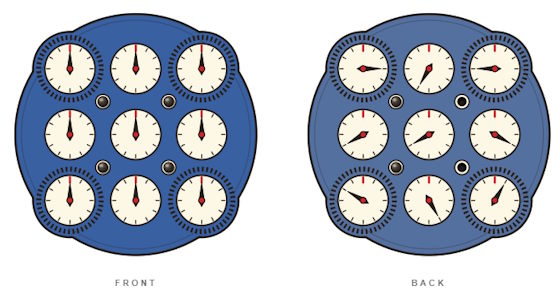
The Rubik's Clock is a flat, two-sided puzzle with nine clock dials on each face, four corner wheels and four pins. It was invented and patented by Christopher C. Wiggs and Christopher J. Taylor, and Erno Rubik bought the patent and marketed it under his name from 1988. The corner dials run straight through the body, so only 14 of the 18 dials move independently, which still gives 12 to the power of 14, about 1.28 quadrillion, dial positions. The goal is simple to state: get every dial on both faces pointing to 12.

On a real Clock you keep flipping the puzzle to check the back. This Rubik's Clock simulator draws the front and back next to each other, the back exactly as you would see it after turning the puzzle over left to right, so you can watch how every move affects both sides.
Controls
- Wheels: drag a corner wheel round like a real dial, or click it to turn it one hour clockwise (Shift-click for counter-clockwise). The keys Q, W, A and S turn the four wheels; add Shift to reverse.
- Pins: click a pin to push it through to the other side, or press 1 to 4. P puts all four pins up or down together.
- Scramble, Undo, Reset: Scramble sets a random position, Undo takes back your last move and Reset returns every dial to 12.
- Timer: Scramble resets the timer but does not start it. Press Start or the Space bar to begin, and again to stop.
Practising WCA scrambles
The simulator reads WCA notation, so you can paste an official-style scramble such as UR3+ DL2- into the first input and press Apply to recreate it, including the y2 that turns the puzzle round. The second input loads a sequence into the step-by-step player, which is a good way to drill a method move by move and see exactly which dials each pin setting couples. Demo algorithms under the notation notes give you something to try straight away, and the link and embed boxes save any scramble as a shareable URL.
How to solve the Rubik's Clock
The beginner method in the Ruwix Rubik's Clock solution guide needs no memorised algorithms:
- Front cross: use pin settings that turn one edge dial together with the centre and line up the four edge dials with the centre.
- Back cross: do the same on the back without disturbing the front.
- Corners: bring the corners in line with the solved cross one at a time, then turn everything to 12.

The key idea is that a raised pin links the four dials around it on that face, and a lowered pin links the mirrored four on the back. Watch both faces in the simulator while you change pins and the pattern soon becomes clear. Speedsolvers use faster methods such as 7-simul, which solves the puzzle in seven pairs of simultaneous wheel turns.
Is the Rubik's Clock still a WCA event?
For now, yes. In June 2026 the WCA, which that month also announced the FTO as a new event, said that Clock will be dropped from its official events: competitions can hold it until 18 July 2027, and the 2027 World Championship is the last official Clock competition.
Why can't I turn some dials on their own?
Because of the gears. The four corner dials are shared between the faces, and every other dial only moves when a pin next to it couples it to a turning wheel. That is why the pin settings, not the wheels, are the real decisions in a Clock solve.