- 2x2x2 pocket cube
- 3x3x3 Rubik's Cube
- 4x4x4 Rubik's Revenge
- 5x5x5 Professor's Cube
- Big Cube
- Picture Cube
- Ghost Cube
- 3x3x3 Cube Heads
- Mirror Cube
- Fisher Cube
- Axis Cube
- Mastermorphix
- Windmill Cube
- Pandora Cube
- Penrose Cube
- Globe puzzle
- Bandaged Cube
- Siamese Cube
- Void Cube
- Mixup Cube
- QJ Dodecahedron
- Floppy Cube
- 2x2x3 tower cube
- 2x2x4 tower cube
- Domino Cube
- 3x3x4 cuboid
- Square-1
- Pyramorphix
- Pyraminx
- Helicopter Cube
- Curvy Copter
- Clover Cube
- Skewb
- Skewb Ultimate
- Ivy Cube
- Rex Cube
- Dino Cube
- Redi Cube
- Face-Turning Octahedron
- Kilominx
- Master Kilominx
- Megaminx
- Pyraminx Crystal
- Starminx
- Rubik's Clock
- 4D Rubik's Cube
- Hungarian Rings
- Sliding 15 Puzzle
- Embed widgets
Algorithm notation. The 4x4x4 uses standard big cube notation. The outer faces U D L R F B turn a quarter turn clockwise, with ' for counter-clockwise and 2 for a half turn, exactly as on a 3x3x3. An inner slice gets a number: 2R turns the second layer from the right alone and 2L the second from the left. A wide move turns layers together: Rw or lowercase r is the right face plus the slice next to it, 3Rw turns three layers, and Ruwix also writes a deep turn with a subscript, so F₂ equals Fw while a plain F2 is the front face turned twice. An even cube has no M E S slices; x y z rotate it. Brackets repeat or invert a group: (Rw U Rw' U')x3 or (Rw U Rw' U')3 and (R U)'. The second input loads an algorithm into the player under the cube, played on the cube as it stands (set up a scramble with the first input): step through it with the buttons, press play, or click a move to jump there.
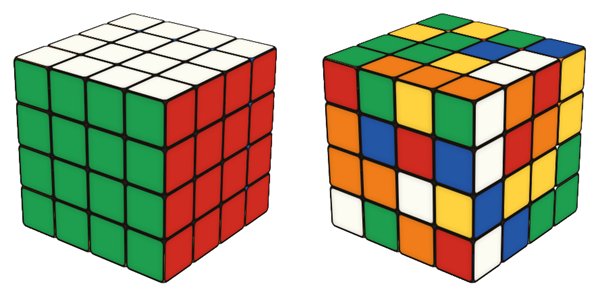
Online 4x4 Rubik's Cube Simulator
Free 4x4 Rubik's Cube simulator: turn a 3D Rubik's Revenge online, practise centres, edge pairing and parity, time your solves and step through algorithms.
4x4 Rubik's Cube simulator: Rubik's Revenge online
The 4x4x4, sold as Rubik's Revenge, was invented by Péter Sebestény and released in 1981. It looks like a bigger 3x3, but it plays quite differently: there is no fixed centre on any face. Each face has four centre pieces that move freely, and each edge of the cube is made of two separate edge pieces. The puzzle has about 7.4 × 10^45 positions (a 46-digit number), and it can show positions that are impossible on a 3x3, known as parity. This 4x4 Rubik's Cube simulator lets you work through all of that in the browser, with an undo button for every mistake.

How to use the 4x4 simulator
- Outer faces and inner slices: drag a sticker to turn its layer; dragging a sticker on an inner row turns that inner slice. Drag the background to orbit the cube.
- Keyboard: U R F D L B turn the outer faces, J and K turn the second layer from the top and from the bottom, X Y Z rotate the cube and Shift reverses a turn.
- Notation input: 2R turns only the second layer from the right, Rw or r turns the two right layers together and 3Rw turns three, as in the big cube notation. Apply plays a sequence at once; the player under the cube steps through it one move at a time.
- Timer: Scramble resets the clock without starting it. Press Space or the Start button when you are ready and again when you finish.
- Share: the link and embed boxes give you a URL or iframe code that contains your scramble and algorithm.
Solving the 4x4: the reduction method
Most solvers turn the 4x4 into a 3x3 and then solve it as one. The Ruwix 4x4 beginner's guide follows these steps:
- Centres: build two adjacent 2x2 centres, then the remaining four. With no fixed centres you must place them in the right colour scheme yourself, otherwise the cube cannot be solved.
- Edge pairing: join the two edge pieces of each colour pair into one long edge.
- 3x3 stage: from now on turn only the outer faces and solve it like a normal Rubik's Cube.
- Parity: fix the cases a 3x3 never shows.
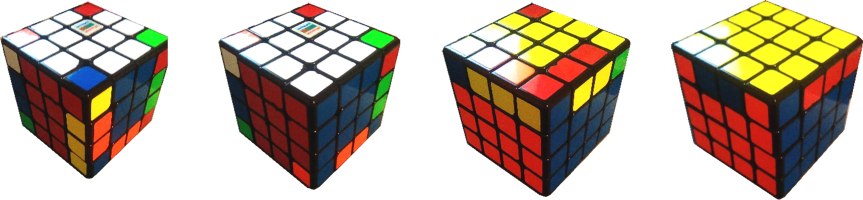
Speedcubers mostly use the Yau method, a variation of reduction that solves two opposite centres and three cross edges first, then the rest of the centres and edges.
What is 4x4 parity?
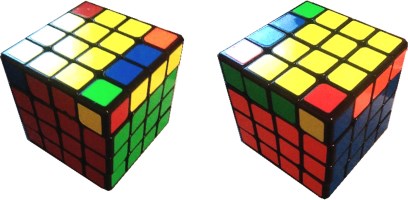
After reduction you can end up with a single flipped edge (OLL parity) or with two edges swapped while everything else is solved (PLL parity). Neither can happen on a 3x3, so they need their own parity algorithms. The demo list on this page includes an OLL parity algorithm: click it, play it on a solved cube and watch exactly which pieces it moves. Seeing it step by step in the player makes the long sequence much easier to memorise.
Tips for practising on the simulator
- Practise centres and edge pairing separately: scramble, build the centres, then Reset and start again until it feels fluent.
- When you meet a parity case, load the algorithm into the player and step through it slowly with your eyes on the inner slices.
- Use the timer per stage, not only per solve, to see whether centres, edges or the 3x3 part holds you back.
Do I need to solve a 3x3 first?
Yes, it helps a lot. The last stage of the reduction method is a regular 3x3 solve, so learn that on the Rubik's Cube simulator first.
What comes after the 4x4?
The 5x5x5 Professor's Cube uses the same reduction idea, has fixed centres again, and the 4x4 parity cases described above cannot occur on it.