- 2x2x2 pocket cube
- 3x3x3 Rubik's Cube
- 4x4x4 Rubik's Revenge
- 5x5x5 Professor's Cube
- Big Cube
- Picture Cube
- Ghost Cube
- 3x3x3 Cube Heads
- Mirror Cube
- Fisher Cube
- Axis Cube
- Mastermorphix
- Windmill Cube
- Pandora Cube
- Penrose Cube
- Globe puzzle
- Bandaged Cube
- Siamese Cube
- Void Cube
- Mixup Cube
- QJ Dodecahedron
- Floppy Cube
- 2x2x3 tower cube
- 2x2x4 tower cube
- Domino Cube
- 3x3x4 cuboid
- Square-1
- Pyramorphix
- Pyraminx
- Helicopter Cube
- Curvy Copter
- Clover Cube
- Skewb
- Skewb Ultimate
- Ivy Cube
- Rex Cube
- Dino Cube
- Redi Cube
- Face-Turning Octahedron
- Kilominx
- Master Kilominx
- Megaminx
- Pyraminx Crystal
- Starminx
- Rubik's Clock
- 4D Rubik's Cube
- Hungarian Rings
- Sliding 15 Puzzle
- Embed widgets
Algorithm notation. Every size from 6x6x6 to 10x10x10 uses the same big cube notation. The outer faces U D L R F B turn a quarter turn clockwise, with ' for counter-clockwise and 2 for a half turn. A number before a face picks one inner slice, so 2R, 3R and 4R are the second, third and fourth layer from the right. A number before a wide move turns that many outer layers together: 3Rw or lowercase 3r turns three layers, Rw alone turns two, and the Ruwix subscript F₂ equals Fw while a plain F2 is a half turn of the front face. M E S exist on odd sizes only; x y z rotate the whole cube. Brackets repeat or invert a group: (Rw U Rw' U')x3 or (Rw U Rw' U')3 and (R U)'. The second input loads an algorithm into the player under the cube, played on the cube as it stands (set up a scramble with the first input): step through it with the buttons, press play, or click a move to jump there.
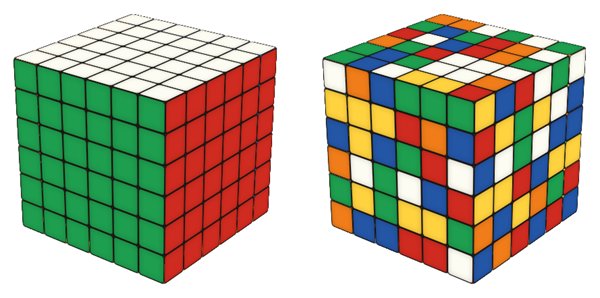
Online Big Cube Simulator
Free big cube simulator: turn a 3D 6x6, 7x7 or any NxNxN cube up to 10x10x10 online. Scramble, time your solves and practise the reduction method.
Big cube simulator: 6x6, 7x7 and every NxNxN up to 10x10x10
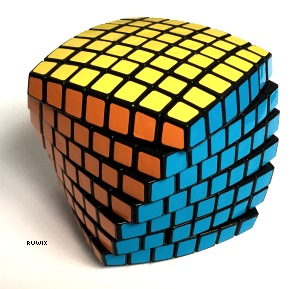
Big cubes are the Rubik's Cube family beyond the 5x5: the 6x6x6, 7x7x7 and larger. Physical big cubes are expensive, and their mechanisms get tricky as they grow; the first mass-produced 7x7x7, invented by Panagiotis Verdes, has rounded sides because its mechanism would not work with layers of identical thickness. A virtual cube has no such limit. This big cube simulator opens on a 6x6x6, and the three size menus above it switch to any cube or cuboid from 1x1x1 to 10x10x10. Picking a size also updates the page address, so you can bookmark or share a 9x9x9 directly.
Controls for large cubes
- Turning slices: drag any sticker to turn the layer it belongs to, outer face or inner slice alike. Drag the background to orbit the cube and check the hidden faces.
- Keyboard: U R F D L B turn the outer faces, J and K the second layer from the top and bottom, X Y Z rotate the cube; M E S work on odd sizes only.
- Notation: a number before a face picks a single slice (2R, 3R, 4R), a number before a wide move turns that many layers together (3Rw turns three), as explained in the advanced notation guide. Type moves into the first input to apply them, or into the second to step through them in the player.
- Timer, Undo and Reset: Scramble zeroes the timer without starting it, Space starts and stops it, Undo takes back one move and Reset returns to solved.
- Share: the link box and the embed box carry your scramble and algorithm, so a friend or your blog readers see the same position.
How to solve any NxNxN cube
Every big cube is solved with the same plan, the reduction method, explained in detail in the Ruwix guide to solving big cubes:
- Centres: build two opposite centres, then two adjacent ones, then the last two.
- Edges: pair all the pieces of each edge into one long bar, placing eight on the top and bottom layers before finishing the last four.
- 3x3 stage: solve the cube like a normal 3x3 using outer face turns.
Once you can do this on the 4x4 and the 5x5, you can technically solve any size; the bigger cubes just take longer and demand more care.
Odd and even sizes
On odd cubes (5x5, 7x7, 9x9) each face has a single middle piece that never moves relative to the others, so the colour scheme is fixed. On even cubes (4x4, 6x6, 8x8, 10x10) there is no such piece: you have to build the centres in the correct colour arrangement yourself, and the 3x3 stage can show parity, a single flipped edge or two swapped edges that a real 3x3 never has.
Practice tips for big cubes
- Step up one size at a time. A 6x6 uses everything you learned on the 4x4, a 7x7 everything from the 5x5.
- Build centres row by row: pair up strips of centre pieces, then insert each strip with a slice move and its inverse.
- Orbit the cube constantly during centres; it is easy to break a finished centre with a slice you did not watch.
- Use Undo freely. On a 10x10 one wrong slice can cost minutes on a real cube, here it costs one click.
What is the largest Rubik's-type cube ever made?
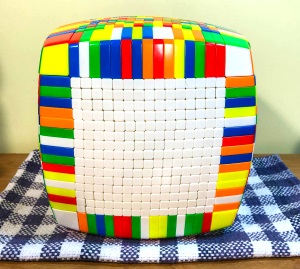
According to the Ruwix big cube page, a 33x33x33 by Grégoire Pfennig earned a Guinness world record in 2017, and the highest-order NxNxN built so far is a 49x49x49 by Preston Alden.

Can I simulate cuboids too?
Yes. Set the three menus to different numbers, for example 3, 4 and 3 for a 3x3x4 cuboid. Sides with a mixed odd and even cross-section turn only 180 degrees, as on the real puzzles.