- 2x2x2 pocket cube
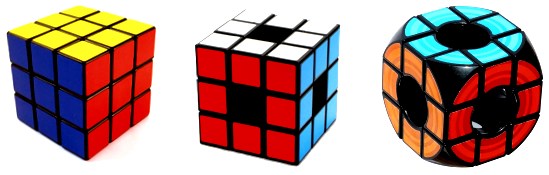
- 3x3x3 Rubik's Cube
- 4x4x4 Rubik's Revenge
- 5x5x5 Professor's Cube
- Big Cube
- Picture Cube
- Ghost Cube
- 3x3x3 Cube Heads
- Mirror Cube
- Fisher Cube
- Axis Cube
- Mastermorphix
- Windmill Cube
- Pandora Cube
- Penrose Cube
- Globe puzzle
- Bandaged Cube
- Siamese Cube
- Void Cube
- Mixup Cube
- QJ Dodecahedron
- Floppy Cube
- 2x2x3 tower cube
- 2x2x4 tower cube
- Domino Cube
- 3x3x4 cuboid
- Square-1
- Pyramorphix
- Pyraminx
- Helicopter Cube
- Curvy Copter
- Clover Cube
- Skewb
- Skewb Ultimate
- Ivy Cube
- Rex Cube
- Dino Cube
- Redi Cube
- Face-Turning Octahedron
- Kilominx
- Master Kilominx
- Megaminx
- Pyraminx Crystal
- Starminx
- Rubik's Clock
- 4D Rubik's Cube
- Hungarian Rings
- Sliding 15 Puzzle
- Embed widgets
Algorithm notation. The Void Cube reads standard 3x3x3 notation. U D L R F B turn the up, down, left, right, front and back face a quarter turn clockwise as you look at that face; an apostrophe (R') turns it counter-clockwise and a 2 (R2) turns it 180 degrees. M E S are the middle slices (M follows L, E follows D, S follows F), a w or a lowercase letter (Rw or r) turns two layers together, and x y z rotate the whole puzzle. A group in brackets repeats or inverts: (R U R' U')x3 or (R U R' U')3 plays the trigger three times and (R U)' plays its inverse. The famous M2 U M2 U2 M2 U M2 sequence is the one to try: on a cube with no centres it leaves the puzzle in a state a normal cube can never reach. The second input loads an algorithm into the player under the cube, played on the cube as it stands (set up a scramble with the first input): step through it with the buttons, press play, or click a move to jump there.
Online Void Cube Simulator
Free Void Cube simulator: turn the see-through 3x3 with no centre pieces in 3-D, learn to spot void parity, time your solves and step through algorithms.
Void Cube Simulator: Practise the Centreless 3x3
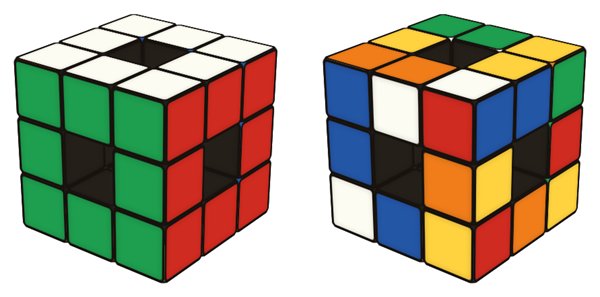
The Void Cube is a 3x3x3 with its six centre pieces and the core taken out, so three square tunnels run straight through it. It was designed by Katsuhiko Okamoto in 2007 and has only the 8 corners and 12 edges of a normal cube, held together by a mechanism that needs no central axis. The layers, the moves and the notation are exactly those of a Rubik's Cube, which is what makes the puzzle so sneaky: it looks easy until the last layer refuses to cooperate.
What changes without centres
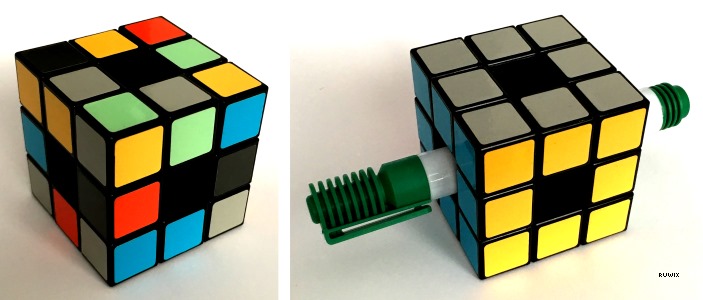
On a regular cube the centres tell you which colour belongs on each face. Here you have to read the colour scheme from the corners instead. More importantly, nothing marks where the middle of a face is, so a middle slice turn is invisible in the centre and you can unknowingly solve a face around the "wrong" centre. The result is void parity: the cube ends up almost solved in a position that is impossible on a normal 3x3, typically with two pieces that seem to need a single swap.
How to use this simulator for practice
- Drag a sticker to turn its layer, slice rings included. Drag the background or a dark tunnel wall to orbit the cube and look through the holes.
- On the keyboard, U R F D L B turn the faces, M E S the slices and X Y Z rotate the cube; hold Shift to reverse a turn.
- Scramble mixes the cube, Undo takes back your own moves and Reset returns it to solved.
- The Start/Stop timer (or the Space bar) times a solve. Scramble resets it to zero without starting it, so you can inspect the cube first.
- Type a sequence into the first input and press Apply, or load one into the player below the cube to step through it move by move. The examples under the notation notes include a superflip and an H perm built from slice moves.
- The link box saves your scramble and algorithm in a URL you can share, and the embed box gives you the code to put the simulator on your own page.
Solving approach
Use the 3x3 method you already know, for example the beginner's method. Pick a corner, decide the face colours from it and build the first layer as usual; the edges simply have no centre to line up with, so check them against the corners. If you reach the last layer and find a case your algorithms cannot finish, you have void parity. One fix is to turn a middle slice a quarter turn, which in effect moves the invisible centres, and then solve the last layers again. The Void Cube solution guide gives a dedicated parity algorithm as well. Because the simulator lets you undo freely, it is a good place to recognise parity early instead of discovering it at the very end.
For comparison, try the same scramble on the standard 3x3 simulator: the moves are identical, only the visible information is different.
Who invented the Void Cube?
Katsuhiko Okamoto designed it in 2007. Versions have been sold by Gentosha and, later, by other puzzle makers.
Does the simulator show void parity like the real puzzle?
Yes. It counts the cube as solved when the eight visible stickers of every face match, just as you would judge the physical puzzle, so parity positions appear naturally while you solve.
Is the Void Cube harder than a Rubik's Cube?
It uses the same moves, so anyone who can solve a 3x3 can solve it. The extra difficulty is recognition and parity: missing centres hide information, and you need one or two extra steps to finish.