- 2x2x2 pocket cube
- 3x3x3 Rubik's Cube
- 4x4x4 Rubik's Revenge
- 5x5x5 Professor's Cube
- Big Cube
- Picture Cube
- Ghost Cube
- 3x3x3 Cube Heads
- Mirror Cube
- Fisher Cube
- Axis Cube
- Mastermorphix
- Windmill Cube
- Pandora Cube
- Penrose Cube
- Globe puzzle
- Bandaged Cube
- Siamese Cube
- Void Cube
- Mixup Cube
- QJ Dodecahedron
- Floppy Cube
- 2x2x3 tower cube
- 2x2x4 tower cube
- Domino Cube
- 3x3x4 cuboid
- Square-1
- Pyramorphix
- Pyraminx
- Helicopter Cube
- Curvy Copter
- Clover Cube
- Skewb
- Skewb Ultimate
- Ivy Cube
- Rex Cube
- Dino Cube
- Redi Cube
- Face-Turning Octahedron
- Kilominx
- Master Kilominx
- Megaminx
- Pyraminx Crystal
- Starminx
- Rubik's Clock
- 4D Rubik's Cube
- Hungarian Rings
- Sliding 15 Puzzle
- Embed widgets
Algorithm notation. Square-1 uses the WCA notation that scramble programs print. A pair (t,b) turns the top layer t steps and the bottom layer b steps, each step being 30 degrees and the values running from -5 to 6; positive is clockwise looking at that layer, the top from above and the bottom from below. A slash (/) flips the right half of the puzzle 180 degrees and is only possible when no piece sits across the cut. Pairs may be written (3,0), (3, 0) or 3,0, and the slash can follow directly, as in (3,0)/. A group in round or square brackets repeats or inverts: (/ (3,0) / (-3,0))x3 or (/ (3,0) / (-3,0))3 plays it three times and ((3,0)/)' plays its inverse; a bracket that reads as a pair, such as (3,0), is always the pair. The whole sequence is checked before anything moves, so an impossible slice rejects the input. The second input loads an algorithm into the player under the puzzle, played on the puzzle as it stands (set up a scramble with the first input): step through it with the buttons, press play, or click a move to jump there.
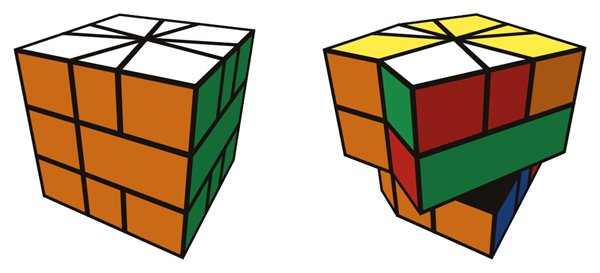
Online Square-1 Simulator
Free 3D Square-1 simulator: turn and slice the layers, practise cube shape with WCA-notation scrambles and a timer, or try the Square-0 and Square-2 variants.
Practise with the Square-1 simulator
The Square-1, also sold as Cube 21, was invented in 1990 by the Czechoslovak designers Karel Hršel and Vojtěch Kopský. Unlike the 3x3, its top and bottom layers are made of wedges: eight kite-shaped corners and eight small triangular edges, with a two-piece middle layer between them. The layers turn in 30-degree steps, and a slice flips the right half of the puzzle by 180 degrees, so a few moves are enough to turn the cube into a strange, lopsided shape. Getting it back into a cube is the first part of every solve. Square-1 is one of the official World Cube Association events, so practice here carries straight over to competition.

Controls and features
- Turning: drag the top or bottom layer to turn it; it snaps to the nearest 30-degree step when you let go. Drag the middle layer, press the Slice button, or press S or / to slice. U and D turn the layers one step from the keyboard, with Shift for the other direction. Drag the background to orbit the view.
- Scramble: about twenty random legal moves, animated and then printed in WCA notation, the same (t,b) and / format that Square-1 competition scrambles use.
- Undo and Reset take back moves or return to a solved cube at once.
- Timer: Start/Stop or the Space bar. Scramble resets the clock but never starts it, so you can inspect first.
- Algorithms: paste a scramble or an algorithm into the first input, or load one into the player and step through it, slice by slice. The demo algorithms under the notation notes are a one-click starting point.
- Variants: the menu switches to the Square-0, which merges each corner with an edge and is simpler, or the Square-2, whose extra cuts make edge and corner wedges the same size.
How to approach a solve
The usual beginner plan has six stages: bring the puzzle back to a cube shape, sort the corners into the top and bottom layers, do the same for the edges, place the corners, place the edges, and finally fix parity, the case where just two edges are swapped. The Square-1 beginner's solution has every sequence with pictures. Cube shape is the step most people find hardest, and the simulator helps here: scramble, return to a cube, then press Undo and try a shorter route. The slice-and-turn pattern / (3,0) / (-3,0), one of the demos, is worth playing slowly in the player to see which pieces it moves.
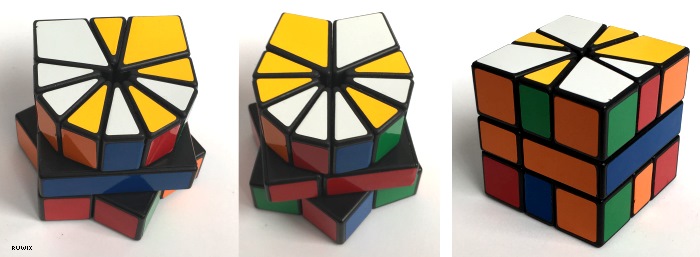
Reading Square-1 notation
A pair such as (3,0) turns the top layer three steps (90 degrees) clockwise and leaves the bottom alone; (-1,2) turns the top one step counter-clockwise and the bottom two steps clockwise, the bottom being viewed from below. A slash is the slice. The simulator checks the whole sequence before it moves anything, so a slice that would cut through a piece is rejected with a message rather than played halfway.
Why will the puzzle not slice?
A slice is only possible when no wedge sits across the cut line on either layer. Turn the top or bottom layer until both layers have a clean gap at the cut, and the slice will work.
Can I practise official scrambles?
Yes. Copy a scramble from an online timer or a competition sheet into the first input and press Apply. The link box then builds a URL with that scramble, handy for sharing a case with a friend.
Is Square-1 harder than the 3x3?
It feels harder at first because of the shapes, but there are fewer pieces, and once cube shape clicks the rest is a short list of algorithms. If you want something gentler, try the Floppy Cube first.