- 2x2x2 pocket cube
- 3x3x3 Rubik's Cube
- 4x4x4 Rubik's Revenge
- 5x5x5 Professor's Cube
- Big Cube
- Picture Cube
- Ghost Cube
- 3x3x3 Cube Heads
- Mirror Cube
- Fisher Cube
- Axis Cube
- Mastermorphix
- Windmill Cube
- Pandora Cube
- Penrose Cube
- Globe puzzle
- Bandaged Cube
- Siamese Cube
- Void Cube
- Mixup Cube
- QJ Dodecahedron
- Floppy Cube
- 2x2x3 tower cube
- 2x2x4 tower cube
- Domino Cube
- 3x3x4 cuboid
- Square-1
- Pyramorphix
- Pyraminx
- Helicopter Cube
- Curvy Copter
- Clover Cube
- Skewb
- Skewb Ultimate
- Ivy Cube
- Rex Cube
- Dino Cube
- Redi Cube
- Face-Turning Octahedron
- Kilominx
- Master Kilominx
- Megaminx
- Pyraminx Crystal
- Starminx
- Rubik's Clock
- 4D Rubik's Cube
- Hungarian Rings
- Sliding 15 Puzzle
- Embed widgets
Algorithm notation. The Siamese Cube is two cubes fused by a block, so the move set is split: the left cube turns L, M, D, E and B, and the right cube turns R, U and F, with 2R and 2U as its inner slices in SiGN notation. Only layers that avoid the fused block exist, and the status line lists the legal ones for each variant. An apostrophe inverts a move and 2 doubles it; there is no x y z because the join never moves. Brackets repeat or invert a group: (R U)x3 or (R U)3 plays it three times and (R U)' plays its inverse. The second input loads an algorithm into the player under the puzzle, played on the puzzle as it stands (set up a scramble with the first input): step through it with the buttons, press play, or click a move to jump there.
Online Siamese Cube Simulator
Free Siamese Cube simulator: two 3x3 cubes fused by a shared block, in four variants. Turn only the legal layers in 3-D, time solves and test algorithms.
Siamese Cube Simulator: Two Cubes, One Puzzle
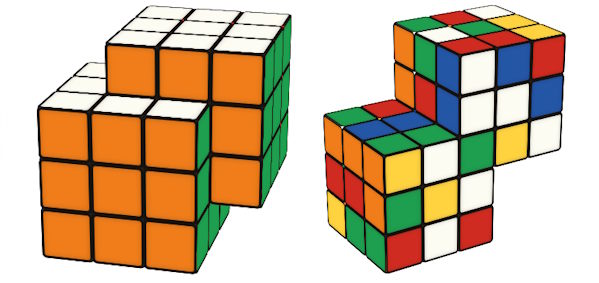
The Siamese Cube is two 3x3x3 cubes joined into a single puzzle. In the classic version the cubes overlap along one edge, so a column of three pieces - corner, edge, corner - belongs to both of them at once. Those shared pieces can never move, because turning them would tear the other cube apart. Tony Fisher made the first Siamese Cubes in the early 1980s, and Ideal sold a version under the name Rubik's Mate in 1983.

How it differs from a normal 3x3
Every layer that contains a shared piece is locked. On the classic puzzle each cube keeps only four turnable layers: two faces and the two slices beside them. Because the pieces of one cube can never travel into the other, the two halves are really two separate bandaged cubes, and you can solve them one at a time. The catch is that each half has lost half of its moves, so the usual 3x3 algorithms that need the missing faces are unavailable and you have to work with what is left.
The dropdown above the puzzle offers four joins: Shared edges (the classic corner-edge-corner column), Shared 1x2x3, Shared 2x2x3 and Shared 2x2x2. The bigger the shared block, the more layers are locked, and the status line always lists which moves are legal for the variant you picked.
Using the simulator
- Drag a sticker to turn its layer. Grabbing the fused block or the background orbits the whole puzzle instead, because holding the join means holding both cubes.
- Scramble mixes both halves, Undo takes back your own moves and Reset restores the solved puzzle.
- The Start/Stop button or the Space bar runs the timer. A scramble resets it to zero without starting it.
- The algorithm input uses the puzzle's own move names: depending on the variant, the left cube turns L, M, D, E and B, the right cube R, U and F, with 2R and 2U as its inner slices. There are no x y z rotations because the join never moves. Load a sequence into the player to step through it move by move.
- Share a scramble with the link box, or copy the embed code to put the puzzle on your own page.
Solving approach
Solve one cube completely, then the other. For each half, use the shared column as your fixed reference: it never moves, so its stickers show the colours of the faces around it. A practical order is to place the corners first, then sort the edges into their correct slices, fix the centres and finish by orienting the edges, using short sequences built from the four legal layers. Commutators such as R U R' U' are your main tool, and repeating them, for example (R U R' U')x3, is a good way to see which pieces a sequence touches. More history and other joined designs are collected in the article on Siamese twisty puzzles, and the Bandaged Cube simulator is good practice for puzzles with glued blocks.

Can pieces move from one cube to the other?
No. On the classic Siamese Cube the pieces of each half stay in that half, which is why the two cubes can be solved separately.
Who invented the Siamese Cube?
Tony Fisher is credited with the original. Erno Rubik also produced a version, sold by Ideal as Rubik's Mate.
Is it harder than a Rubik's Cube?
Each half has fewer moves, which removes many familiar algorithms. Expect slower, more thoughtful solves rather than a speed challenge.