- 2x2x2 pocket cube
- 3x3x3 Rubik's Cube
- 4x4x4 Rubik's Revenge
- 5x5x5 Professor's Cube
- Big Cube
- Picture Cube
- Ghost Cube
- 3x3x3 Cube Heads
- Mirror Cube
- Fisher Cube
- Axis Cube
- Mastermorphix
- Windmill Cube
- Pandora Cube
- Penrose Cube
- Globe puzzle
- Bandaged Cube
- Siamese Cube
- Void Cube
- Mixup Cube
- QJ Dodecahedron
- Floppy Cube
- 2x2x3 tower cube
- 2x2x4 tower cube
- Domino Cube
- 3x3x4 cuboid
- Square-1
- Pyramorphix
- Pyraminx
- Helicopter Cube
- Curvy Copter
- Clover Cube
- Skewb
- Skewb Ultimate
- Ivy Cube
- Rex Cube
- Dino Cube
- Redi Cube
- Face-Turning Octahedron
- Kilominx
- Master Kilominx
- Megaminx
- Pyraminx Crystal
- Starminx
- Rubik's Clock
- 4D Rubik's Cube
- Hungarian Rings
- Sliding 15 Puzzle
- Embed widgets
Algorithm notation. The QJ Dodecahedron is a 3x3x3 in a twelve-sided shell, so it reads standard cube notation: the faces U R F L D B turn 90 degrees clockwise, an apostrophe is counter-clockwise and 2 is a half turn. M E S are the middle slices (M follows L, E follows D, S follows F), a lowercase u r f l d b turns two layers, and x y z turn the whole puzzle. Brackets repeat or invert a group: (R U R' U')x3 or (R U R' U')3 plays the trigger three times and (R U)' plays its inverse; a spaced ") x2" is a group followed by the rotation x2. The second input loads an algorithm into the player under the puzzle, played on the puzzle as it stands (set up a scramble with the first input): step through it with the buttons, press play, or click a move to jump there.
Online QJ Dodecahedron Simulator
Free QJ Dodecahedron simulator: a 3x3 mechanism in a 12-colour dodecahedron shell that changes shape on every quarter turn. Scramble, solve and time it in 3-D.
QJ Dodecahedron Simulator: a 3x3 That Changes Shape
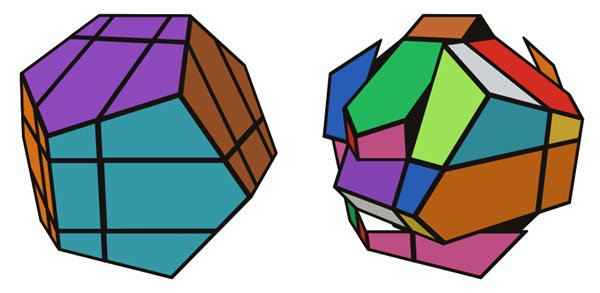
The QJ Dodecahedron is a 3x3x3 shape mod produced by the puzzle maker QJ. Inside is a normal cube mechanism with the usual layers, but the outside is cut into a twelve-sided solid, so the puzzle no longer looks like a cube at all. This simulator models it as a regular dodecahedron shell with twelve differently coloured pentagons wrapped around the 3x3 core.
Why it shape-shifts on every turn
A cube looks the same after a quarter turn of any layer, which is why a scrambled Rubik's Cube keeps its shape. A dodecahedron does not have that symmetry, so every 90-degree turn swings spiky pentagon fragments out of the solid and leaves gaps elsewhere. Even one quarter turn makes the puzzle look badly scrambled. Half turns are the exception: the shell looks the same after a 180-degree turn about each of the three axes, so a move such as R2 keeps the outline intact. Restoring the dodecahedron shape is therefore half of the job, and the simulator only reports the puzzle as solved when the twelve faces are back, each in a single colour.
Using the simulator
- Drag any piece to turn its layer and drag the background (or use the right mouse button) to orbit the puzzle.
- The keys U E D R L F B M S turn the layers and Shift reverses a turn.
- Scramble, Undo and Reset sit next to the Start/Stop timer. Press its button or the Space bar to time a solve; a scramble resets the clock without starting it.
- The algorithm input reads standard cube notation, with lowercase letters for wide turns and x y z for whole-puzzle rotations. Load a sequence into the player under the puzzle to step through it.
- The examples include the Sune and an H-perm; watching them on this shell is a good way to see how 3x3 algorithms move the twelve-colour surface. The link and embed boxes let you share any scramble.
Solving approach
Because the mechanism is a 3x3, you solve it with a 3x3 method, for example the layer-by-layer beginner's method. The difference is recognition. Pieces show unusual fragments of up to several colours, and a corner or edge only belongs in one place, where its fragments complete the surrounding pentagons. Work out where each piece goes by asking which faces its fragments must join, not by counting colours as on a cube. In this model each centre piece sits where two pentagons meet, so it shows two colours and, as on a picture cube, must also be turned the right way round; if a centre ends up upside down at the end, the well-known sequence (R U R' U)x5 turns the top centre by 180 degrees without disturbing anything else.
A good way to start is to scramble with half turns only, which mixes the colours but keeps the shape, and solve that before moving on to full scrambles. For other 3x3 mechanisms in unusual shells, see the Mastermorphix simulator or the overview of 3x3 shape mods.
Is the QJ Dodecahedron the same as a Megaminx?
No. Both are twelve-sided, but a Megaminx turns its pentagon faces. The QJ Dodecahedron turns like a cube, along three axes, and its shell changes shape as you turn it.
Do I need new algorithms?
Not for the mechanism: any 3x3 algorithm works. What takes practice is recognising the pieces on the twelve-colour surface.